You've just dropped serious cash on a beastly GPU and a top-tier CPU. Your rig should be crushing frames in Apex Legends and Warzone, right? Yet, you're still seeing frustrating stutters and dips. What gives? The culprit might be the one component many gamers overlook: your RAM. We’re not just talking capacity… we’re talking speed. With kits pushing past 8000MHz, it's time to ask: how much does 8800MHz memory gaming actually boost your FPS?
How Memory Speed Directly Impacts Your Gaming FPS 🚀
Think of your PC components as a team. Your CPU is the brain, processing game logic and physics. Your GPU is the muscle, rendering those gorgeous graphics. But your RAM? That's the high-speed nervous system connecting them. Every piece of data, from enemy positions to texture files, zips through your memory. If that pathway is slow, it creates a bottleneck, starving your powerful CPU and GPU. They end up waiting for data instead of pushing out frames.
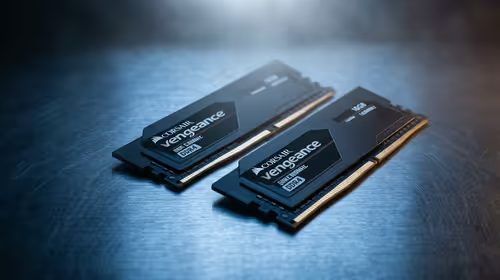
This is where high-frequency DDR5 comes in. The jump from older standards to the speeds we see today provides a much wider data highway. This allows your processor to feed the graphics card information at a blistering pace, especially noticeable in CPU-intensive games or when you're aiming for ultra-high refresh rates (144Hz and above). Exploring the latest DDR5 memory shows just how far the technology has come. The difference isn't just theoretical; it translates to smoother gameplay and higher average FPS.
Beyond Raw Speed: Is Faster Always Better?
While a massive number like 8800MHz looks impressive, it's not the only spec that matters. You also need to consider latency, specifically CAS Latency (CL). Latency is the delay before your RAM starts transferring data after receiving a command. The ideal scenario is high frequency (MHz) paired with low latency (CL).
For most South African gamers building a new rig, the value sweet spot often lies with popular DDR5 6000MHz kits, which offer a fantastic balance of speed, low latency, and price. However, if you're an enthusiast chasing every last frame, stepping up to high-performance 7200MHz options can provide a noticeable uplift in those crucial 1% low frame rates, making your experience feel significantly smoother.
Don't Forget to Enable XMP/EXPO! 🔧
Your new high-speed RAM won't run at its advertised speed out of the box. You must enter your motherboard's BIOS UEFI (usually by pressing DEL or F2 on startup) and enable the Extreme Memory Profile (XMP for Intel) or Extended Profiles for Overclocking (EXPO for AMD). It's a one-click setting that unlocks the performance you paid for!
Is 8800MHz Memory Gaming Worth It for You? ✨
So, who really needs this level of extreme performance? An 8800MHz memory gaming setup is for the bleeding-edge enthusiast. It’s for competitive players who need the absolute lowest system latency and for benchmark chasers who want to squeeze every drop of performance from their hardware. To even take advantage of these speeds, you'll need a high-end motherboard and a top-tier CPU (like Intel's 14th Gen or AMD's Ryzen 7000 X3D series) that can handle the memory controller load.
For everyone else, the decision is about balance. A well-rounded system is always the goal. Investing in a solid kit from top brands like Kingston or finding reliable choices from ADATA in the 6000-7200MHz range will deliver a phenomenal gaming experience without breaking the bank. The key is matching your RAM to the rest of your components to create a powerful, bottleneck-free machine.
Ready to Unleash Your PC's True Speed?
From value-packed kits to record-breaking speeds, the right RAM unlocks your CPU and GPU's full potential. Explore our massive range of PC Components and give your gaming rig the boost it deserves.