Chasing that buttery-smooth 240 frames per second in League of Legends feels like a different game. Every skillshot is crisper, every team fight clearer… it’s the ultimate competitive edge for climbing the ladder. But as we look towards 2026, what's the best GPU for League of Legends at 240fps? You don’t need to drop R40,000 on a top-tier card to dominate the Summoner's Rift. Let’s find the perfect graphics card for your grind. 🚀
Why 240fps is the New Standard for LoL
For a fast-paced MOBA like League of Legends, high frame rates offer a tangible advantage. Hitting a stable 240fps, paired with a 240Hz monitor, dramatically reduces input lag and motion blur. This means you see enemy abilities sooner and can react faster. While LoL is famously CPU-intensive, your graphics card does the heavy lifting during visually chaotic moments like a full-scale Baron fight, preventing frame drops that could cost you the game. A solid GPU ensures your performance is consistently high when it matters most.
Finding the Best GPU for League of Legends 240fps
Choosing the right graphics card is about balancing performance, resolution, and your budget. The best GPU for achieving 240fps in League of Legends will be different for a 1080p player versus someone aiming for 1440p.
The Sweet Spot: 1080p Dominance
For the vast majority of players, 1080p is the go-to resolution for competitive gaming. The good news? You don't need the most expensive card on the market. Modern mid-range cards are more than capable of smashing the 240fps target in LoL with settings cranked up.
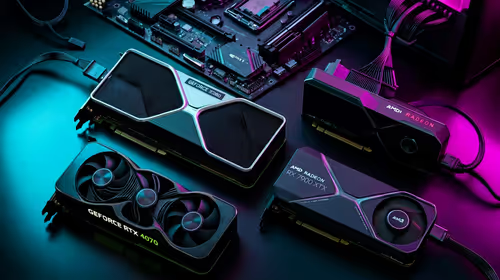
Today's cards from the main players offer incredible value. You can explore a wide variety of NVIDIA GeForce graphics cards or check out the competitive performance from the latest AMD Radeon graphics cards. Even the newer contenders, like the range of Intel Arc graphics cards, provide excellent performance-per-rand for esports titles.
Future-Proofing for 1440p and Beyond ✨
What if you want to play at a higher resolution or ensure your rig is ready for more demanding games down the line? Stepping up to a more powerful GPU is the answer. Investing in one of today's high-performance NVIDIA models or other top-tier graphics cards guarantees you'll be hitting 240fps at 1440p in LoL and enjoying high frame rates in graphically intense AAA titles for years to come. Think of it as an investment that will still be a beast in 2026.
Some might wonder if professional workstation graphics cards are an option. While powerful, their drivers are optimised for creative software, not gaming, so it's best to stick with a GeForce, Radeon, or Arc card for the Rift.
More Than Just a GPU: Building a Balanced Rig 🔧
Your powerful new GPU needs a solid support system to deliver those silky frames. Bottlenecking your system with a weak component is a surefire way to get frustrating performance stutters.
- CPU: Since LoL relies heavily on single-core speed, a modern processor from Intel or AMD is crucial.
- RAM: 16GB of fast DDR4 or DDR5 RAM is the current standard for a smooth gaming experience.
- Power Supply (PSU): Never skimp on your power supply! A new graphics card can be power-hungry. Ensure you have a reliable power supply unit with enough wattage to handle your components under load.
PSU Pro Tip ⚡
Always choose a power supply with more wattage than you think you need. A good rule of thumb is to add up the power consumption of your CPU and GPU, then add another 100-150W for headroom. This ensures your PSU runs efficiently and quietly, and it gives you room for future upgrades without needing a replacement.
For a clean build and easy cable management, opting for a fully modular PSU is a fantastic choice. You only connect the cables you need, improving airflow and making your PC look much tidier.
The Final Verdict: Your Path to 240fps
Securing the best GPU for League of Legends at 240fps in 2026 doesn't have to be complicated. For 1080p, today's mid-range cards are incredible value and will serve you well for years. For those wanting to push to 1440p or simply build a rig that will last, a higher-tier card is a worthy investment. The key is to build a balanced system where your CPU, RAM, and PSU can keep up with your graphics card.
Ready to Find Your Perfect Match? Hitting your target framerate is about finding the right hardware for your budget and goals. Explore our massive range of graphics cards and build the perfect PC to conquer the Summoner's Rift.