Paying for fast fibre but still getting clapped in your favourite lobby? You’re not alone. Before you phone your ISP and unleash your inner Karen, let's talk about the real culprit that might be throttling your connection: your PC. Running a proper DeepSeek PC Internet Speed Test in SA isn't just about checking your line speed; it’s about finding out if your rig can actually keep up. Let’s diagnose the problem and unlock your machine’s max performance. 🚀
Why Your Internet Speed Test Results Matter
When you run an internet speed test, you see three key numbers: download speed, upload speed, and ping (or latency). For gamers, ping is king. It's the reaction time of your connection, measured in milliseconds (ms). A low ping (under 40ms) means your actions are registered almost instantly, giving you a competitive edge.
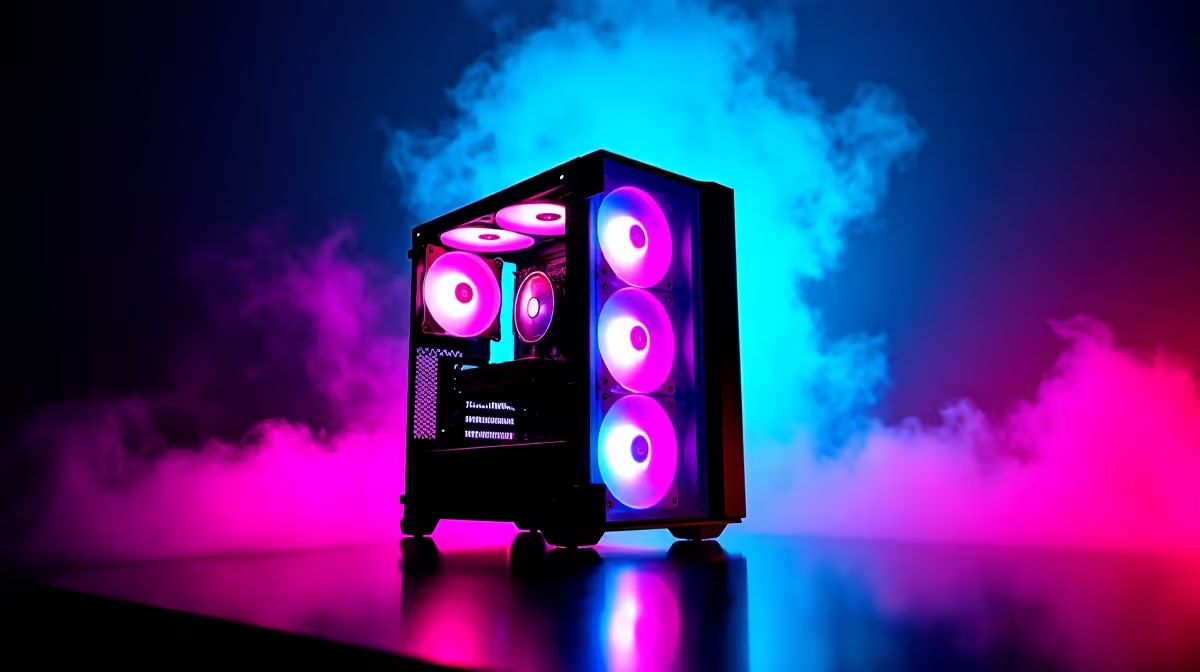
But what if you have a 20ms ping and a 200Mbps line, yet still experience lag spikes? The issue might not be your internet, but your PC's ability to process the incoming data. An older CPU or insufficient RAM can create a bottleneck, meaning your hardware can't keep up with your fast connection, especially in graphically intense moments where a high-end NVIDIA GeForce gaming PC would excel.
How to Run an Accurate PC Internet Speed Test in SA
Getting a true reading of your performance requires more than just opening a website and clicking 'Go'. To conduct a meaningful DeepSeek PC Internet Speed Test in SA, you need to eliminate variables that could skew the results.
Prep Your PC for a Clean Test 🔧
- Go Wired: Ditch the Wi-Fi. Connect your PC directly to your router with an Ethernet cable for the most stable and accurate measurement.
- Close Everything: Shut down all background applications. That means closing Discord, exiting Steam and Battle.net, pausing cloud backups (like OneDrive), and making sure nobody else is streaming Netflix on your network.
- Pick a Local Server: When the test prompts you, always choose a server located in South Africa, preferably in Johannesburg or Cape Town. This ensures you're measuring your local performance, not your connection to a server in Europe.
Following these steps gives you a baseline. If the numbers are good, but your gaming experience is poor, it’s time to look inwards at your machine. This is where many gamers realise that their hardware is the weak link, struggling to keep pace with the demands of modern titles, a task for which powerful AMD Radeon gaming PCs are specifically built.
Network Driver Pro Tip ⚡
Is your PC's Ethernet port blinking amber instead of green? It might be running at a slower speed (e.g., 100Mbps instead of 1Gbps). Dive into your network adapter's 'Advanced' properties in Windows and ensure 'Speed & Duplex' is set to 'Auto Negotiation' or '1.0 Gbps Full Duplex'. This tiny setting can be a massive, hidden bottleneck!
Is Your PC the Real Bottleneck?
You've got a great fibre line, and your speed test results are solid. So, why the lag? The final step in our deep seek for max performance is analysing your PC's components.
An ageing processor, slow RAM, or an old-school hard drive can all contribute to in-game stuttering that feels like network lag. Your PC has to manage everything at once: running the game, processing graphics, handling your inputs, and managing network data. If any one component can't keep up, the whole system suffers. This is especially true for intensive tasks beyond gaming, where professionals rely on custom-built Workstation PCs designed for handling massive data loads without breaking a sweat.
A simple speed test is a great starting point, but true max performance comes from a balanced system where your hardware is just as fast as your internet connection. ✨
Ready to Unleash Your True Speed?
A blazing-fast internet line is only half the battle. If your speed test results are great but your experience isn't, your hardware is the bottleneck. Stop letting an old PC hold you back. Explore our massive range of custom gaming PCs and find the perfect machine to conquer your world.