Quick Answer
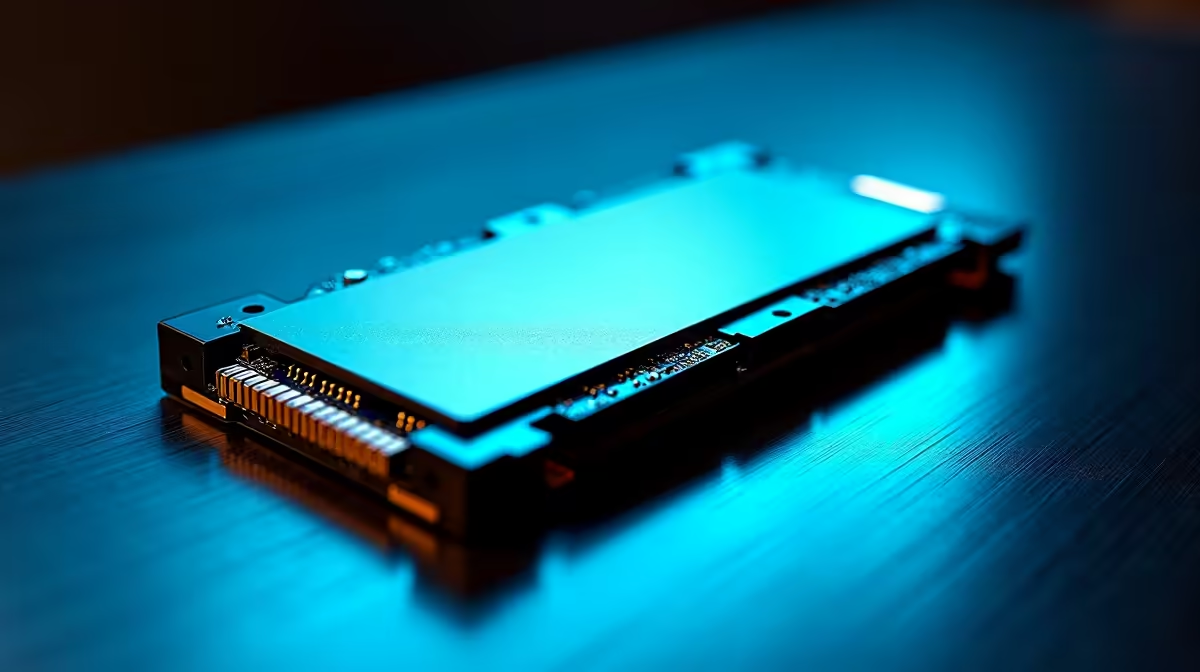
Your SSD affects Fortnite performance primarily through loading times and texture streaming speed, not raw in-game frame rates. Upgrading from a hard drive to an SSD dramatically reduces map load times and eliminates texture pop-in, while moving from a SATA SSD to an NVMe drive offers smaller but still noticeable improvements in asset streaming during fast-paced matches.
Loading Times: HDD vs SSD vs NVMe
The most obvious impact an SSD has on Fortnite is how quickly the game loads. On a traditional hard drive, loading into a match from the lobby can take 60-90 seconds or more. On a SATA SSD, this drops to under 20 seconds. On a modern NVMe SSD, loading is often complete in 10-15 seconds. In a fast-paced battle royale where landing early gives a meaningful advantage, faster load times genuinely affect your gameplay.
Beyond initial load, Fortnite's engine continuously streams assets as you move through the map. Areas with dense builds, new POIs, and high player counts require the game to pull textures and geometry from storage quickly. A slow drive introduces pop-in, where objects or textures load visibly after you arrive in an area. An SSD eliminates most of this.
In-Game FPS: Does the SSD Directly Affect Frame Rate?
Frame rate in Fortnite is primarily determined by your CPU and GPU. A faster SSD will not add frames per second during steady gameplay. However, during scenes with heavy asset streaming such as landing, fast rotations across the map, or entering dense areas, a slow storage device can cause momentary frame drops as the CPU and GPU wait on data. This shows up as micro-stutters rather than sustained low FPS.
For competitive Fortnite players in South Africa grinding ranked modes, eliminating these micro-stutters through a quality NVMe SSD is worth the investment. The game is already well-optimised, so removing storage as a bottleneck lets your CPU and GPU operate without interruption.
Frequently Asked Questions
Will an NVMe SSD give me better Fortnite frame rates than a SATA SSD?
Not significantly in most scenarios. The primary gains are in load times and reduced texture streaming stutter. If you already have a SATA SSD, upgrading purely for Fortnite frames is not the best use of your budget. Upgrading your GPU or RAM would yield more measurable fps gains.
Does Fortnite benefit from DirectStorage or similar technology?
Fortnite has made use of advanced asset streaming features on capable systems. While not all optimisations are fully active on PC in the same way as console implementations, a faster NVMe drive still provides a better foundation for these systems to operate efficiently.
How much SSD space does Fortnite need in 2026?
Fortnite's install size fluctuates with each season update, but generally requires 30-40GB minimum. If you also install other games and applications, a 500GB or 1TB SSD is a practical minimum for a gaming build in South Africa.
Ready to Find Your Perfect Match? Upgrade your storage and eliminate loading lag for good. Shop SSDs at Evetech