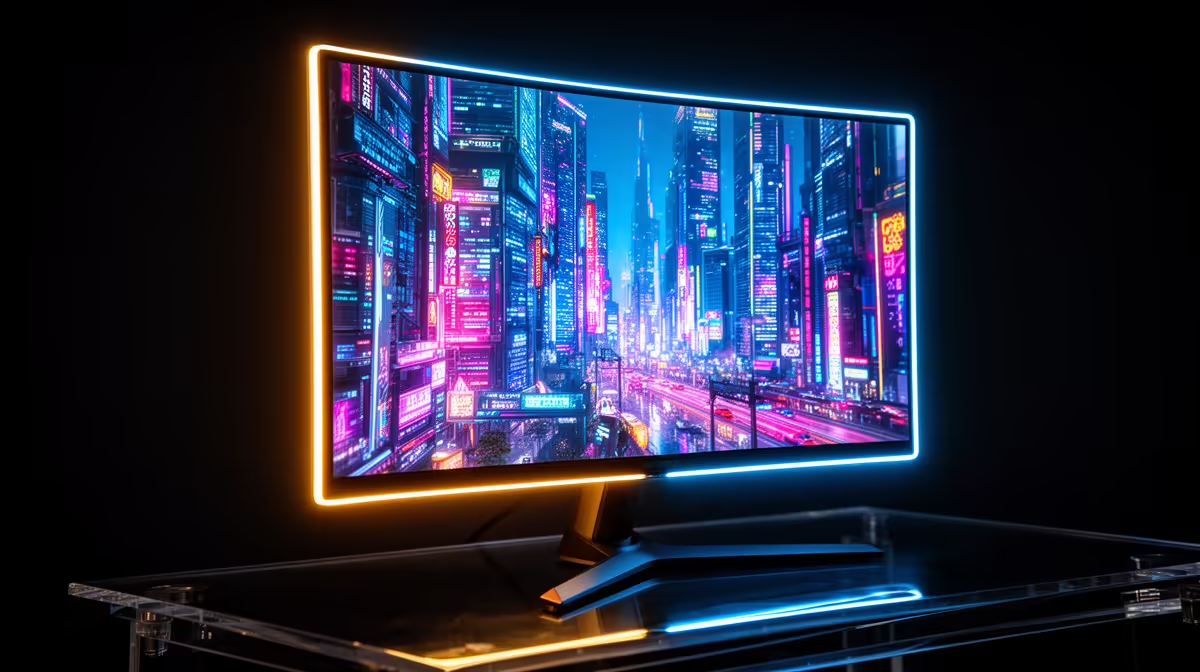
You've just dropped some serious cash on a new GPU, ready to experience Night City or the Lands Between in all their glory. But something’s off. The colours look… washed out. Lifeless. The culprit? Your monitor. The truth is, without a display that can keep up, you're leaving performance on the table. That's why we're diving deep into OLED gaming monitor colour accuracy—to show you what you've been missing. ✨
Why Colour Accuracy is Your Secret Weapon
Let’s be honest, “colour accuracy” sounds like a term for graphic designers, not gamers. But in reality, it's a crucial part of the gaming experience. Think about it: superior colour performance isn't just about pretty visuals. It’s about a competitive edge.
In a game like Apex Legends, accurate colours mean the subtle purple of an enemy’s shield is instantly distinguishable from the background. In a story-driven epic like Baldur's Gate 3, it’s the difference between a dimly lit crypt feeling atmospheric or just looking like a muddy grey mess. Poor colour reproduction can flatten the image, crush details in dark scenes, and ruin the artistic vision the developers worked so hard to create.
Truly accurate colours provide depth, realism, and clarity. It’s what makes HDR content pop and what helps you spot that sniper glint in the distance. When you're looking for an upgrade, browsing a vast selection of PC monitors can be daunting, but prioritising colour accuracy is a fantastic place to start.
How We Test for True-to-Life Colour
To move beyond marketing hype, we put these screens through a rigorous testing process. We don't just eyeball it; we use professional-grade hardware and software to get objective data on OLED gaming monitor colour accuracy. 🔧
Our process involves:
- Colorimeter & Spectrophotometer: These tools measure the exact colours a monitor produces.
- Specialised Software (like Calman): We analyse colour gamuts (how many colours a screen can show) like sRGB, DCI-P3, and Adobe RGB.
- Delta E Measurement: This is the key metric. It calculates the "error" between the colour the monitor is supposed to show and what it actually shows. A Delta E value below 2 is considered excellent, as the human eye can barely perceive the difference.
This objective testing ensures that when we talk about the incredible colour performance of modern displays, from vibrant high-resolution 4K monitors to lightning-fast esports panels, we're backing it up with hard numbers.
Our In-Depth Test Results: The OLED Advantage
So, what did we find? Unsurprisingly, OLED panels consistently lead the pack in colour performance, but the reasons why are what's truly interesting.
Key Findings:
- Infinite Contrast is King: Because OLED pixels can turn off completely to create true black, the perceived contrast is infinite. This makes every other colour next to it appear richer and more vibrant. A deep red on an OLED looks far more intense than the same red on an LCD with a greyish "black" backlight bleed.
- Wide Gamut Coverage: Most quality OLED gaming monitors we tested cover over 95% of the DCI-P3 colour space. This is the gamut used for HDR movies and many modern games, resulting in the deep reds, lush greens, and brilliant blues that developers intended.
- Outstanding Factory Calibration: Manufacturers know that OLED gaming monitor colour accuracy is a major selling point. Many high-end models now come with a factory calibration report in the box, proving a low Delta E value right out of the gate.
This combination means you get an image that is not only technically accurate but also breathtakingly immersive. It's a key reason why so many gamers are exploring the best PC monitor deals to make the jump to OLED.
Check Your Calibration 🎯
Even if you don't have professional tools, you can perform a basic check. Windows has a built-in "Display Color Calibration" tool (just search for it in the Start Menu). It will guide you through adjusting gamma, brightness, and colour balance. It's not as precise as a colorimeter, but it can fix obvious issues and improve your viewing experience in minutes!
Is an OLED Monitor Right for Your Setup?
With such stellar performance, an OLED seems like a no-brainer. But is it the perfect choice for every South African gamer? Let’s weigh the pros and cons.
The advantages are clear: unmatched contrast, near-instantaneous response times for zero motion blur, and phenomenal colour accuracy. If you play a lot of cinematic single-player games or want the absolute best HDR experience, an OLED is tough to beat. The immersion offered by many immersive curved monitors using this panel technology is simply on another level. 🚀
However, there are considerations. The biggest is the risk of burn-in, where static images (like a game's HUD) can leave a permanent ghost on the screen. Modern OLEDs have built-in mitigation features like pixel shifting and screen savers to combat this, but it's still a valid concern for those who play the same game for thousands of hours. Price can also be a factor, though they are becoming more competitive.
Ultimately, the choice depends on your usage. You have a massive variety of options, from traditional desktop screens to even portable monitors for different needs. But if visual fidelity and colour performance are your top priorities, the results of our OLED gaming monitor colour accuracy tests speak for themselves.
Ready to See Games in True Colour? The difference a truly colour-accurate monitor makes is astounding. From competitive shooters to breathtaking RPGs, the right display unlocks the full potential of your PC. Explore our massive range of gaming monitors and find the perfect panel to bring your world to life.