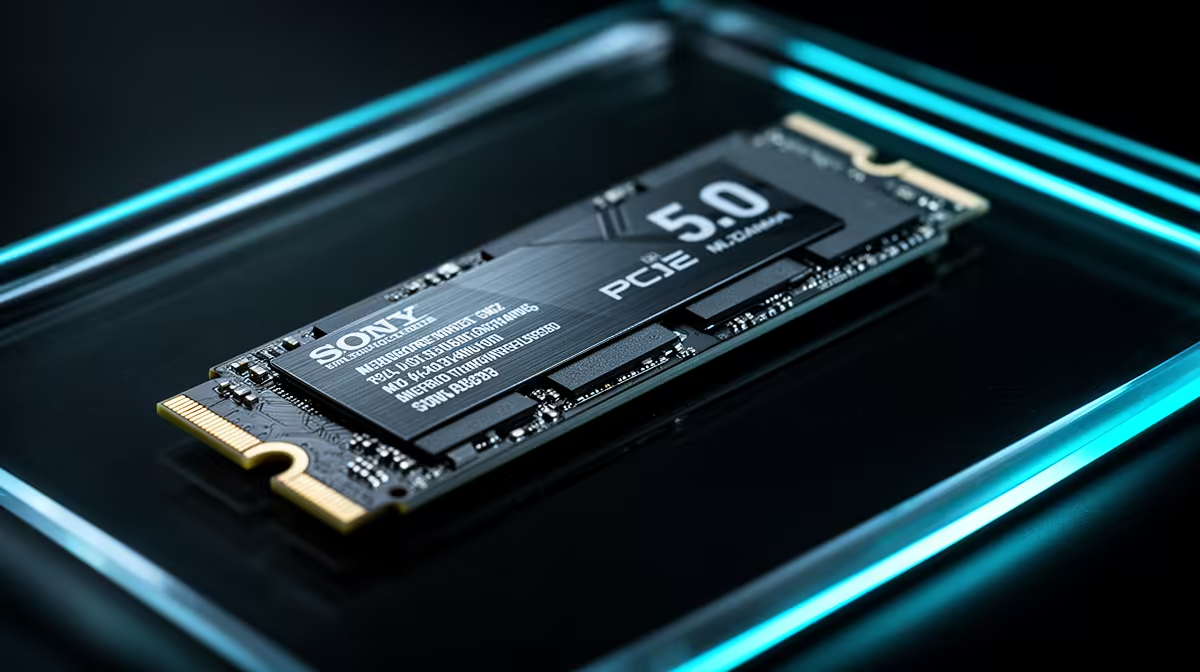
You’ve seen the hype: PCIe 5.0 SSDs promising god-tier speeds. But as a South African gamer, staring at your rig, the real question is… will it actually make your load times in Warzone or Starfield any faster? Or is it just an expensive way to drain your wallet for bragging rights? 🚀 Let's cut through the noise and see if the upgrade from a trusty PCIe 4.0 SSD is worth your hard-earned Rands.
The Raw Speed: What Do the Numbers Mean?
On paper, the battle of PCIe 5.0 vs 4.0 SSD performance looks like a total knockout. A typical Gen 4 drive might hit read speeds of around 7,000 MB/s. A new Gen 5 drive? It can blast past 12,000 MB/s. That’s nearly double the theoretical performance, a massive leap forward in storage technology.
Think of it like a water pipe. PCIe 4.0 is a big pipe, letting lots of data flow quickly. PCIe 5.0 is a massively wider, higher-pressure fire hose. For huge, single-file transfers, the difference is staggering. But games don't load one giant file; they access thousands of small ones. This is where the real-world difference gets a bit more... complicated. All modern gaming rigs benefit from blazing-fast NVMe SSDs, but the generation is key.
Gaming Load Times: The Reality Check 🎮
So, does that fire hose of data translate to near-instant load screens? The answer, for now, is mostly no.
For the vast majority of current games, the bottleneck isn't your SSD's maximum speed. It's the CPU decompressing assets and the game engine itself. Tests by major tech outlets consistently show that when comparing a high-end PCIe 4.0 SSD to a PCIe 5.0 SSD, the difference in game load times is often less than a single second. Sometimes, it's fractions of a second.
Your gameplay experience—your FPS, your graphical fidelity—will be identical. The truth is, games are currently optimised for the performance profile of Gen 4 drives. While future technologies like Microsoft's DirectStorage API aim to change this by letting the GPU decompress game assets directly from the SSD, widespread adoption is still a way off. This makes one of our top-tier Gen 4 NVMe SSDs the undisputed value king for pure gaming today.
Check Your Motherboard! 🔧
Before you even think about a Gen 5 SSD, check your motherboard's specs. You need a compatible motherboard (like an AMD AM5 or Intel Z690 Z790 series) with a dedicated PCIe 5.0 M.2 slot to get those top speeds. Plugging a Gen 5 drive into a Gen 4 slot will limit its performance to Gen 4 levels.
So, Who Actually Needs a PCIe 5.0 SSD?
If the upgrade isn't truly worth it for most gamers right now, who is it for? The answer lies with content creators and professionals who move massive files daily.
Consider these scenarios:
- Video Editors: Scrubbing through 8K video timelines or exporting huge projects.
- 3D Artists: Loading and saving complex, multi-gigabyte scene files.
- Data Scientists: Working with enormous datasets that need to be accessed quickly.
For these users, saving minutes on every large file transfer adds up to hours of saved productivity. Here, the raw sequential speed of cutting-edge Gen 5 SSDs provides a tangible return on investment. It's also a great choice for hardcore enthusiasts building a top-of-the-line rig with future-proofing as a primary goal.
The Price vs. Performance Verdict in SA 💰
Here in South Africa, value for money is everything. A premium 2TB PCIe 5.0 SSD can easily cost over R1,500 more than a top-performing 2TB PCIe 4.0 drive.
Ask yourself this: could that R1,500 be better spent elsewhere in your build? For a gamer, that money could go towards a better graphics card, more RAM, or a faster CPU—upgrades that will deliver a far more noticeable improvement in your gaming experience than saving half a second on a loading screen.
The performance-per-Rand equation overwhelmingly favours PCIe 4.0 for gaming builds in 2024. The smart money is on getting a fantastic Gen 4 drive and investing the savings into components that boost your in-game FPS. To make the best choice for your budget, it's always a good idea to check out the latest SSD deals and see where the sweet spot is.
Ready for a Real Speed Boost? While PCIe 5.0 is the future, PCIe 4.0 is the champion of today's gaming world. For the best value and performance where it counts, a Gen 4 SSD is the smart choice. Explore our massive range of SSD deals and find the perfect drive to slash your load times without breaking the bank.