Quick Answer
The RTX 5090 running Fortnite at 1080p maxes out well above 400fps at maximum visual fidelity, and at 4K with maximum settings it sustains over 200fps. This card is extreme overkill for Fortnite, but it delivers the most responsive and visually polished experience possible, particularly at high refresh rates.
RTX 5090 Fortnite FPS Benchmarks by Resolution
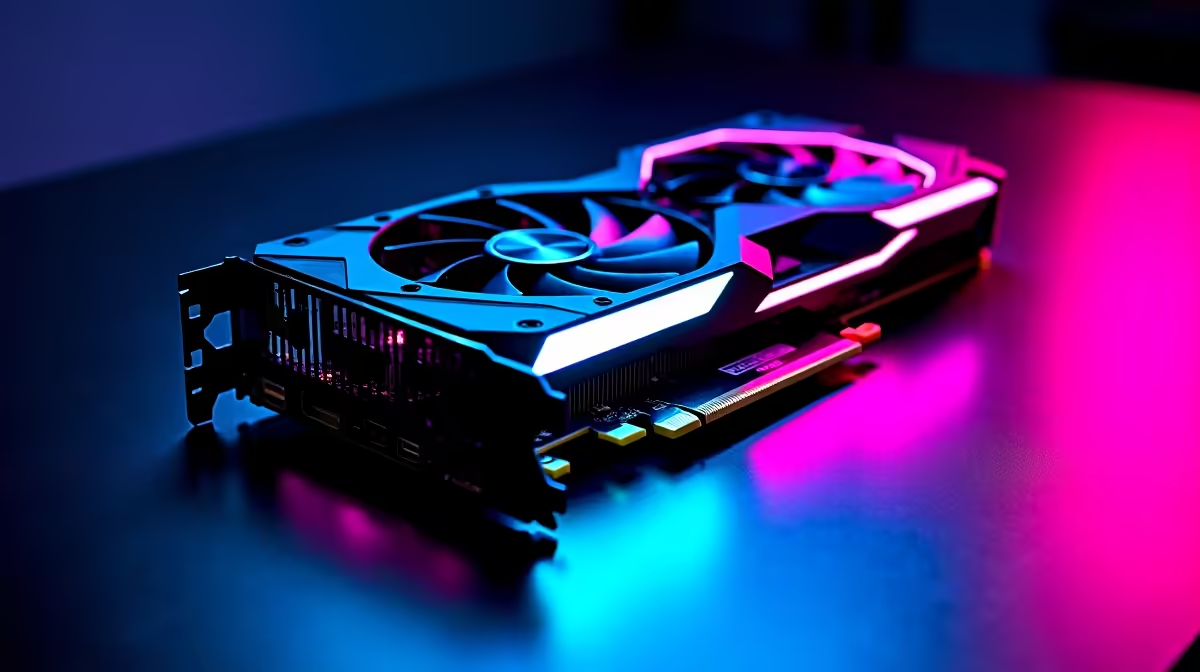
Fortnite is a relatively well-optimised title and does not stress even mid-range GPUs at 1080p. The RTX 5090, built on NVIDIA's Blackwell architecture with 32GB of GDDR7 memory and a 575W TDP, is in an entirely different class from what Fortnite demands. That said, pushing the game to its visual ceiling while maintaining triple-digit frame rates at 4K is where this card distinguishes itself.
At 1080p, Epic quality settings: the RTX 5090 exceeds 500fps in most gameplay scenarios, dipping to around 420fps in GPU-heavy moments such as large storm circles with multiple players building simultaneously. At 1440p, Epic settings: average frame rates land around 380-420fps with DLSS Quality mode or 300-340fps natively. At 4K, Epic settings with DLSS Performance: the card maintains 250-290fps consistently, and with DLSS Quality you can expect 180-220fps.
For competitive play at any resolution below 4K, the RTX 5090 is capable of feeding 360Hz monitors with consistent frame delivery, which is the primary reason a professional player would consider the card alongside Fortnite.
Best Fortnite Settings for the RTX 5090
At this GPU tier, you are not chasing performance, you are optimising for smoothness and visual clarity. The following settings extract maximum quality without any frame rate compromise:
Display: your native monitor resolution, Fullscreen mode, max frame rate set to match your monitor's refresh rate (360Hz or 240Hz). Rendering mode: DirectX 12 for best DLSS integration. Anti-aliasing: DLSS set to Quality at 4K or Balanced at 1440p. All visual quality sliders at Epic. Shadow quality at Epic or High depending on whether competitive debris visibility matters to you. View distance at Epic. Motion blur should be Off for competitive play regardless of GPU.
At 1080p for a 360Hz setup: turn off DLSS and run native rendering with NVIDIA Reflex On, all settings at Epic except shadows at Medium to ensure no shadow-based visual obstructions interfere with enemy spotting.
In ZAR: Is the RTX 5090 Worth It for Fortnite?
The RTX 5090 is priced in the R25,000 to R35,000 range in South Africa depending on board partner and stock levels. For a player who plays only Fortnite, this is an extreme spend, and an RTX 5070 Ti or RX 9070 XT at a fraction of the price delivers 240fps+ at 1440p with no visible compromise.
The RTX 5090 earns its place as a Fortnite card only when paired with a 360Hz monitor and a system built around zero-latency competitive play, or when Fortnite is one of several demanding titles in a rotation that includes games like Cyberpunk 2077 or Alan Wake 2 at 4K.
Frequently Asked Questions
Does Fortnite support DLSS Frame Generation on the RTX 5090? Yes. Fortnite supports DLSS Frame Generation, which the RTX 5090 can leverage for additional frames at 4K, though at the native frame rates this card achieves, Frame Generation is rarely needed in this title.
What CPU pairs best with the RTX 5090 for Fortnite? Fortnite is moderately CPU-dependent, particularly in busy lobbies. A Ryzen 9 9900X or Intel Core i9-14900K paired with fast DDR5 RAM ensures the GPU is never CPU-bottlenecked.
Can an RTX 5090 maintain stable frame rates during Fortnite's storm events? Yes. Even in the busiest final-circle scenarios with building, storm effects, and multiple players, the RTX 5090 holds frame rates well above 300fps at 1080p and above 180fps at 4K.