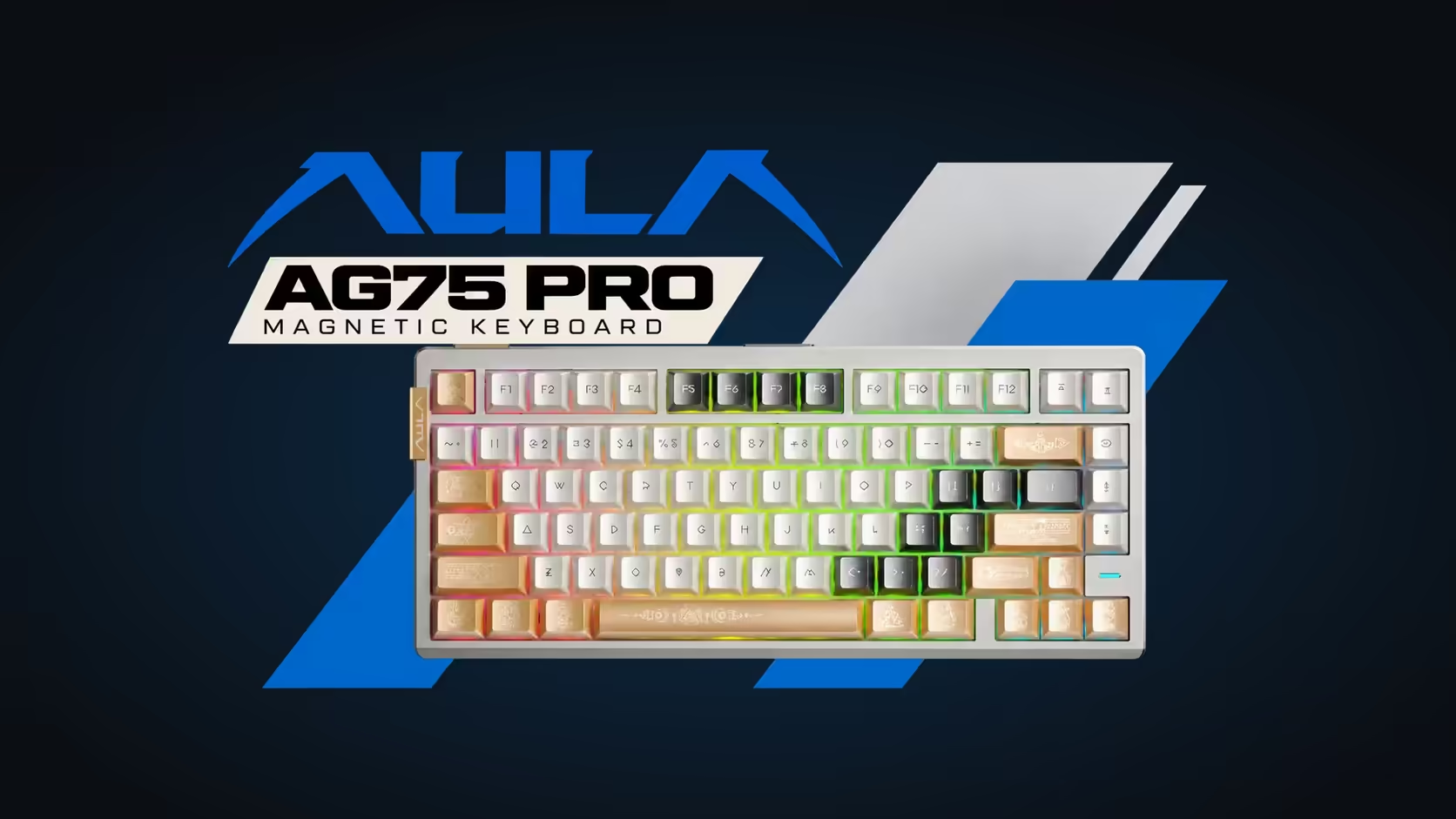
A latency number on a keyboard box looks like a promise about how fast your character will move. It is narrower than that. When AULA quotes 0.1ms for the AG75 Pro, it is describing a single link in a long chain, the one inside the keyboard. Knowing what a keyboard average latency figure covers, and what it leaves out, stops it being oversold or dismissed.
Quick Answer
The AULA AG75 Pro's 0.1ms average latency is AULA's rating for the keyboard's own processing delay, not the delay of your whole PC, game and monitor. AULA puts it down to a triple-MCU design working with 8000Hz polling and 256kHz full-key scanning over the USB-C cable. Both Pro colourways, Shadow Grey and Armor Silver, carry the same rating. At Evetech, Shadow Grey sells for R2,399 and Armor Silver for R2,799.
📐 What "average latency" is measuring
Every keypress goes through a sequence before anything appears on screen:
- The switch moves and the sensor under it registers a change.
- The keyboard's controllers decide that a keypress has happened.
- The keyboard sends a report to the PC at its next polling slot.
- The operating system and the game read the input.
- The game updates, the graphics card renders a frame, and the monitor shows it.
AULA's 0.1ms figure lives in steps one to three. It is the keyboard's contribution to the chain, and it is quoted as an average because the exact delay varies a little from press to press depending on where in the scan and polling cycle the key happens to change.
The later steps are outside the keyboard's control. A game running at 144 frames per second produces a new frame roughly every 7ms, and a monitor adds its own processing and response time on top. Those numbers dwarf 0.1ms.
🧠 Where the three MCUs come in
An MCU is a microcontroller, a small processor. Many keyboards use one to read every key and talk to the PC. AULA splits that work across three on the AG75 Pro, calling it a triple-MCU direct connection, with the stated aim of reducing processing delay.
That design feeds two fast rates:
- Scanning: the controllers sweep every sensor 256,000 times a second, and a lone key can be sampled at 2304kHz.
- Polling: 8000Hz, one report to the PC every 0.125ms.
Reading keys many times faster than reports go out means a change is almost always caught in time for the very next report. The latency rating is the combined result of those pieces.
🎮 Will you feel 0.1ms?
Honestly, no, not as a distinct sensation. Human reaction times are measured in hundreds of milliseconds, and the rest of a gaming system adds several milliseconds more. What a low keyboard figure does is make sure the keyboard is never the weak link.
What you will notice on the AG75 Pro is the behaviour built on the same hardware. Rapid Trigger at 0.001mm precision resets a key the instant it starts to rise, with a true zero dead zone. SOCD and DKS, set in AULA's web HUB, change how movement and multi-action keys behave. Those are the features that change how the board plays.
The AG75 Pro is part of Evetech's gaming keyboards line-up, in Shadow Grey and Armor Silver, with a 2 Years Local Warranty. You can also compare it with the boards in Evetech's keyboard best sellers. Its price is shown on the product page.
Frequently Asked Questions
Why is the figure an average rather than a fixed number?
The delay shifts slightly with where each press falls in the scan and polling cycle, so AULA quotes the typical value.
Does 0.1ms include my monitor and PC?
No. It covers the keyboard's own processing. The PC, game and display each add their own delay.
What does the triple-MCU design do?
It spreads the keyboard's work across three microcontrollers, which AULA says reduces processing delay.
How fast does the Pro scan its keys?
A whole-board sweep runs at 256kHz, and one key read by itself reaches 2304kHz.
Do both Pro colours share the rating?
Yes. Shadow Grey and Armor Silver are the same AG75 Pro with the same 0.1ms figure.
Want a board that is never the slow link?
Explore Evetech's gaming keyboard range and see the AG75 Pro alongside other 8000Hz magnetic boards.