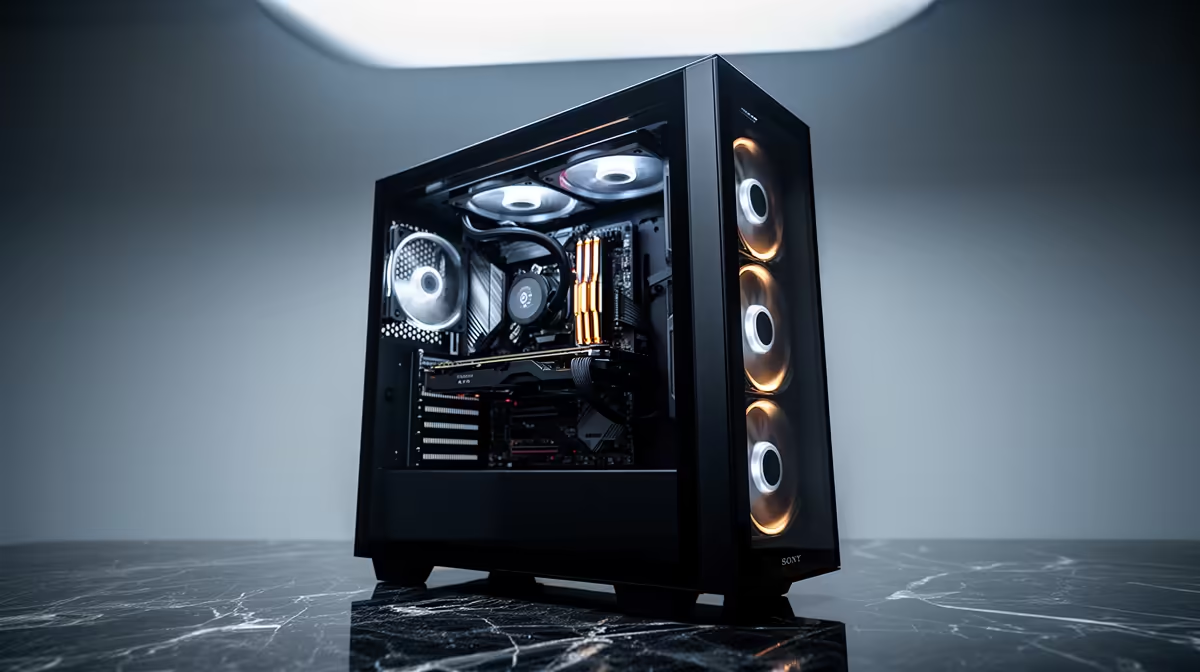
Buying a case before knowing your motherboard size is one of the more common ordering mistakes first-time builders make, and it usually ends in an awkward compromise. A properly sized atx mid-tower case removes that risk entirely, mounting full-size boards and far smaller ones on one shared internal frame, as long as you know your board size before you shop.
Quick Answer
At R1,199, the Antec NX410 mounts full-size ATX, Micro-ATX and compact Mini-ITX boards using a single shared standoff pattern, so motherboard size never forces a separate case purchase.
🖥 Full-Size Boards Get the Most Room
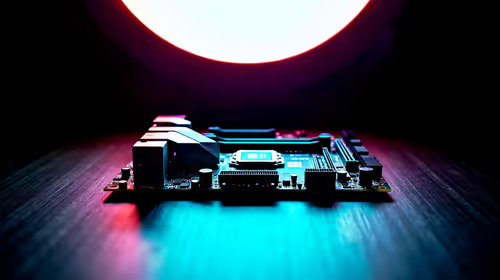
A full-format board carries the widest run of expansion slots and header connectors this chassis supports, and the internal layout is built around that largest footprint first. Builders planning a second graphics card, extra fan headers or more USB connectors down the line often default to the full-size format simply because the space is already there waiting.
🧩 A Smaller Board, the Same Shell
Stepping down a size trims a couple of expansion slots compared with the full-size format, yet the smaller board bolts into the identical mounting points. Choosing the smaller format comes down to what that particular board offers for its price, not any restriction from the case, since the surrounding shell stays exactly the same regardless of which you pick.
Why Some Builders Choose the Smaller Format on Purpose
A smaller board sharing the same chipset and socket as its full-size sibling is often the cheaper of the two, and skipping headers you will never use is a saving you can pocket without losing an inch of case volume.
📐 The Compact Format, Inside a Roomier Shell
The most compact board format trades the portability of a genuinely small enclosure for far more breathing room around the board itself once it sits inside a case sized for full ATX. That extra volume simplifies cable routing, leaves clearance for taller air coolers, and keeps every fan mount usable in a way a true small-form-factor case rarely manages.
Whatever board size you land on, the listing for this model confirms it mounts the same way every time, and Antec's wider range of case sizes is there if your plans shift toward a different chassis later. Once the board is seated, adding airflow from the case fan lineup is the same task no matter which of the three formats you ended up choosing.
Frequently Asked Questions
Does motherboard size limit which case I can buy?
Only if the case itself does not cover that board's size. This one spans all three common formats on a single mounting layout, so it rarely becomes the deciding factor.
Is a smaller board format worse than full-size ATX?
Not worse, just narrower on expansion slots. It suits builds that will never need the extra PCIe or M.2 headers, often for a lower price.
Why put a compact board inside a mid-tower shell at all?
For the extra clearance around cable runs, cooler height and fan mounting that a genuinely small case cannot match at a similar price.
Should the case or the motherboard be chosen first?
Settle on board size around the features you actually need, then confirm the case supports it. A shell built for all three formats removes that step from the decision entirely.
Does the exterior footprint shrink with a smaller motherboard installed?
No. The chassis keeps its mid-tower dimensions no matter which board format goes in, so desk footprint stays identical either way.
Ready to match your motherboard to the right case?
Pick up the Antec NX410 case in Evetech's gaming case range for R1,199 flat. Confirm it suits your board size before you start the build.