The difference between lumbar systems begins with whether contact is intended to stay in one form or extend around the support area. Auto-wrap versus fixed lumbar support is therefore a fit decision, not an automatic upgrade path. The E3 Air supplies a R7,399 auto-wrap example using three zones across 80 degrees.
Quick Answer
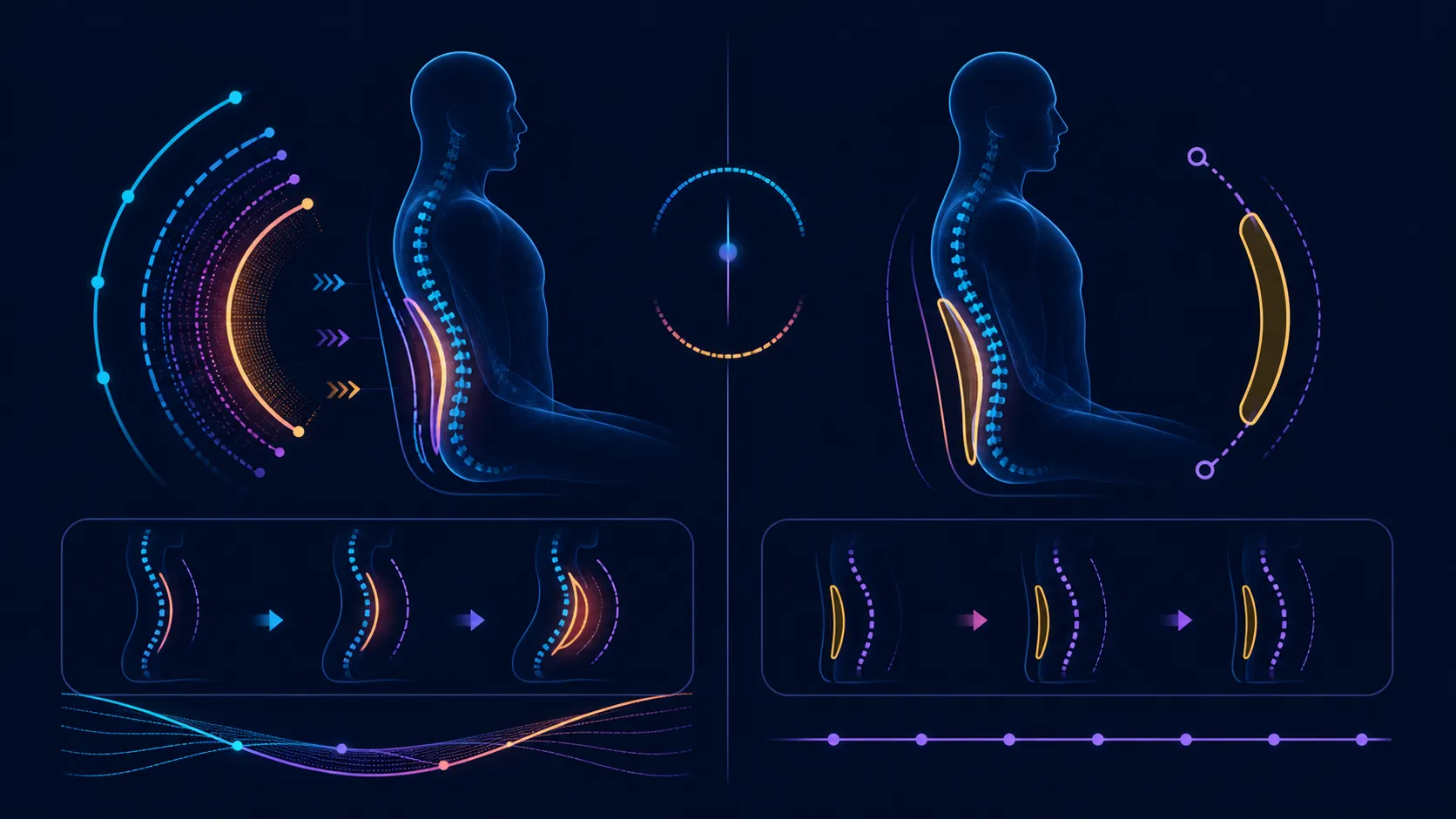
Auto-Wrap differs from fixed lumbar by adding 80-degree rotational freedom, changing wing curvature, 30mm depth selection and six height levels.
Fixed lumbar retains a set support form, while auto-wrap is designed to reach farther around the lumbar region. Neither is best for everyone. At R7,399, the E3 Air uses three-zone 80-degree auto-wrap; compare that contact with a fixed candidate during the same desk task and over the same period.
🧱 See what fixed support asks of the user
A fixed design relies on its built-in shape meeting the seated body appropriately. There may be little to configure, which can be useful on a straightforward or shared setup. The trade-off is that the user cannot assume the contact form will move toward an individual mismatch.
Test where it meets the lower back while typing naturally. Seat and backrest measurements still matter because a fixed form that lands correctly for one person may meet another in a different place.
Review HBADA office chairs at Evetech after recording the user's contact preference rather than browsing by feature count.
🫂 Understand the wrap-around alternative
Auto-wrap describes a design that extends around the supported region. On the E3 Air, the coverage figure is 80 degrees and the support is divided across three zones. These facts do not establish an exact control mechanism, pressure or guaranteed comfort.
Keep the desk, seat and task unchanged when comparing it with a fixed design. Notice the centre and side contact after attention returns to work. Broader coverage only adds value when it suits that person throughout the routine.
⚖️ Put both inside the complete chair
Other E3 Air features need independent tests. Cloud-like mesh of high-density construction forms the seat, and the headrest combines dual axes with 4D movement. Mechanical arms provide omni-motion, while the backrest reaches 140 degrees. Keeping these checks apart protects the lumbar verdict from seat or upper-support bias.
Neither design can treat a back condition or guarantee relief. Persistent symptoms need appropriate professional guidance. Capacity remains a distinct boundary too: this model supports a maximum user weight of 150kg on a steel five-star base.
Take one scorecard across both approaches in Evetech's wider office-chair category. A good choice fits, stays acceptable during ordinary work and does not demand constant correction.
The absence of controls can be convenient when a fixed form already fits and a firm limitation when it does not. Record which case applies before assigning value to complexity. For the wrap-around candidate, repeat the task after standing and returning; daily usefulness depends on recoverable contact rather than an interesting first sensation. Shared seating needs separate contact maps because one person's low-maintenance choice can become another person's intrusive support. Only bring price into the scorecard after those fit results are clear.
Keep the comparison duration equal and use the same keyboard or reading activity on both chairs.
The E3 Air also uses a 12-degree dynamic track intended to move before the body. Fixed support keeps one form. Compare both through the same tasks, giving the adaptive system value only when its broader contact remains comfortable.
The four locked depth settings make the E3 Air easier to return to a known support level.
Frequently Asked Questions
How does a fixed lumbar design behave?
It keeps a built-in support form rather than offering the wrap-around approach described here. Whether that form fits can only be judged against the intended user.
What sets auto-wrap support apart?
It is intended to extend contact around the lumbar area. The amount and feel depend on the exact chair, so the category name is only a starting point.
Which approach is used on the E3 Air?
Its lumbar contact occupies three zones around an 80-degree auto-wrap area. Explore exact mechanism behaviour through a seated test on the chair.
Is wrapping contact superior for every body?
No. Coverage, shape, task and individual posture all influence fit. A fair comparison keeps the desk and work activity constant.
Can either design treat back problems?
No chair feature provides that guarantee. Ongoing pain or other symptoms require appropriate professional assessment rather than a feature-label decision.
What other adjustments accompany the lumbar area?
The E3 Air pairs a dual-axis, 4D-adjustable headrest with mechanical arm supports that offer omni-motion through 360 degrees. Its backrest reaches 140 degrees.
Ready to compare support shape through the same work task?
Browse Evetech office chairs with a fixed baseline and a simple centre-and-side contact note.