An under-R15,000 list should not pretend that every affordable card suits the same creative work. This guide presents the RTX A1000 as a qualified candidate rather than a winner. The workstation graphics card under R15,000 costs R12,099, and its value depends on the workload it must support.
Quick Answer
At R12,099, the RTX A1000 is a sub-R15,000 professional GPU with a 50W single-slot design, 8GB GDDR6 and support for up to four 5K displays.
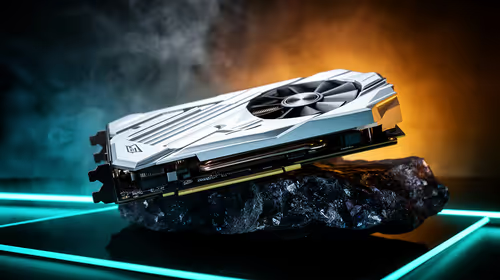
The PNY RTX A1000 qualifies below the R15,000 ceiling because it costs R12,099. Its creative-work reference begins with 8GB GDDR6 and an Ampere GPU carrying 2304 CUDA cores. The interface width is 128-bit. It belongs on the shortlist, but comparable models and workload tests are needed before naming a winner.
🧭 Use the ceiling as a boundary
A R15,000 cap creates R2,901 between the A1000's price and the budget limit. That difference may matter if the workstation also needs system memory, storage or another measured improvement. Do not spend it automatically; preserve it until the rest of the workflow has been checked.
The product price should be tied to a deliverable. Define the CAD file, render scene or video timeline that must remain practical, then ask whether an 8GB card has enough capacity and whether the software uses CUDA resources relevantly.
🧭 Audit the candidate specification
At R12,099, the A1000 combines Ampere architecture and 2304 CUDA cores with 8GB GDDR6 connected through 128 bits. Together, those four points describe the card for an initial comparison. Physical fit, power needs and measured performance require separate checks.
The PNY RTX A1000 is one candidate at R12,099. Use Evetech's professional graphics category to identify other options, then apply the same software, memory and budget questions to each one.
🧭 Match the creative task
A video editor should test a normal timeline, effects and intended output. A 3D artist needs a scene that reflects actual textures and geometry. CAD buyers should include the assemblies and visual styles used in production. One generic "creative" result cannot represent all three.
Record whether the project opens reliably, whether the accelerated stage uses the GPU and whether output remains correct. If the test fails because of memory demand or missing support, being under budget does not make the card good value.
🧭 Check the wider machine
Graphics may not be the only constraint. AI-assisted tools can introduce platform requirements that involve CPU, RAM or other accelerators. The AI PC range gives buyers a broader comparison when a component-only upgrade would leave several bottlenecks untouched.
Expand an under-R15,000 shortlist only when each added card has a complete specification and current price. Avoid forcing a ranking merely to fill positions. The strongest recommendation is the card that clears the documented task within the ceiling.
Keep an under-budget comparison current
Prices and candidate lists can change, so date the shortlist and preserve the project used for testing. Keep the R15,000 ceiling as the decision boundary and date the A1000's R12,099 price alongside it.
When another card is added, record its complete specifications and current price before ranking it. Run the same creative project rather than borrowing results from a different scene or timeline. Consistency matters more than the number of models in the table.
If no candidate clears a mandatory requirement below the ceiling, report that gap plainly. The responsible response is to revisit the budget or project constraint, not to label the least unsuitable card as "best".
Creative professionals also receive 2,304 CUDA cores, 18 RT cores and 72 Tensor cores, backed by 192GB/sec of memory bandwidth. Those resources make the A1000 a concrete shortlist entry for supported CAD, 3D and content work, particularly where the workstation is compact. Calling it the overall best under the ceiling would still require named rivals, current prices and matched application tests.
Its R2,901 headroom below the ceiling also leaves room for other workstation needs.
Frequently Asked Questions
Which workstation card qualifies below R15,000?
The PNY RTX A1000 qualifies at R12,099. It combines 8GB GDDR6, 2304 CUDA cores, Ampere architecture and a 128-bit interface.
How much remains below the spending ceiling?
Subtracting R12,099 from R15,000 leaves R2,901. That amount is budget headroom, not a discount or a second product price.
Does the cap prove suitability for creative work?
No. CAD, rendering and video workloads need their own application-support, capacity and project tests before the card can be recommended.
What is needed to rank multiple models?
Ranking requires named alternatives with complete specifications, current prices and results from the same workload used for the A1000.
Ready to build an under-R15,000 shortlist around real creative work?
Check Evetech's workstation graphics selection, then keep the budget ceiling beside a representative project and its software requirements.