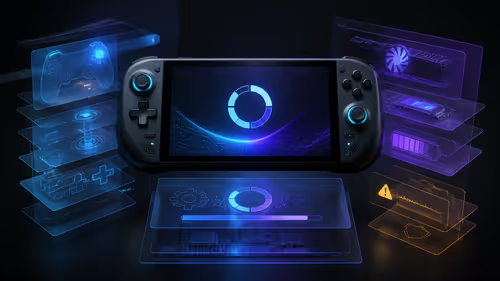
Device labels such as laptop, phone and console are too broad to prove a display route. A USB Type-C portable monitor connection works only after the exact source port, cable capability, screen input and power plan have been matched.
Quick Answer
The monitor can serve compatible laptops, phones and consoles, but each source must provide a supported USB-C display route or Mini HDMI signal plus adequate power.
USB Type-C can connect a compatible device when that specific port outputs display video and the cable carries the required signal. Before pairing the R2,499 UPERFECT UGame NxtLED One Plus with any laptop, phone or console, confirm its exact input and the complete route needed for 1920x1080 at 120Hz.
💻 Check each laptop port by function
Laptop USB-C sockets can support different combinations of data, charging and video. Use the model documentation to identify external-display output on the exact port rather than assuming every socket behaves alike.
If several ports exist, label the one that passes the display test. Save the operating-system mode, selected refresh and cable with that result so a later update can be diagnosed from a known state.
Work docks introduce another device. Verify dock output, power and supported display mode independently before including it in the connection path.
Once the laptop's output is understood, explore alternative input arrangements among Evetech portable monitors.
📱 Treat phones as exact models
A USB-C phone connector does not automatically carry wired display output. Review the handset's precise hardware and software behaviour, including whether the intended application appears on an external screen.
Power deserves a separate plan. Do not assume the phone powers the display, the screen charges the phone or one cable performs both jobs. Test battery and supply behaviour during a realistic session.
Adapters should have a proven signal purpose. An adapter that physically fits can still fail to pass external video or the selected Full HD mode.
🎮 Prove console output and control needs
Check the console's physical video output, supported resolution and refresh modes. A USB-C route may be irrelevant if the system uses another display connector, and controller or audio arrangements remain separate from picture output.
The NxtLED One Plus updates at 120Hz, while pixel response is 14ms. These display details do not guarantee that a console sends the higher rate or every title produces matching frames.
Test the real game and save a lower-refresh fallback if the source does not expose the maximum panel mode.
🔌 Finish with one cross-device matrix
Create a row for each source and columns for output port, cable, power, resolution, refresh, sound and successful reconnection. Blank cells are checks, not invitations to assume shared support.
Use native 1920x1080 when available and comfortable scaling for computer sources. Keep phone and console results separate even when they use the same physical lead.
The Evetech monitor accessories department is useful after the matrix identifies a precise cable or support requirement. A truly flexible setup has a documented route for every device that will be used.
Colour-code the rows by confidence: a completed physical test, explicit device support not yet tested, or an unresolved check. Do not let a passing laptop route turn a phone or console row green. Each source deserves its own evidence because shared connector shapes can conceal different signal and software behaviour.
Retest any amber row before travel. A documented capability is useful, but the actual cable, software state and power arrangement still need a rehearsal with the equipment being packed.
Date every completed row for later review.
Once compatibility succeeds, every source reaches the same 18.5-inch 1080p IPS panel with 120Hz capability, 100% sRGB and wide viewing. Keep known working cables with the 2.79-pound monitor in its protective case, especially when moving among several devices. A phone may need video-capable USB-C, while a console may use Mini HDMI through the correct cable; connector shape alone does not prove the full route.
Store the adapters for each source in separate labelled pockets. A portable screen becomes easier to trust when every intended device has one proven end-to-end route.
Frequently Asked Questions
Why might two laptop USB-C ports differ?
Manufacturers can assign different data, charging and display functions to sockets on the same computer.
What phone detail matters beyond connector shape?
The exact handset must support wired external video and the intended application's external-screen behaviour.
Does the panel's 120Hz force console output?
No. The console and game determine which refresh modes and frames are sent through their supported route.
What belongs in a device matrix?
Record port, cable, power, resolution, refresh, audio and reconnection results separately for every source model.
Ready to replace broad device claims with a proven connection matrix?
Verify each source independently, then compare portable monitors and route-matched accessories through Evetech.