Quick Answer
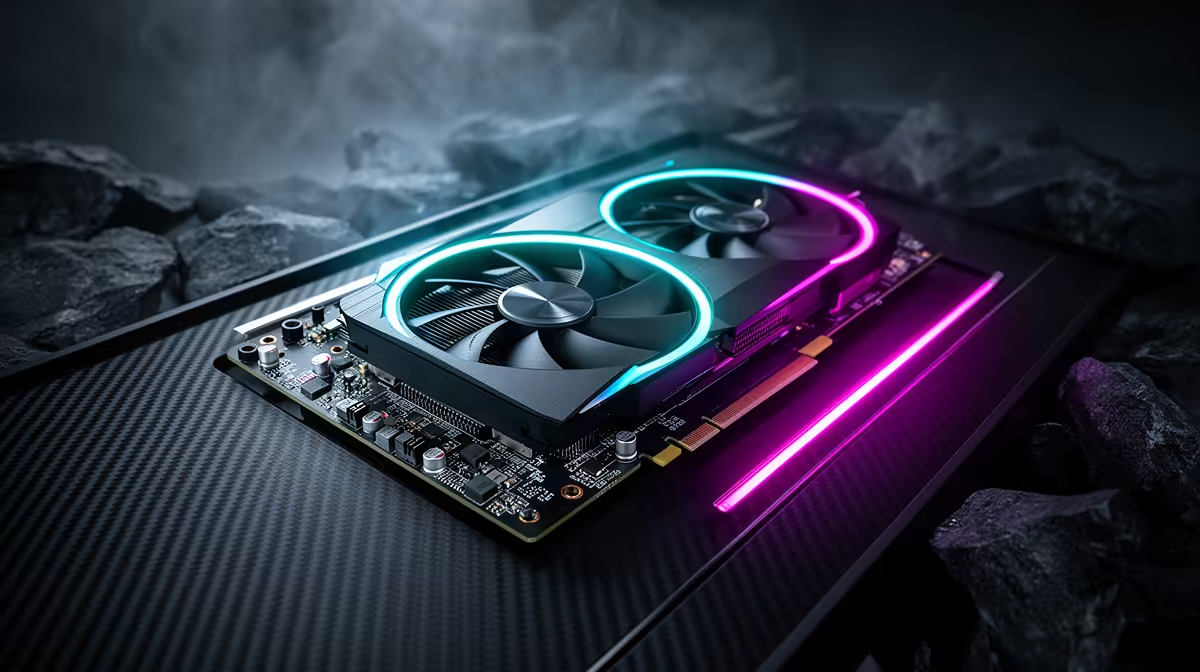
RX 9060 makes sense for competitive esports when the target is 1080p 144 Hz to 240 Hz. The short answer is yes, if the price leaves room for a high-refresh monitor. Use broad SA pricing around R6,000 to R10,000 as a planning band and confirm the exact live card before checkout.
Where this GPU fits
For competitive esports, the useful question is not only peak FPS. Check frame-time stability, VRAM comfort, driver support, and whether the CPU can keep the card fed. A Ryzen 5 7600 is fine for many value builds, while Ryzen 7 7800X3D or 9800X3D is cleaner for high-refresh play.
Expected performance target
Plan around 60 to 100 fps at 1080p High, with 1440p needing reduced settings in heavier titles. Lighter games and esports titles can run far higher, while heavy ray tracing or 4K textures can pull performance down quickly. If you play in South Africa, the local angle is practical: keep delivery, warranty, case airflow, and monitor cost in the same basket instead of judging the GPU alone.
What to buy around it
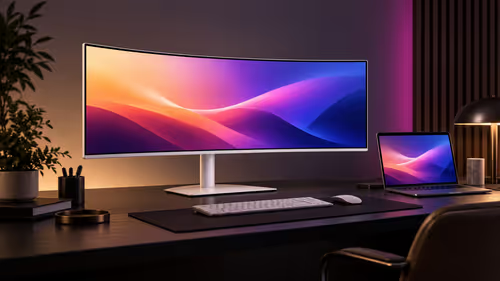
A sensible build uses 32 GB DDR5, a 1 TB or 2 TB NVMe SSD, and a power supply sized for the card. Spending R2,000 more on a better monitor can matter more than a small GPU tier jump if your current screen is still 1080p 60 Hz.
FAQ
Is RX 9060 overkill for competitive esports?
It is overkill only if your monitor cannot show the extra frames or detail. For 1080p 144 Hz to 240 Hz, the card is easier to justify than it is for a basic 60 Hz screen.
What CPU should I pair with RX 9060?
Use Ryzen 5 7600 or Core i5 class chips for value builds. Choose Ryzen 7 7800X3D or 9800X3D when high-refresh consistency matters.
Should I wait for a bigger GPU?
Wait only if your current PC already meets your games and monitor target. If you are below 60 fps or stuck on low settings, a right-sized upgrade now is easier to justify.
Pro Tip
Match the card to the monitor you own today; if the screen is the weak link, put part of the budget into refresh rate or resolution instead of only GPU tier.