


1000W PSU Planning for RTX 5090 Builds in SA
1000W for RTX 5090 needs a full-build check, not a simple yes. Review GPU guidance, CPU draw, transient load, connectors, PSU quality, and upgrade plans before deciding.
Read moreDual PC streaming is largely overkill in 2026, since modern NVENC hardware encoding offloads the workload from the GPU with almost no cost on a single gaming pc. Evetech still stocks gear for a second PC where heavy capture and overlays demand it.
Modern hardware encoders let one PC play and stream with a small performance cost in many setups. Dual-PC streaming in 2026 earns its complexity for demanding production workflows, redundancy or capture needs a single system cannot meet.
Dual-PC streaming is overkill for most creators in 2026 because a recent single PC can use a hardware video encoder while the game continues on the same system. A second machine becomes worth considering when your real broadcast scene still causes frame-time spikes, you need the gaming PC isolated from production failures or your capture workflow uses several cameras and complex processing. Measure the single-PC limit before building around another computer.
Modern GPUs include dedicated media blocks for video encoding. NVIDIA calls its encoder NVENC, while AMD and Intel have their own hardware paths. Support and quality depend on GPU generation, codec, streaming software and platform settings.
Start with the encoder your existing GPU provides. Set the stream resolution, frame rate and bitrate supported by the service, then record a private session in your hardest game. Watch game frame times, encoder lag, rendering lag and dropped network frames as separate numbers.
Hardware encoding still uses some system resources. It does not promise zero performance cost, and a GPU pinned near full utilisation may leave too little room for scene rendering. A frame-rate cap can restore headroom.
Encoder lag points towards encoder load or settings. Rendering lag can come from complex scenes, browser sources or GPU saturation. Network drops need an upload and route check. Adding a second PC will not repair an unstable connection.
Reduce one cost at a time. Limit game frame rate, simplify animated overlays and test the camera at a lower capture format. Keep a log so you know which change fixed the stream.
In a two-system setup, the gaming PC sends video and audio through a capture path to the production machine. The second PC handles scenes, encoding and stream tools. A crash or update on one side may still disrupt the chain, but the game workload is separated.
That benefit suits event production, several capture sources or a creator whose income depends on a robust show. It also adds a capture device, audio routing, network traffic, cables, power, heat and another operating system to maintain.
Audio is the trap. Plan game sound, microphone, alerts, voice chat and monitoring on paper before buying hardware. Avoid feeding a delayed stream mix back into your headphones.
A small channel may gain more from a clear microphone, controlled lighting and stable upload than a second computer. Use the streaming essentials range to solve those parts, then compare cameras in the webcam range.
No. It solves much of the encoding load, while complex production, isolation and several sources can still justify another system.
Only when the current PC or encoder is the limiting factor. Service bitrate, source quality and settings still cap the result.
Record the hardest game with the final scene and inspect game frame times, render lag, encoder lag and network drops.
Stress-test your complete single-PC scene, identify the measured bottleneck and add a second PC only when workload separation solves it.
No. It solves much of the encoding load, while complex production, isolation and several sources can still justify another system.
Only when the current PC or encoder is the limiting factor. Service bitrate, source quality and settings still cap the result.
Record the hardest game with the final scene and inspect game frame times, render lag, encoder lag and network drops.
1000W for RTX 5090 needs a full-build check, not a simple yes. Review GPU guidance, CPU draw, transient load, connectors, PSU quality, and upgrade plans before deciding.
Read more
RTX 5080 Super with a 750W PSU is more comfortable than lower wattage if the unit is quality. SA builders should still confirm GPU guidance, CPU draw, connector type, airflow, and upgrade room.
Read more
How to fix FPS drops after a RX 9070 XT starts with driver cleanup, chipset updates, thermals, and power checks. For SA gaming PCs, confirm PCIe seating, monitor refresh, frame caps, and per-game graphics settings before replacing parts.
Read more
How to fix low FPS Windows 11 Wi-Fi 7 issues starts by checking whether the problem is frame rate or network lag. Test ping, drivers, power settings, Ethernet, and game FPS before adjusting visuals.
Read more
AM5 is smart for SA builders because it supports newer Ryzen CPUs, DDR5 memory, and a longer upgrade path. Compare board cost, cooling, gaming needs, and local part availability before choosing your next PC platform.
Read more
AM5 gives Randburg gaming builders a longer upgrade path. For SA buyers, DDR5 support, newer board features, and future CPU options can justify the platform. Weigh board cost, cooler support, BIOS maturity, and upgrade timing before choosing.
Read more
RTX 5090 on a 550W PSU leaves almost no practical room for OC plans. Treat the setup as constrained, with CPU draw, power spikes, cable quality, thermals, and stability checks more important than chasing extra clocks.
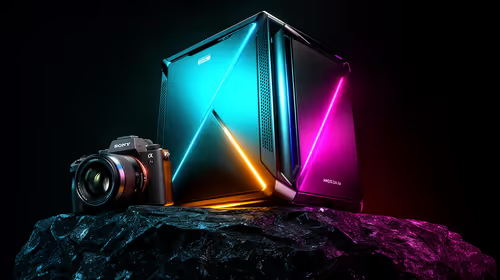
FPS drops on a Ryzen 9 9950X3D build often have a fixable cause. Check settings, drivers, thermals, background tasks, network conditions, and bottlenecks before assuming a part must be replaced.

The difference between PCIe 5.0 and PCIe 4.0 for SA gamers is mostly bandwidth headroom. Compare GPU slot needs, NVMe speed, motherboard support, and upgrade timing before paying extra for a newer platform.

Gaming PC stuck pixel checks in South Africa should confirm the monitor fault first. Use colour tests, screenshot comparison, cable swaps, display menu checks, and clear photos before deciding on support.

AMD's current driver now lists a Radeon RX 9050 4GB, while product coverage details a narrowed memory system. SA buyers should weigh the low VRAM ceiling against current local Radeon options.

Samsung Display has demonstrated a 16-inch 2.5K OLED laptop panel running at 300Hz. SA buyers should wait for a named notebook, full panel specifications and a local price before planning an upgrade.

Microsoft says some Windows 11 game crashes after recent updates are linked to RGB-related drivers. Affected SA gamers should confirm the update and driver before using the published registry workaround.
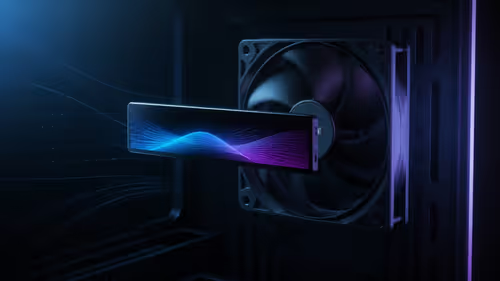
Thermalright's Fan Frame Vision-1 adds a 640x172 status screen to a standard 120mm fan. SA builders should check clearance, USB routing and local support before treating it as an easy upgrade.

Shokz OpenFit Air 2 earbuds weigh 7.2g each and use a redesigned dual-driver open-ear layout. SA buyers should choose them for comfort and awareness, not maximum isolation.

A fake 113GB GTA VI ISO reportedly used empty padding around a small malware payload. SA gamers should delete unofficial builds, keep Windows security active and wait for official channels.
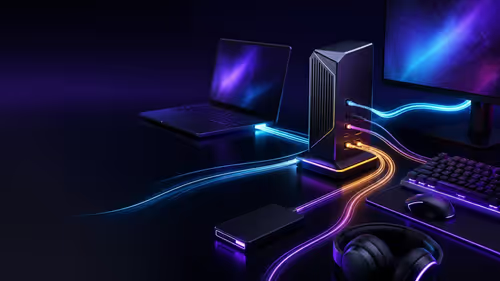
The ROG Flux Charger Dock combines 260W total output, 140W laptop charging and HDMI 2.1. SA buyers should check laptop USB-C limits, display needs and local warranty first.

ASRock's Rock 360 Digital AIO adds a 1.05-inch CPU temperature display, 360mm radiator and simplified wiring. SA builders should check case fit, socket support and local warranty.