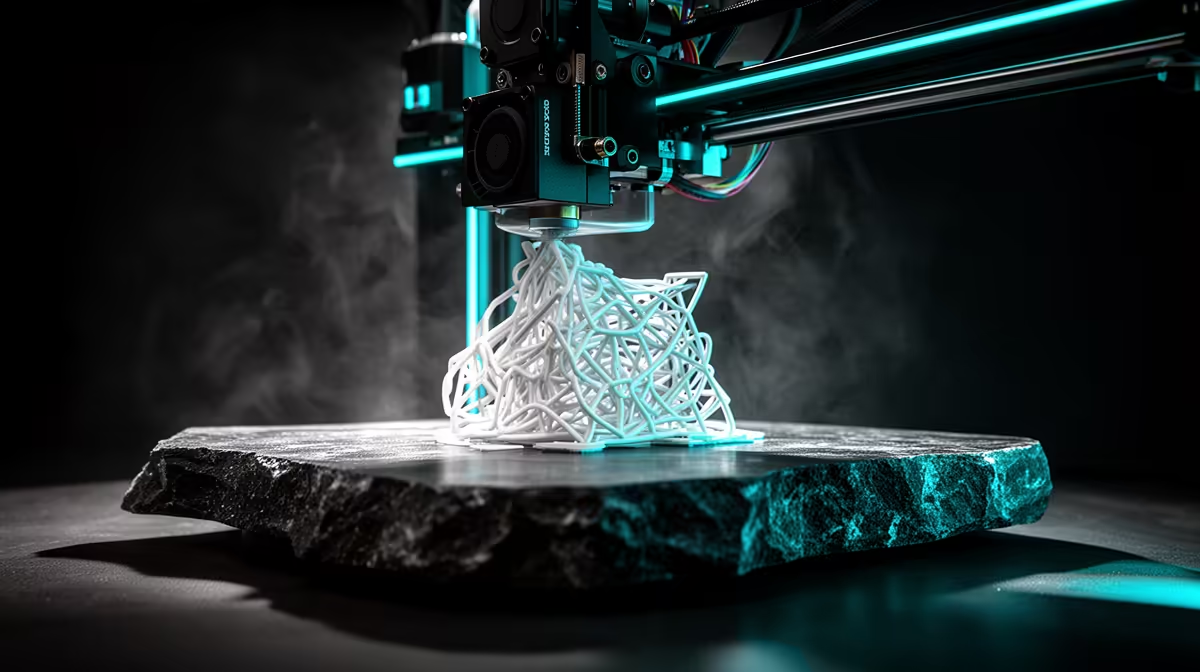
Tall, skinny support columns are the first thing to fail on a finicky print, and supports detaching mid-print and toppling almost always comes down to two things working against you at once: too little grip at the bed and too much vibration at speed. A thin pillar standing 60mm tall has a tiny footprint, so it flexes every time the nozzle whips past, and once it rocks loose the model resting on top collapses with it.
Quick Answer
Add a support brim, push support density to around 20 percent, and drop print speed below 40mm/s for the support sections. The brim widens the contact patch at the bed so the column cannot peel up, and the slower speed cuts the sideways resonance that walks tall supports off the plate.
Why Supports Topple in the First Place
Supports are usually printed thinner and faster than the model, which makes them the weakest part of the whole job. A standalone column has almost no base area touching the build plate, so the same adhesion that holds a wide part down barely registers under a 2mm pillar. Add the rapid direction changes of an outer perimeter and you get a structure that flexes a little more with every pass until a corner lifts. From there it is a domino effect: the lifted support shifts, the overhang it was holding droops into the nozzle path, and the printer keeps extruding into a moving target.
Cooling plays a role too. PLA that is over-cooled on a skinny column stays slightly springy at the join, while an under-cooled tall feature stays soft and sags. Getting the support to stand still long enough to solidify is the real goal.
The Settings That Actually Hold Supports Down
Enable the support brim option in your slicer first. This rings the base of each support tower with extra material, exactly like a brim around a model, and it is the single highest-impact fix because it directly attacks the adhesion problem. Two to four brim lines is usually plenty.
Next, raise support density. Many defaults sit around 15 percent, which leaves wide, flexible gaps. Lifting it to roughly 20 percent stiffens the column so it resists flexing without becoming impossible to remove later. If a support is genuinely tall and thin, a slightly larger trunk or base diameter on tree supports gives it a wider, more planted footing.
Then deal with speed. A first layer printed slowly bonds far better, so keep your initial layer speed conservative and let the bed grab the support. For the tall sections, holding support speed under 40mm/s removes most of the resonance that rocks columns loose. Pair that with good part cooling so each layer firms up before the next one lands.
If columns are still marginal, lower the support Z-distance slightly so the support is better tied to the model above, giving the whole stack more rigidity as it climbs.
SA Practicalities
A clean, level bed matters more than any single setting. Wipe the build surface with isopropyl alcohol to clear skin oils, re-level if your nozzle gap has drifted, and make sure your enclosure or room is not in a draught, since a cold cross-breeze on one side of a tall print causes uneven shrinkage that tugs supports off the plate. A small roll of fresh, dry filament also helps, because moisture-bloated PLA lays down inconsistent thin walls that flex more readily. Most of these consumables, brushes, scrapers and spare nozzles, sit in the accessories best sellers if you need to restock a maintenance kit.
Frequently Asked Questions
Does a support brim make supports harder to remove?
Slightly, but only at the base where the brim rings the column. The brim peels away with the support tower in one piece, so the trade-off is a few extra seconds of cleanup against a print that finishes at all.
What support density should I use for tall thin columns?
Around 20 percent is the sweet spot. Below that the lattice is too open and flexes; much higher and you waste filament and fight to snap the supports off afterwards.
Will slowing the whole print down help?
You mainly need to slow the support sections and the first layer. Slowing everything works but adds a lot of time, so target support speed under 40mm/s and keep your model speed where it already prints cleanly.
My supports lift on one side only. Why?
That is almost always uneven cooling or a draught hitting one edge of the print. Close your enclosure, move the printer out of a breeze, and make sure the bed is level so adhesion is consistent across the footprint.
Can the wrong filament cause toppling supports?
Yes. Damp filament extrudes inconsistently and lays down weak, bubbly thin walls that flex more, so dry your spool and store it sealed if your prints have been getting steadily worse.
Battling supports that will not stay put through a long print? Start with a reliable, well-tuned machine and the right consumables. Browse the 3D printer range at Evetech to find a printer that holds detail on tall, demanding models.