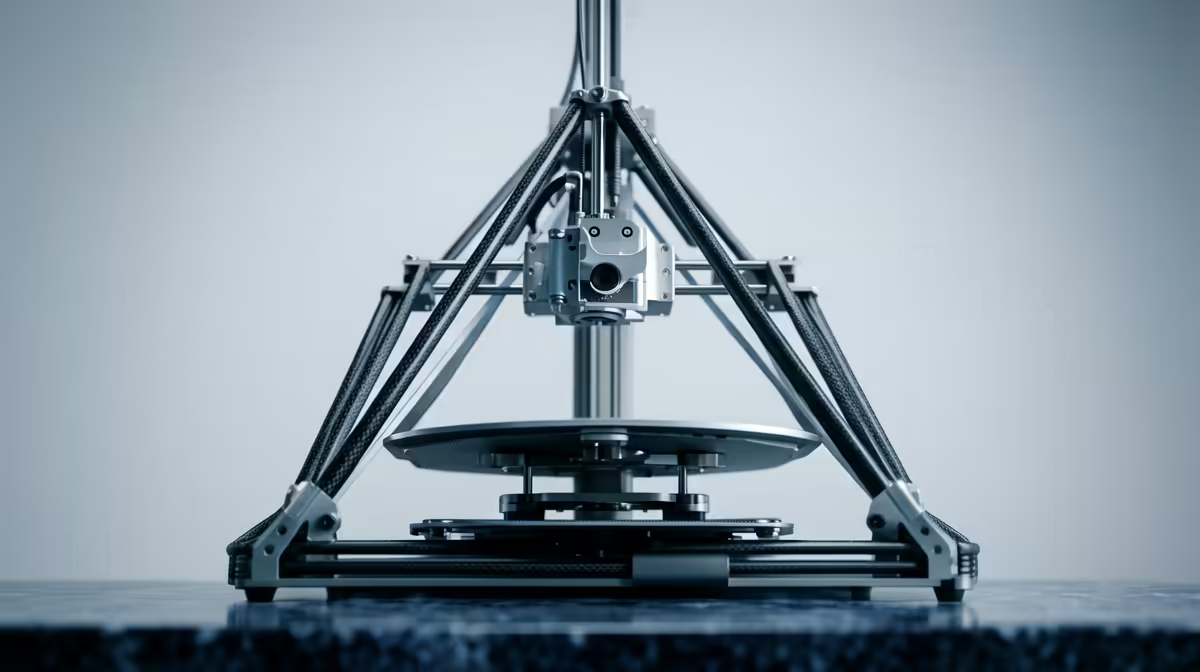
Watch a delta 3D printer run and the first thing you notice is that the bed never moves. Three vertical towers stand around a round build plate, and a small triangular platform called the effector floats between them, carried by six thin arms. The toolhead darts left, right, up and down in quick diagonal sweeps while the print stays dead still beneath it. That stillness is the whole point of the design.
Quick Answer
A delta printer positions its hotend by changing the height of three carriages that slide up and down three fixed towers. Each carriage connects to the effector through a pair of parallelogram-linked rods, so moving the towers in different combinations places the nozzle anywhere over a fixed circular bed. It trades a more complex calibration routine for tall print volumes and very fast, low-inertia toolhead motion.
How the Three Towers Actually Move One Nozzle
On a Cartesian printer, separate motors drive the X, Y and Z axes one at a time, and the bed or gantry physically shifts along each one. A delta works nothing like that. All three towers carry identical carriages, and all three move only vertically. To slide the nozzle to the right, the controller raises one carriage and lowers another by calculated amounts. Every position over the bed is a solved combination of three tower heights, worked out continuously by the printer's firmware using delta kinematics.
Because the carriages move on their own and the heavy stepper motors stay bolted to the frame, the only mass that has to accelerate is the lightweight effector and hotend. Less mass means faster direction changes with less ringing, which is why deltas built up a reputation for speed long before fast Cartesian machines became common.
The Parallelogram Arms And Why They Matter
Each tower connects to the effector with two parallel rods of exactly equal length, fixed at both ends by ball joints. That paired arrangement is a parallelogram linkage, and it does one critical job: it keeps the effector level no matter where it travels. The toolhead never tilts, so the nozzle stays square to the bed across the whole print area.
This is also where calibration discipline comes in. If the three rods on one tower are even slightly unequal, or a tower leans a fraction of a degree off vertical, the maths the firmware relies on stops matching reality. The result is a print that looks bowed or scooped, higher in the middle than at the edges or the reverse. Getting the towers true and the rod lengths matched is the foundation every good delta print sits on.
Tall Volumes And The Round Bed
The fixed circular bed is a natural fit for the geometry, since the reachable area under three evenly spaced towers is round rather than square. What deltas give up in corner-to-corner footprint they often claw back in height. Adding print height on a delta usually just means taller towers, so many delta designs, including the popular Kossel family, are built for slim, tall objects like vases, columns and figurines that a short Cartesian bed struggles with.
If you are weighing a delta against a more conventional machine, browse the current 3D printer range at Evetech to compare build volumes and frame styles side by side. Stocking up on spare nozzles, PTFE tube and a decent set of feeler gauges from the 3D printing accessories shelf before your first calibration session will save a frustrating afternoon later.
Frequently Asked Questions
Is a delta printer harder to calibrate than a Cartesian one?
Generally yes, because all three towers and rod lengths interact in the kinematic maths. A small error on one tower shows up as a curved first layer across the whole bed, so initial setup takes more patience. Once dialled in, though, a delta holds calibration well.
Why do delta printers have a round bed instead of a square one?
The reachable area under three evenly spaced towers is naturally circular. A square bed would leave corners the effector cannot reach cleanly, so designers match the bed shape to the geometry the towers allow.
Are delta printers actually faster than other 3D printers?
The hotend assembly is very light because the motors stay on the frame, so the toolhead accelerates quickly with little ringing. That lets a well-tuned delta run high travel speeds, though final print speed still depends on the hotend's melt rate and your slicer settings.
What is the effector on a delta printer?
The effector is the small platform, usually triangular, that carries the hotend and rides between the three towers. The six arms attach to it, and the parallelogram linkage keeps it level as it moves across the bed.
Can I print tall objects on a delta printer?
Yes, height is a delta strength. Because adding vertical reach mostly means fitting taller towers, many delta machines offer generous Z height, making them well suited to vases, lamps and slim figurines.
Ready to pick a 3D printer that matches the way you like to print? Compare frame styles, build volumes and prices across the full 3D printer range at Evetech and get yours shipped anywhere in South Africa.