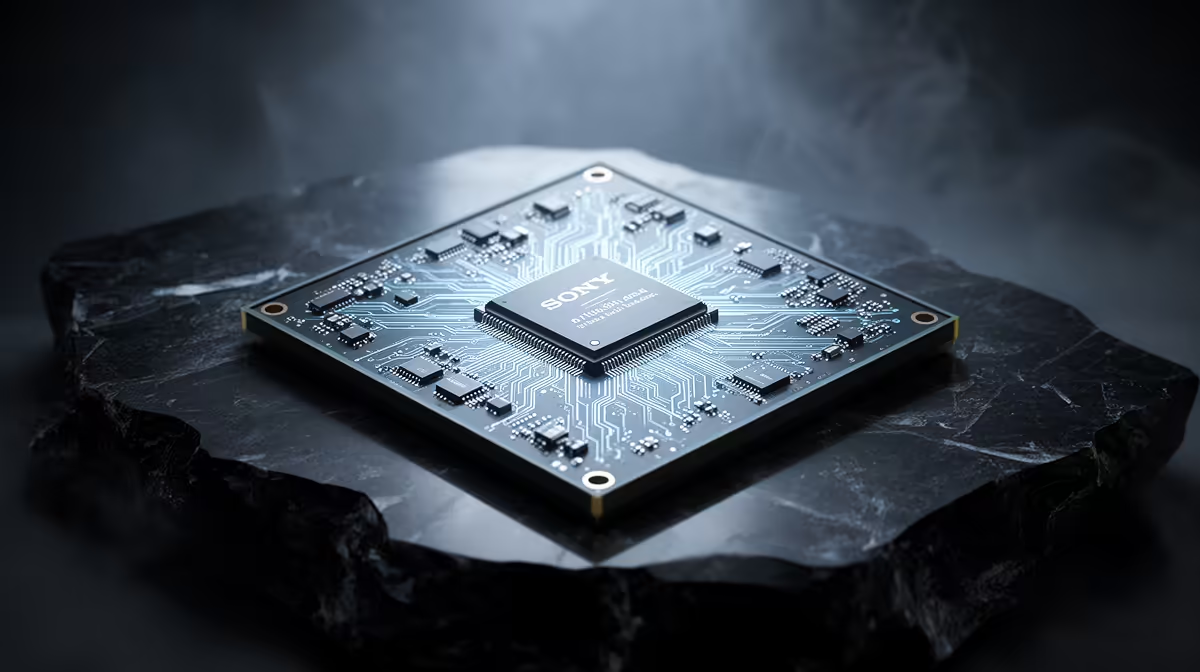
Open a task manager on a recent laptop and you may spot a chip block you never had before, sitting beside the CPU and GPU. That block is the NPU, the neural processing unit, and it exists for one job: running AI maths quickly without draining your battery. As on-device AI features spread across Windows and the apps you already use, the NPU is quietly becoming as standard as the graphics core.
Quick Answer
An NPU is a dedicated hardware accelerator built to handle the matrix maths behind neural networks at very low power. It runs AI tasks directly on your laptop instead of sending them to the cloud, and modern chips from Intel, AMD and Qualcomm now include one as standard.
What an NPU actually does
Neural networks boil down to enormous numbers of small multiply-and-add operations across grids of values. A CPU can do this work but spends a lot of energy doing it serially, and a GPU does it fast but draws heavy power. The NPU is purpose-built for exactly these repetitive matrix calculations, so it finishes the same AI workload using a fraction of the watts. That efficiency is the whole point: it lets features run continuously in the background without flattening your battery or spinning up the fans.
NPU vs GPU vs CPU
Think of it as division of labour. The CPU handles general logic, the GPU handles graphics and large parallel jobs including heavier AI training, and the NPU handles smaller AI inference tasks efficiently while everything else stays free. For local features like live captions, background blur on calls, image cleanup and on-device assistants, the NPU does the work so your GPU stays available for games or rendering. Performance is measured in TOPS, trillions of operations per second, and Microsoft's Copilot+ branding sets a baseline of 40 TOPS for the richest local features.
Why on-device matters in South Africa
Running AI locally means it works without a connection and without sending your data to a server, which matters when data costs money and signal is not guaranteed. A laptop that processes voice or images on its own NPU keeps that work private and instant, with no upload delay. For students, mobile professionals and anyone on metered data, that is a genuine practical advantage rather than a spec-sheet bragging point. You can see which current notebooks and desktops carry capable NPUs on the Evetech AI PC range, and the machines buyers reach for most often appear on the top-selling PCs at Evetech.
Frequently Asked Questions
Do I need an NPU right now?
Not strictly, but it is becoming standard, so a new laptop with one is more future-ready. If you use AI features like live captions, background effects or local assistants regularly, an NPU runs them efficiently without taxing your battery.
How is NPU performance measured?
In TOPS, trillions of operations per second. Microsoft's Copilot+ tier sets a 40 TOPS baseline for the fuller set of local AI features, so that figure is a useful reference when comparing chips.
Can an NPU replace a graphics card?
No. The NPU handles efficient AI inference, while a GPU handles graphics, gaming and heavier AI training. They complement each other rather than compete.
Which chips include an NPU?
Most current laptop platforms from Intel, AMD and Qualcomm now integrate one. The TOPS figure varies between generations, so check the specific chip if local AI performance matters to you.
Want a laptop that handles on-device AI without draining the battery? Browse the AI PC range at Evetech via https://www.evetech.co.za/components/ai-pcs-443 and compare NPU-equipped machines by TOPS.