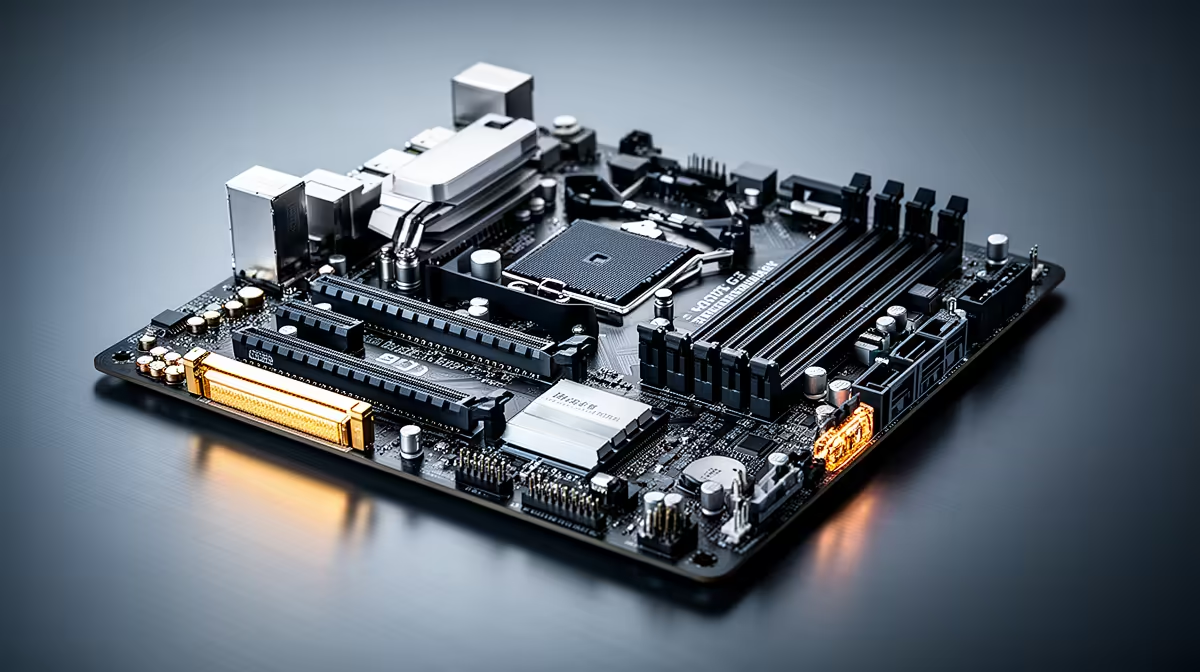
Smaller does not automatically mean weaker, but plenty of builders still assume a compact board is a compromise rather than a deliberate choice. A b860m motherboard built to the same standard as its full-size siblings challenges that assumption directly, once you look past the case dimensions on the box.
Quick Answer
A Micro-ATX B860 board wins when you want a smaller, less expensive build without giving up core gaming features. The ASUS B860M MAX Gaming AX proves this at R4,499, packing PCIe 5.0 graphics support, triple PCIe 5.0 M.2 storage, and DDR5 up to 8666MT/s (OC) into a compact footprint.
📏 When Case Size Should Drive the Decision
If you are building into a smaller desk footprint, a home entertainment unit, or simply want less case to move around, Micro-ATX is the more sensible starting point. The trade-off used to mean losing expansion slots or M.2 count, but that is no longer automatic on current boards.
What You Are Not Giving Up Here
The B860M MAX Gaming AX keeps the same PCIe 5.0 x16 graphics slot, triple M.2 storage, 2.5Gb Ethernet and 20Gbps USB-C with DisplayPort output that you would expect from a same-tier ATX board, just arranged into a smaller board area.
🖥️ When a Full-Size Board Still Makes More Sense
A full ATX board still wins if you need more than three M.2 slots, additional PCIe expansion slots for capture cards or extra networking, or simply want maximum spacing for airflow and cable management in a large tower case.
💸 Value Comparison in the South African Market
In South Africa, where case and component pricing already stretches most gaming budgets, choosing Micro-ATX to save on both the board and a smaller case is a legitimate way to redirect funds towards a GPU or SSD instead. At R4,499, this specific board on Evetech does not ask you to sacrifice PCIe generation or storage flexibility to get that saving.
Anyone comparing sizes and feature sets across the chipset family can look through Evetech's B860 selection, and those open to other Intel chipset generations should browse the general Intel motherboard listing for further options.
Frequently Asked Questions
Does Micro-ATX limit cooling compared to ATX?
It generally means less physical space between components, so airflow planning matters more, though it does not inherently limit cooling performance if the case has decent intake.
Is a Micro-ATX board always cheaper than its ATX equivalent?
Not always, but it is a common way to save money on both the board itself and on case size without dropping core features.
Can I still fit a full-size GPU on a Micro-ATX board?
Yes, the PCIe 5.0 x16 slot accepts standard graphics cards, so GPU size is limited by the case rather than the motherboard's form factor.
When should I choose ATX over Micro-ATX instead?
Choose ATX if you need more than three M.2 slots or additional expansion slots beyond what a Micro-ATX layout typically offers.
Does the smaller board size affect DDR5 memory support?
No, the B860M MAX Gaming AX still supports DDR5 up to 8666MT/s (OC), so memory performance is not reduced by the smaller form factor.
Is Micro-ATX a good choice for a first-time build?
It can be, since the smaller case is often easier to work in for a first build, and this board still includes the tool-free Q-Design features that simplify assembly further.
Ready to see when smaller is the smarter buy?
The ASUS B860M MAX Gaming AX features near our Intel B860 motherboard shelf, set to beat a full-size ATX board on footprint without giving up features.