


650W PSU Planning for RTX 5090 Builds in SA
650W for RTX 5090 needs a full-build check, not a simple yes. Review GPU guidance, CPU draw, transient load, connectors, PSU quality, and upgrade plans before deciding.
Read moreUse NVIDIA Mosaic when a large wall or multi-screen layout needs its supported display-arrangement capability. The R19,599 PNY card adds Genlock and Frame Lock, reaching 32 synchronised displays while keeping the RTX Pro GPU count at eight or below.

NVIDIA Mosaic is useful when a group of screens must operate as an intentionally arranged visual surface. It is not a compulsory upgrade for every multi-monitor desk. The right moment to use NVIDIA Mosaic for large video walls is when the content design explicitly crosses or occupies several displays as one canvas.
Use NVIDIA Mosaic when an installation needs several outputs arranged as one coordinated canvas, with RTX PRO Sync supporting up to 32 displays or projectors.
Use Mosaic when a large wall or multi-screen installation needs its supported display-arrangement capability. The R19,599 PNY RTX Pro Sync card pairs Mosaic with Genlock and Frame Lock, serving up to 32 synchronised displays through no more than eight RTX Pro GPUs.
Draw the content as it should appear across the complete screen field. If imagery, data or presentation regions deliberately span panel boundaries, Mosaic has a clear role. If each monitor remains an independent task area, an extended workspace may be the simpler concept.
Use Evetech's PC monitor selection to compare panels against the planned canvas, audience distance and physical arrangement. Mosaic does not remove bezels or choose mounting geometry.
For this Mosaic decision, Genlock covers the equipment's reference-timing relationship. Frame Lock keeps frame presentation aligned among the graphics processors taking part. Neither is another name for Mosaic, although a professional wall can need all three functions together.
At R19,599, the PNY RTX Pro Sync option includes the full trio. Put canvas arrangement, timing reference and frame coordination on separate lines in the requirement document.
The PNY card can coordinate up to 32 displays in an architecture containing eight NVIDIA RTX Pro GPUs or fewer. Count outputs and processors together; a visually ambitious wall can still have an incomplete graphics allocation.
Compare suitable processors through Evetech's workstation graphics cards page after applications and display groups have been assigned. Do not use the eight-GPU limit as a reason to enlarge the build.
Run content that crosses the full width or height of the planned canvas. Observe panel transitions, important content placement and the GPU boundaries identified on the design. Repeat every mode expected in normal operation.
When the architecture is accepted, choose relevant items in Evetech's graphics card accessories category. Keep the R19,599 synchronization card separate from displays, processors and installation work.
Give designers a canvas template that includes the screen grid and visible panel boundaries. Ask them to preview key frames at the wall's intended aspect and to trace any important moving element across the entire arrangement. The exercise makes Mosaic a production decision rather than a setting discovered at installation.
Prepare fallback layouts for content that should not span bezels. A broad presentation can use the arranged canvas while smaller data views occupy defined regions. Test each approved layout and the transition between them with the same GPU ownership map.
This collaboration also improves later updates. New creative work can be checked against an existing wall template before it enters the commissioning environment, reducing last-minute changes to hardware or screen placement.
The wider system can distribute that surface across eight GPUs and two synchronisation cards. This lets an immersive wall or digital-signage installation scale while retaining a defined display map. Windows 10, Windows 11 and Linux are supported, so the Mosaic plan can sit within different professional software environments. The canvas design should still be validated at its real resolution and content load.
A project needs Mosaic when several displays should form an arranged visual canvas rather than operate only as independent task screens.
No. PNY RTX Pro Sync also includes Genlock for the timing reference and Frame Lock for frame agreement between GPUs.
The architecture reaches 32 synchronised displays and permits up to eight participating RTX Pro GPUs.
No. The content behaviour should decide. Separate windows and tasks may work well without a single arranged canvas.
Send it back whenever panel geometry, audience position or an approved layout changes. Designers should recheck safe zones, important text and motion paths against the revised canvas. This keeps creative work aligned with the physical wall and prevents a late content problem from being misdiagnosed as synchronization trouble. Store the updated template with the corresponding Mosaic mode so the correct version reaches future creators. Retire old templates clearly.
Date the active version for unambiguous handover.
Ready to decide whether the screens should become one canvas? Compare Evetech's professional GPUs and monitors after drawing how content will move across every display boundary.
A project needs Mosaic when several displays should form an arranged visual canvas rather than operate only as independent task screens.
No. PNY RTX Pro Sync also includes Genlock for the timing reference and Frame Lock for frame agreement between GPUs.
The architecture reaches 32 synchronised displays and permits up to eight participating RTX Pro GPUs.
No. The content behaviour should decide. Separate windows and tasks may work well without a single arranged canvas.
Send it back whenever panel geometry, audience position or an approved layout changes. Designers should recheck safe zones, important text and motion paths against the revised canvas. This keeps creative work aligned with the physical wall and prevents a late content problem from being misdiagnosed as synchronization trouble. Store the updated template with the corresponding Mosaic mode so the correct version reaches future creators. Retire old templates clearly. Date the active version for unambiguous handover.
650W for RTX 5090 needs a full-build check, not a simple yes. Review GPU guidance, CPU draw, transient load, connectors, PSU quality, and upgrade plans before deciding.
Read more
How to fix FPS drops Windows 11 RX 9070 XT starts with GPU drivers, overlays, power plans, and frame pacing checks. For SA gaming PCs, verify chipset updates, HAGS, refresh rate, thermals, and per-game graphics settings.
Read more
How to fix FPS drops on X870E motherboard starts with BIOS, chipset drivers, PCIe settings, and memory stability. SA gamers can check EXPO, resize BAR, thermals, display refresh, and background apps before replacing components.
Read more
RTX 5060 is popular with SA students because it can fit gaming, coursework, and creative app needs in one setup. Compare total system price, cooling, RAM, storage, and screen quality before picking a desktop or laptop.
Read more
1440p is the sweet spot for SA gamers because it balances sharp visuals, high frame rates, and GPU cost better than 4K. It is a practical monitor target for players who want smoother upgrades without the heavier hardware demands of 4K.
Read more
RAM pricing for Midrand gamers can shift with exchange rates, supply, specs, and model tier. Treat the title as a buying prompt, then compare SA warranty, timing, and build priorities.
Read more
From 1 October 2026, WhatsApp Business Platform service replies in South Africa are expected to cost about $0.0076, or 12 cents, per delivered message.
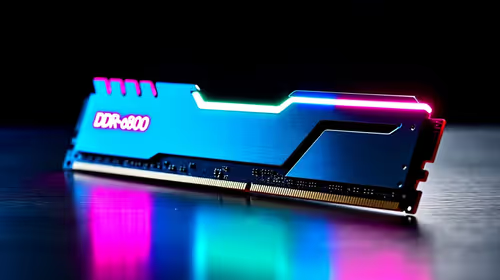
DDR5-8000 RAM Kits pros and cons depend on the build, budget, and workload. Weigh gaming needs, platform fit, power, cooling, warranty support, and South African pricing context before shortlisting it.
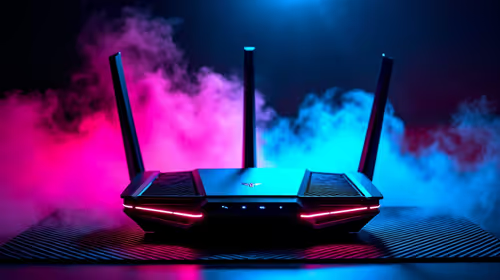
Wi-Fi 6E vs Wi-Fi 6 depends on AAA single-player gaming needs, platform limits, and budget fit. Compare compatibility, latency, upgrade path, and real setup constraints before choosing for an SA build.

Ryzen 9 9950X3D dead pixel checks should isolate the panel first. Run colour fills, inspect the monitor menu, test another cable or input, and capture proof before linking it to the SA CPU upgrade.
YouTube will count public views from the first frame across video formats from 24 August, while earnings and eligibility remain tied to engaged viewing.
Canonical expects Ubuntu on WSL users to outnumber native Ubuntu desktop users before the end of 2026. The software is open source and runs inside supported Windows PCs.
Telkom's daily bundles pair WhatsApp access with 10 all-network voice minutes. The R15 option includes 300MB, while the R17 option uses a fair-use threshold.
A 10,000-hour test found similar image retention across older and newer OLED TVs, while newer panels were brighter and more efficient. Local OLED monitors started at R9,999.

Windows 11 update KB5121003 is linked to crashes in several multiplayer games on versions 24H2 and 25H2. Check the build, report the fault and avoid risky file or update changes unless the problem is confirmed on your PC.

Comsol's standalone 5G network covers about one million Gauteng homes and starts commercial ISP service in September. Early packages range from R275 to R875 a month, but coverage and fair-use rules still decide the real value.

Sennheiser's Momentum True Wireless 5 adds user-replaceable batteries, 12-hour playback and a $299.95 launch price. There is no confirmed South African date, so compare longevity with live earbuds from R199 to R2,999.

AVerMedia's GC531 and GC535 are professional HDMI capture devices for continuous streaming, with RGB24 capture up to 2K30 and 4K30. South African creators should compare them with live 4K capture cards from R2,099.