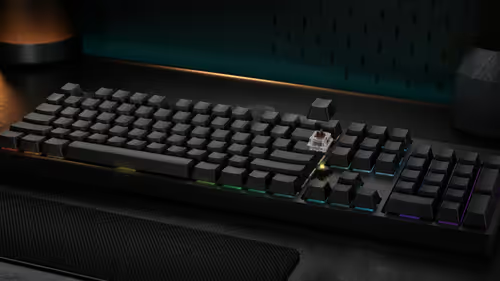
Maximum-rate troubleshooting works best when the wired path is checked before unrelated settings. An 8 kHz keyboard report-rate problem on the Logitech G316 X should be narrowed through one controlled change at a time. The board supports 8 kHz and costs R1,599, but no exact control menu should be assumed.
Quick Answer
Use the G316 X dial and dot-matrix display to select its 8kHz rate, then keep the wired USB-A connection and host conditions stable.
Check the G316 X cable and host port, wait for the installed G HUB version to recognise the board, then use its model instructions to verify 8 kHz operation. Restore the baseline before every new test. Reaching the rate confirms configuration, not a measured latency gain.
🧭 Rebuild the simplest wired path
Connect the keyboard directly through the intended cable path and keep it on one known host port. Remove unnecessary changes from the troubleshooting session. Moving the board among ports while reinstalling software and altering lighting makes it impossible to identify which action restored or disrupted reporting.
Prove ordinary key input in plain text before inspecting the maximum state. Resolve any basic instability first. Because the G316 X connects by wire, exclude pairing, battery condition and radio modes from this diagnosis.
Write a baseline note before opening software: host port, application used for the input check, lighting state and whether the keyboard survived a reconnect. Repeat that same baseline after every troubleshooting action. A result that appears only once is a clue, not a fix. The record also prevents an accidental port change or unrelated profile edit from being credited with restoring maximum reporting.
Close and reopen the test application after a successful result, then repeat the same input sequence. Persistence matters more than a single promising reading.
Save the final working state in the troubleshooting note.
Compare exact wired models in Evetech's Logitech gaming-keyboard range with their own report figures and operating guidance. Do not transfer another keyboard's menu or connection procedure to the G316 X.
🧭 Verify software recognition without guessing the control path
Use the installed G HUB version to confirm that the correct keyboard appears. It also controls dynamic Lightsync RGB, which should remain unchanged during this rate check. Locate the supported verification method through the model instructions rather than expecting a familiar software screen.
Change one software condition, test and record the result. Keep RGB effects stable during the reporting check unless a reproducible diagnosis shows a relationship. Disabling lighting by habit may appear to fix the problem while leaving the actual cause unknown.
Include the successful port and installed software version in the final note so another user can reproduce the state.
🧭 Confirm stability with a repeatable input sequence
Once 8 kHz is verified, run the same short input drill several times under a stable application and host state. Note whether the operating state persists after a restart. A reproducible configuration is more useful than a single reading that disappears when the software or port changes.
Keep latency language precise. The report rate is one part of the path from switch to screen. Computer processing, software, game behaviour and display output continue after the keyboard report, so successful 8 kHz operation cannot prove a particular end-to-end improvement.
Use Evetech's gaming-keyboard category to compare stable alternatives if the issue remains unresolved. Preserve the R1,599 price, wired connection and actual diagnostic result rather than declaring hardware failure from one missing setting.
The board supports Windows 10 or later and macOS 12 or later through a 1.8m cable. If the displayed rate will not hold, troubleshoot the port, G HUB recognition and competing settings one at a time before changing games or other devices.
Record the displayed rate after every successful change so later troubleshooting starts from a known state.

Frequently Asked Questions
What maximum report rate applies to the G316 X?
The wired keyboard supports an 8 kHz report rate. Confirm its active operating state through the exact model guidance.
Which connection should be checked first?
Check the cable path and intended host port, then confirm ordinary key input. Keep that baseline fixed while testing later software conditions.
How does G HUB enter the troubleshooting process?
G HUB powers the software experience and should recognise the keyboard. Do not assume a specific menu controls 8 kHz unless the current model instructions show it.
Can a report-rate problem prove hardware failure?
No. Connection, software recognition and configuration can also cause a missing rate. Isolate those factors before reaching a hardware conclusion.
Does reaching 8 kHz confirm a latency gain?
No. It confirms the reporting state. End-to-end latency includes other system stages and requires suitable measurement for a numerical claim.
Ready to troubleshoot reporting methodically?
Browse Evetech wired keyboards with the port, software state and repeatable input check recorded.