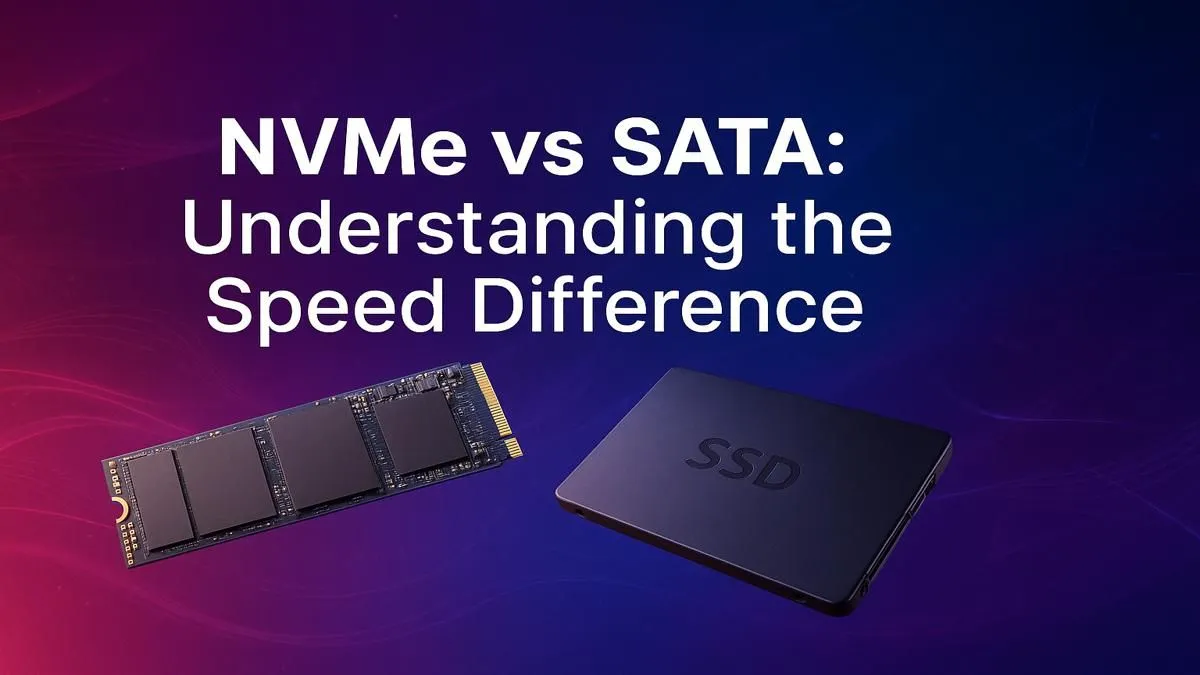
Staring at another loading screen in Apex Legends, wondering if you could have made a cup of coffee in the time it took to drop? We've all been there. That sluggish feeling often comes down to your storage. The big question for any PC builder in South Africa is the classic showdown: NVMe vs SATA. Which SSD is actually faster for your rig, and which one gives you the best bang for your buck? Let's settle the debate.
What's the Real Difference Between NVMe and SATA SSDs?
At a glance, both are Solid-State Drives, meaning they're leagues faster than old-school mechanical hard drives. But how they talk to your PC is worlds apart, and that's the key to understanding the NVMe vs SATA performance gap.
The Old Faithful: SATA III
SATA (Serial ATA) is the veteran technology. For years, it has been the standard connector for storage drives. Most traditional 2.5-inch SATA SSDs use this interface, which was originally designed for spinning hard drives. Think of it as a reliable single-lane road... it gets the job done, but traffic can build up. SATA III, the most common version, maxes out at a theoretical speed of around 600MB/s. It's a massive upgrade from a hard drive, but it's hitting its ceiling.
The Speed Demon: NVMe ⚡
NVMe (Non-Volatile Memory Express) is the new-school champion, built from the ground up for modern SSDs. Instead of the old SATA road, NVMe uses the super-fast PCIe bus—the same multi-lane highway your graphics card uses to talk directly to the CPU. This direct line of communication cuts out the middleman, drastically reducing latency and unlocking insane speeds. When you see those small, gumstick-sized M.2 drives, you're likely looking at one of these blazing-fast NVMe SSDs.
NVMe vs SATA: The Speed Showdown 🚀
So, how much faster are we talking? The difference isn't just a number on a box; it's something you can feel every time you boot up your PC or load a new game level.
A typical SATA III SSD will give you sequential read/write speeds of around 550MB/s. That's snappy, and for a while, it felt like the pinnacle of performance.
An entry-level PCIe 3.0 NVMe SSD, however, starts at around 2,500MB/s and can easily reach 3,500MB/s. Newer PCIe 4.0 drives can blast past 7,000MB/s, with the latest PCIe 5.0 models pushing even further. That’s over 12 times faster than a SATA SSD. This means your operating system boots in seconds, massive files transfer in a flash, and games like Starfield or Baldur's Gate 3 load their worlds almost instantly.
Check Your Motherboard First! 🔧
Before you rush to buy a new NVMe drive, check your motherboard's manual online. You need a dedicated "M.2 slot" that supports "PCIe" or "NVMe" mode. Some older or budget boards have M.2 slots that only run at SATA speeds, which would create a serious bottleneck and waste your money.
So, Which SSD is Right for Your Rig?
The "best" drive really depends on your specific needs and budget. The NVMe vs SATA debate isn't about one being "bad," but about choosing the right tool for the job.
- Go for NVMe if... It's for your primary Windows installation, your most-played competitive games, or demanding creative work like video editing. The responsiveness and reduced loading times are undeniable. The price gap has shrunk significantly, making NVMe the top choice for most new builds in South Africa.
- Stick with SATA if... You're on a tighter budget, upgrading an older PC without an M.2 slot, or you just need a massive, affordable drive for your secondary game library or media storage. A 1TB or 2TB SATA SSD is still a fantastic, cost-effective upgrade over any mechanical hard drive.
Ultimately, the best setup often involves both. Use a speedy NVMe drive for your OS and favourite applications, and a larger, cheaper SATA SSD for everything else. You can explore Evetech's complete range of SSDs to find the perfect combination for your needs. ✨
Find Your Perfect SSD Speed Boost
Ready to slash your loading times and make your PC feel brand new? Check out our latest specials on a massive range of SSDs. Shop the best SSD deals in South Africa for performance that leaves lag in the dust.