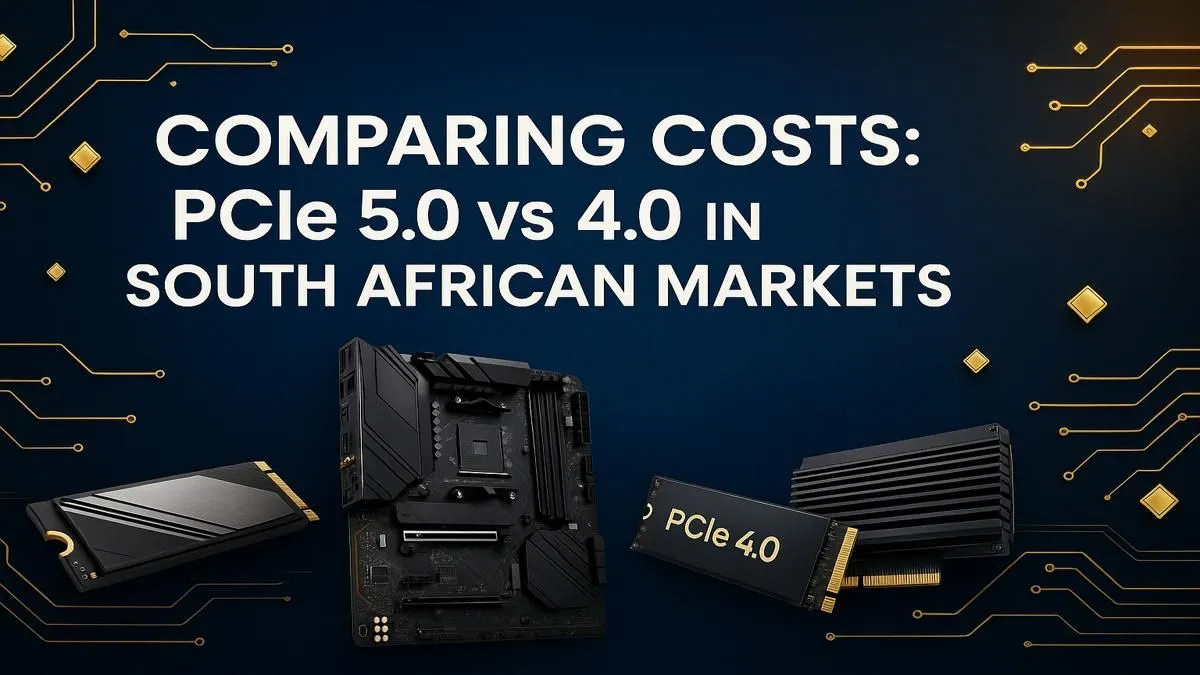
Building a new PC in South Africa and staring at motherboard specs? The 'PCIe 5.0' label screams future-proof power, but the price tag often screams... ouch. 💰 So, let's cut through the hype. When you look at the PCIe 5.0 vs 4.0 price in South Africa, is the performance leap actually worth your hard-earned Rands for gaming and everyday use? Or is it an expensive feature you won't even notice? Let's find out.
Understanding the PCIe 5.0 vs 4.0 Speed Difference
Before we talk price, let's quickly get what we're dealing with. Think of PCIe (Peripheral Component Interconnect Express) as the super-highway inside your PC. It connects your most important components—like your graphics card and SSD—to your motherboard and CPU. The version number simply tells you how many lanes the highway has, or how fast the traffic can move.
- PCIe 4.0: Delivers a maximum bandwidth of ~64 GB/s on a full x16 slot.
- PCIe 5.0: Doubles that, pushing the theoretical maximum to a massive ~128 GB/s on an x16 slot.
On paper, that jump is huge. But does it translate to real-world performance you can actually feel, especially in Mzansi where every component rand counts?
Does a PCIe 5.0 GPU Make a Difference in Gaming?
For most South African gamers, this is the main question. The short answer? Not really, at least not yet. 🚀
Even the most powerful graphics cards on the market today, like the NVIDIA GeForce RTX 4090, don't fully saturate a PCIe 4.0 x16 slot. When tested side-by-side, the performance difference between running a top-tier GPU on a PCIe 4.0 vs 5.0 slot is often less than 1-2%. That's a margin of error you'll never notice in the middle of a heated Warzone match.
This means you can confidently pair a high-end graphics card with a more affordable PCIe 4.0 motherboard and lose virtually no performance. It's a smart way to allocate your budget towards things that make a bigger impact, like a faster CPU or more RAM. You can find excellent value across a wide range of cheap Intel and AMD based motherboards that deliver all the gaming performance you need.
Where PCIe 5.0 Shines: Next-Gen NVMe SSDs
So if it's not for graphics cards, where is the PCIe 5.0 speed useful? The answer lies with next-generation NVMe SSDs. These storage drives are unbelievably fast, with read/write speeds exceeding 10,000 MB/s.
For a video editor working with 8K RAW footage or a 3D artist rendering complex scenes, these speeds can dramatically cut down project times. For them, the investment in a compatible AMD motherboard and a Gen5 drive could pay for itself in productivity gains. For gamers, however, the benefit is less pronounced. While game loading times are faster, the jump from a fast Gen4 SSD to a Gen5 SSD is far less noticeable than the jump from an old hard drive to any SSD.
Check Your M.2 Slots! 🔧
Not all M.2 slots on a motherboard are created equal. When buying a new board, check the spec sheet on the product page. Some boards offer one PCIe 5.0 M.2 slot for a super-fast OS drive, while the others might be PCIe 4.0. This can be a great compromise, giving you a taste of the future without the cost of a fully-kitted 5.0 board.
Analysing the PCIe 5.0 vs 4.0 Price in South Africa
This is where the decision becomes clear for most people. In South Africa, the "early adopter tax" for PCIe 5.0 is significant. Motherboards equipped with PCIe 5.0 slots and the necessary beefier power delivery systems often cost thousands of Rands more than their high-quality PCIe 4.0 counterparts.
For example, a premium Z790 board with PCIe 5.0 support can easily cost double what a very capable B760 board with PCIe 4.0 costs. That price difference could be used to upgrade your Core i5 to a Core i7, or get you a significantly better graphics card. When considering your options, it's always worth browsing the latest Intel motherboards to see where the sweet spot of price and performance lies for your build.
The Verdict: Is a PCIe 5.0 Upgrade Worth It Today? ✨
So, let's circle back to our original question about the PCIe 5.0 vs 4.0 price in South Africa.
- For the vast majority of gamers and PC users: No. A PCIe 5.0 upgrade is not worth the significant extra cost in 2024. The performance gains in gaming are negligible, and the money is far better spent on components that will give you a tangible boost, like your GPU or CPU.
- For elite content creators, data scientists, or future-proofers with a big budget: Maybe. If your daily work involves transferring massive files and every second counts, the speed of a Gen5 NVMe SSD can be a powerful tool. If you're building a top-of-the-line rig and want it to be ready for whatever comes next, it's a valid choice... if you're willing to pay the premium.
For now, PCIe 4.0 remains the king of value, offering more than enough bandwidth for today's most demanding games and applications.
Ready to Build Your Next-Gen Rig?
The choice between PCIe 5.0 and 4.0 depends on your budget and needs. For the best value and performance in South Africa, a well-chosen motherboard is key. Explore our massive range of motherboards and find the perfect foundation for your dream PC.