You’ve done it. After weeks of saving and watching reviews, you’ve finally installed that beastly new graphics card. You boot up your favourite game, ready for glorious high-frame-rate action… but what’s that noise? Suddenly, your PC sounds less like a high-tech machine and more like a small jet preparing for takeoff. ✈️
Don't worry, you're not alone. Upgrades often introduce new cooling demands. This guide will walk you through creating the quiet gaming PC of your dreams.
Pinpointing the Noise: Who's the Loudest in the Room?
Before you can fix the problem, you need to find the source. The main culprits behind a loud gaming rig are almost always fans. Your mission, should you choose to accept it, is to carefully listen and identify which component is making a racket under load.
- CPU Cooler Fan: Often a high-pitched whir that ramps up when you're running demanding tasks.
- GPU Fans: These usually only spin up during gaming and can be the loudest part of your system.
- Case Fans: A constant, low hum that gets louder as internal temperatures rise.
- PSU Fan: The power supply has its own fan, which can become noisy on older or cheaper units.
A simple way to test is to (carefully!) use software to control fan speeds individually, helping you isolate the noisy offender.
Taming the Beast: Core Components for a Quiet Gaming PC
Achieving a silent build is all about smart component choices and optimisation. It’s a balancing act between cooling performance and acoustics.
The CPU Cooler: Your First Line of Defence 💨
The stock cooler that came with your processor is designed to be just "good enough." When you upgrade to a more powerful CPU processor, that stock cooler has to work overtime, creating a lot of noise.
Investing in a quality aftermarket air cooler with a large heatsink and a 120mm or 140mm fan is one of the best upgrades for reducing PC noise. Larger fans can spin slower while moving the same amount of air, resulting in a much quieter operation. For top-tier performance and near-silence, an All-in-One (AIO) liquid cooler is an excellent choice.
Master Your Fan Curves 🔧
Most modern motherboards let you customise fan curves in the BIOS or via desktop software. Instead of letting your fans jump from 0 to 100% instantly, create a gradual curve. This allows the fans to ramp up smoothly as temperatures rise, preventing those sudden, distracting bursts of noise during gameplay. A slow, steady airflow is much less noticeable.
Graphics Card Acoustics
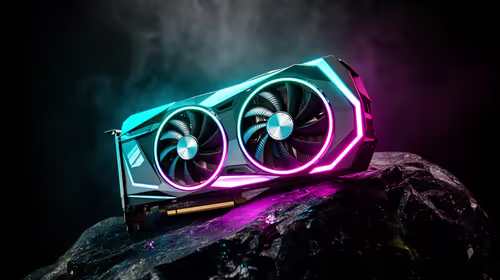
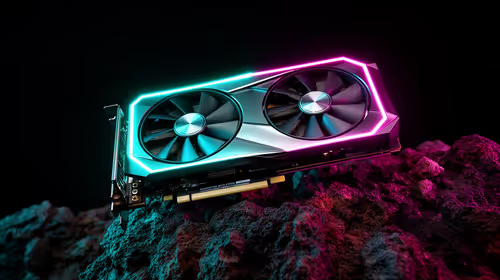
Thankfully, most modern graphics cards come with a "zero RPM" mode. This means the fans don't spin at all when you're just browsing the web or watching videos, ensuring total silence. They only kick in when the GPU hits a certain temperature during gaming.
The key to keeping them quiet during gaming is excellent case airflow. If your case traps hot air, the GPU has to spin its fans faster and louder to compensate.
Building Silence from the Ground Up
If you're starting a new build or considering a major overhaul, the chassis itself plays a massive role in creating a quiet gaming PC. Look for cases with features like sound-dampening foam on the panels and solid front panels (with good side ventilation for airflow).
This is where planning ahead makes a huge difference. Starting your journey with a solid foundation, like a well-chosen Intel barebone kit or a powerful AMD barebone bundle, often sets you up with a case and motherboard combination that's already geared for efficient and quiet cooling. ✨
Ultimately, reducing noise after upgrades isn't about eliminating fans… it's about making them work smarter, not harder. With the right cooler, good airflow, and a little tweaking, you can have a rig that's both powerful and wonderfully discreet.
Ready to Build Your Silent Rig? A powerful gaming PC doesn't have to sound like a jet engine. Armed with the right knowledge, you can build a beast that whispers. Explore our wide range of PC components and start piecing together your dream quiet gaming PC today.