Keen to run powerful AI like DeepSeek locally on your own rig? You're not alone. South African builders are diving into local AI, but the big question remains: which CPU gets the job done without breaking the bank? Choosing the best CPU for DeepSeek isn't just about specs… it's about matching the right silicon to your ambition. Let's break down the Intel vs. AMD showdown for your next AI build. 🚀
Why Your CPU Choice Matters for DeepSeek
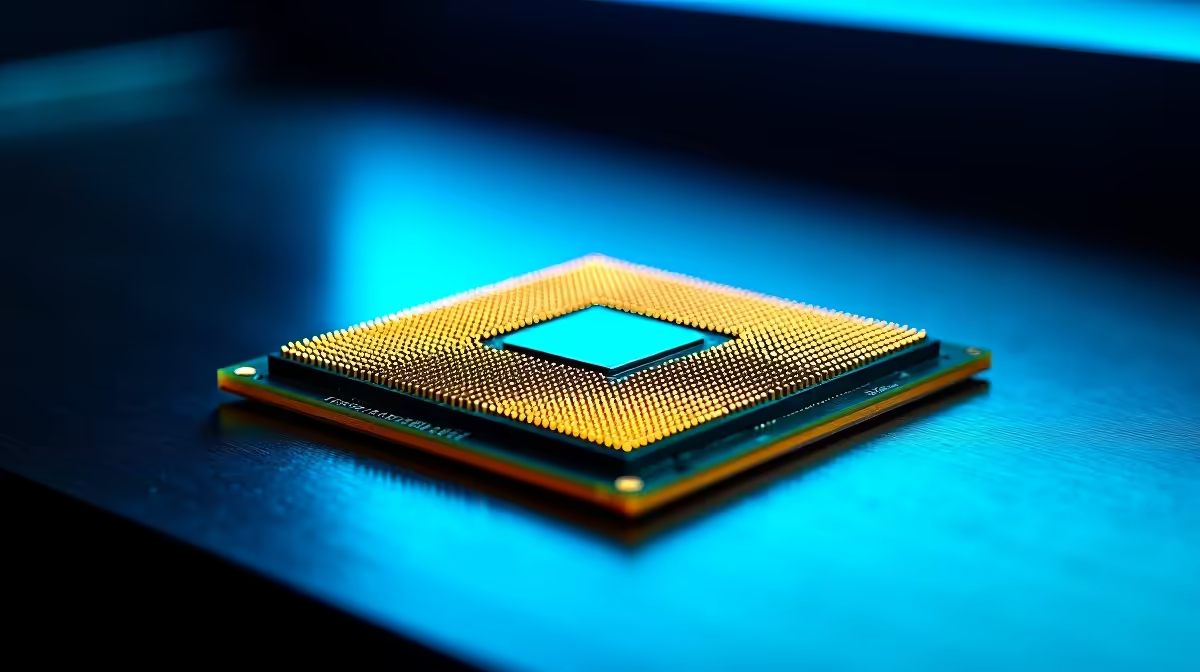
Before we dive into the Intel vs. AMD debate, let's clear something up. While a powerful GPU does the heavy lifting for training AI models, your Central Processing Unit (CPU) is the unsung hero for running models like DeepSeek locally. It manages data pipelines, handles complex instructions, and keeps the entire system responsive. A weak CPU will bottleneck even the mightiest GPU, leading to frustrating lag and slow performance.
Finding the best CPU for DeepSeek means looking beyond just clock speeds. You need to consider core counts, thread performance, and how the architecture handles the specific parallel tasks that AI workloads demand.
Intel vs. AMD: The Core Battle for AI Supremacy
For years, the Team Blue vs. Team Red rivalry has driven innovation. When it comes to AI, both camps bring serious firepower to the table, but they do it in slightly different ways.
Team Blue: Intel's All-Rounder Prowess
Intel CPUs, especially the Core i7 and i9 series, are renowned for their incredible single-core performance. This raw speed is fantastic for overall system snappiness and tasks that can't be easily split across multiple cores. For a machine that will pull double duty as your daily driver and AI experimentation box, Intel is a formidable choice. Their combination of Performance-cores (P-cores) and Efficient-cores (E-cores) provides a balanced approach to handling background tasks while you focus on coding or model inference.
This balance makes them the heart of many versatile and powerful NVIDIA GeForce gaming PCs, which are increasingly being used for both gaming and AI development.
Team Red: AMD's Multi-Core Might
When it comes to raw multi-threaded muscle, AMD's Ryzen 7 and Ryzen 9 processors are often the top contenders. They typically pack more cores and threads at competitive price points, which is a massive advantage for the highly parallelised nature of AI workloads. Running multiple processes, compiling code, and processing large datasets all benefit hugely from having more cores.
If your primary goal is to build a machine that chews through AI tasks efficiently, AMD's core-heavy approach offers incredible value. It's no surprise that many high-performance AMD Radeon gaming PCs are built around a Ryzen CPU, offering a fantastic platform for both work and play.
Don't Forget the RAM! ⚡
Your CPU needs data, and it needs it fast. When running large language models like DeepSeek, system memory is critical. Aim for a minimum of 32GB of fast DDR5 RAM to avoid bottlenecks. For more intensive work, 64GB is becoming the new standard, ensuring your processor isn't left waiting for data to load from your storage drive.
Picking the Best CPU for DeepSeek in South Africa
So, what's the final verdict for a South African builder? It comes down to your primary use case and budget.
The Balanced Build: Great for Gaming & AI
If you want a do-it-all machine, an Intel Core i5-14600K or an AMD Ryzen 7 7700X offers a fantastic blend of single-core speed and multi-core capability. You'll get excellent gaming frame rates and have more than enough power to run DeepSeek and other models smoothly. This is the sweet spot for most enthusiasts.
The AI-Focused Powerhouse: Maximum Performance
For those who are serious about local AI and want to minimise processing time, the best CPU for DeepSeek will be a multi-core monster. The AMD Ryzen 9 7950X with its 16 cores or the Intel Core i9-14900K with its high core count and blistering clock speeds are the top dogs. These processors will tear through any task you throw at them.
For professionals whose work depends on this power, a dedicated system is often the smartest investment. Purpose-built Workstation PCs are optimised for stability and sustained performance under heavy, continuous loads, making them ideal for serious AI development. ✨
Ultimately, both Intel and AMD offer fantastic options. Your choice will shape your PC's character: Intel for balanced, high-speed versatility, and AMD for raw, multi-threaded productivity.
Ready to Build Your AI Powerhouse? The Intel vs. AMD debate is fierce, but the best CPU for DeepSeek is the one that fits your budget and ambition. Whether you need a multi-core monster or a balanced all-rounder, we've got the heart of your next build waiting for you. Explore our massive range of Intel and AMD CPUs and find the perfect match for your machine.