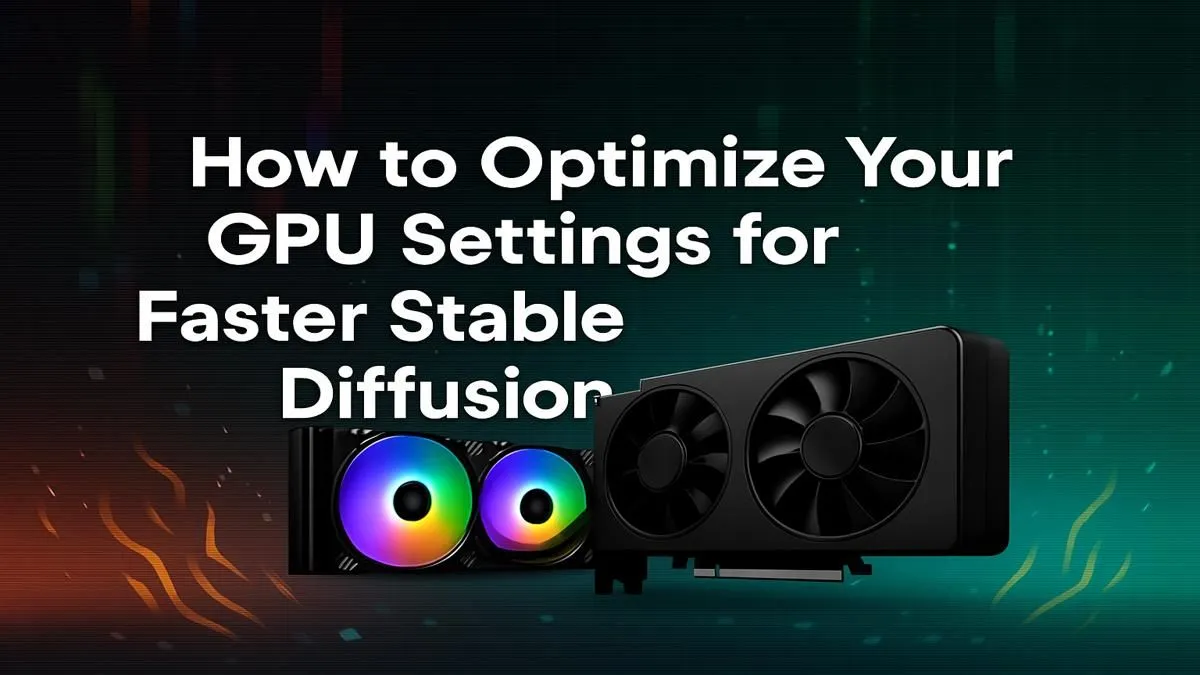
So, you’ve dived into the incredible world of AI art with Stable Diffusion, ready to create mind-bending visuals... only to find yourself staring at a progress bar that moves slower than Cape Town traffic on a Friday. We get it. That frustrating wait-time is almost always down to one component: your graphics card. This guide is your key to unlock lightning-fast image generation. Let's show you how to properly optimise your GPU for Stable Diffusion. 🚀
Why GPU Performance is Crucial for Stable Diffusion
Before we dive into the tweaks, let's quickly understand why your GPU is the star of the show. Stable Diffusion works by performing millions of complex calculations to turn text prompts into images. This process heavily relies on parallel processing—something graphics cards are brilliant at.
The two most important factors are:
- VRAM (Video RAM): Think of this as your digital canvas. More VRAM allows you to generate larger images at higher resolutions and process bigger batches without your system grinding to a halt. 8GB of VRAM is a decent starting point, but 12GB or more is ideal.
- Processing Cores (CUDA/Stream Processors): These are the workhorses. The more cores you have, the faster your GPU can perform the necessary calculations, drastically cutting down your image generation time.
The Hardware Foundation: Choosing the Right GPU
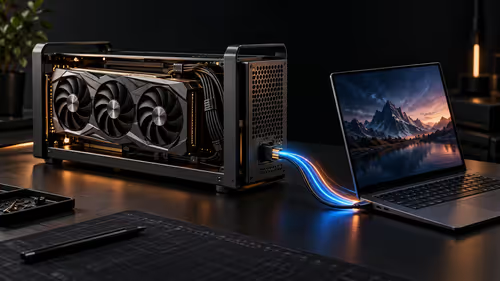
Software tweaks can only get you so far. The biggest performance leap comes from having the right hardware from the get-go. To truly optimise your GPU for Stable Diffusion, you need a card that's up to the task.
NVIDIA: The CUDA Kings
For the best out-of-the-box experience, NVIDIA is currently the top choice. Its CUDA architecture is the industry standard for machine learning and AI tasks, meaning most tools, including Stable Diffusion, are heavily optimised for it. An NVIDIA GeForce RTX card, especially from the 30-series or 40-series, will give you fantastic performance.
AMD: The High-Value Contenders
Don't count out Team Red. While NVIDIA has historically held the lead in AI, AMD has made huge strides. With technologies like ROCm, many Stable Diffusion interfaces now run smoothly on Radeon cards. If you're looking for incredible performance-for-your-Rand, a modern AMD Radeon GPU is a powerful and increasingly viable option for AI enthusiasts.
Professional-Grade Power
For those running AI models commercially or working with enormous datasets, a consumer card might not be enough. This is where workstation graphics cards come in, offering massive VRAM pools and drivers certified for stability under extreme, continuous workloads.
Ultimately, the best card balances your budget with your creative ambitions. Comparing the latest graphics cards is the best way to see what VRAM and power you can get for your money.
Software Tweaks to Supercharge Your Renders 🔧
Got your hardware sorted? Brilliant. Now let's fine-tune the software settings. These adjustments can dramatically improve speed and efficiency, giving you a much smoother creative workflow.
1. Keep Your Drivers Updated
This is the simplest yet most important step. Both NVIDIA and AMD regularly release driver updates that include performance improvements and bug fixes for AI and machine-learning applications. Always ensure you're running the latest version for your card.
The XFormers Speed Boost ⚡
For NVIDIA users, enabling 'xFormers' is one of the most effective optimisations. It's a memory-efficient attention mechanism that can speed up image generation by a significant margin and lower VRAM usage. In many popular Stable Diffusion UIs like AUTOMATIC1111, you can enable it by adding the --xformers command line argument to your launch file. It’s a must-try!
2. Optimise Your Generation Settings
Not all settings are created equal. For faster renders, consider the following:
- Sampler: Use faster samplers like
Euler aorDPM++ 2M Karras. - Steps: More steps don't always mean a better image. You can often get excellent results with just 20-25 steps, saving a lot of time compared to 50 or more.
- Resolution: Start with a standard resolution like 512x512 or 768x768. You can always use AI upscalers later to increase the image size without the initial rendering overhead.
By combining a capable GPU with these smart software tweaks, you'll spend less time waiting and more time creating. The goal of GPU optimization for Stable Diffusion is to find that perfect balance between speed, quality, and your hardware's capabilities. Happy generating! ✨
Ready to Unleash Your AI Creativity? A powerful GPU is the heart of any AI or gaming rig. If your current card is holding you back, an upgrade is the single biggest performance boost you can make. Explore our incredible PC component specials and find the perfect hardware to bring your ideas to life instantly.