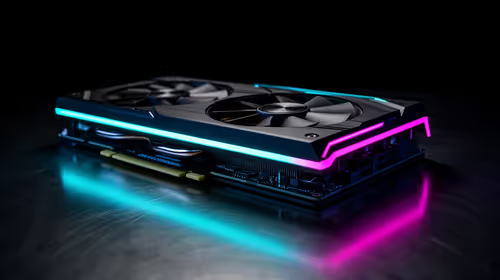
So you’ve just dropped a serious amount of cash on a shiny new graphics card. Awesome! But before you crank every setting to ultra, there’s a crucial question: is your motherboard up to the task? Pairing a beastly GPU with an old or mismatched motherboard is like putting retreads on a Ferrari. You’re just creating a bottleneck. This guide will help you find the best motherboard for your gaming GPU, ensuring every single rand you spent translates into pure performance. 🚀
Beyond the CPU Socket: Why Your Motherboard is Key for GPU Performance
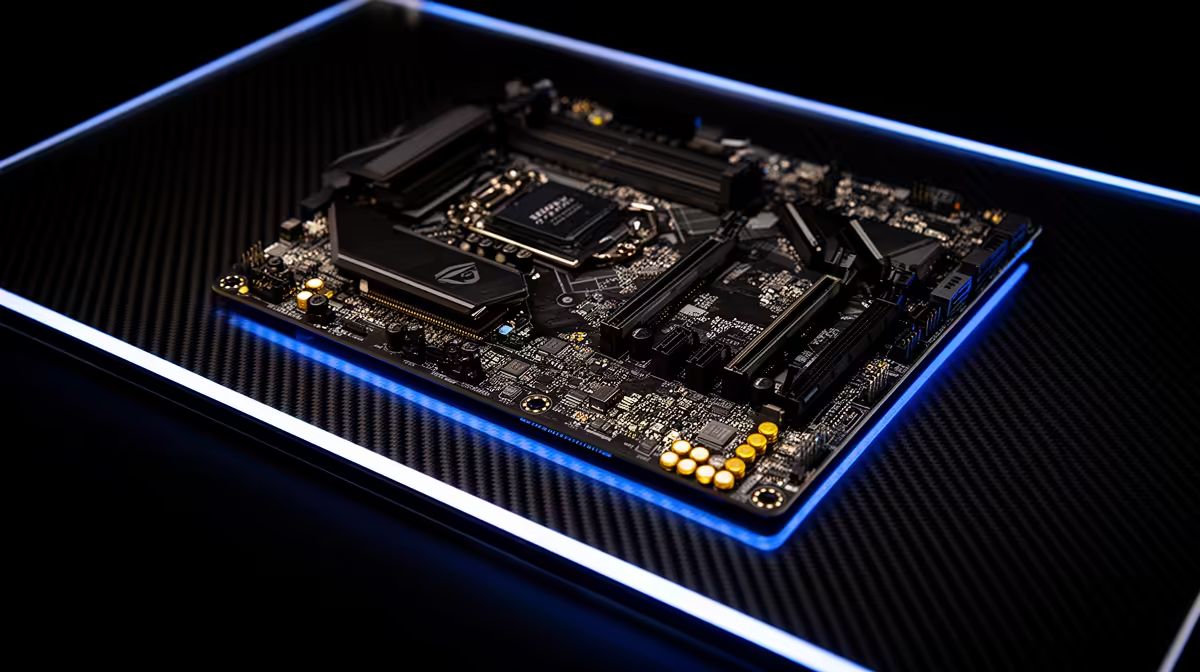
Think of your motherboard as the central nervous system of your PC. It’s not just a place to plug in your CPU; it’s the high-speed communications hub that allows every component to talk to each other. For your graphics card, the most important connection is the PCI Express (PCIe) slot.
This slot is the superhighway that carries data between your GPU and the rest of your system. Modern motherboards and GPUs use PCIe 4.0 or even 5.0, which offer massive bandwidth. While a new GPU will work in an older PCIe 3.0 slot, you could be leaving a small but noticeable amount of performance on the table, especially with top-tier cards. Choosing the right motherboard ensures this highway is wide open.
The Non-Negotiables: Finding the Best Motherboard for Your Gaming GPU
Getting the compatibility right isn't just about picking the same brand. A few key technical details make all the difference between a stable, high-performance rig and a frustrating mess of problems. Here’s what to focus on when searching for the best motherboard for a gaming GPU.
PCIe Slot: The Superhighway for Your Graphics Card
This is priority number one. Your graphics card will slot into the top-most, longest PCIe slot, which runs at x16 speed. For any modern gaming GPU (like an NVIDIA RTX 30/40 series or AMD RX 6000/7000 series), you'll want a motherboard that offers at least a PCIe 4.0 x16 slot to get its full potential. While PCIe 5.0 is the latest standard, very few current GPUs can actually saturate that much bandwidth, making a solid PCIe 4.0 board the sweet spot for value and performance right now.
Check Your Clearances! 🔧
Modern GPUs are massive. Before you buy, check the graphics card's dimensions (length and width slot-height) against your PC case specifications. Also, ensure the motherboard's layout won't cause the GPU to block important SATA ports or M.2 slots you plan on using. A few minutes of checking can save hours of frustration.
Physical Size & Form Factor
Motherboards come in different sizes, mainly ATX (standard), Micro-ATX (shorter), and Mini-ITX (tiny). This choice must match your PC case. A bigger ATX board usually offers more features, like extra M.2 slots for super-fast storage and more PCIe slots for other expansion cards. For most gaming builds, ATX provides the best balance of features and space, ensuring your chunky, triple-fan GPU has plenty of room to breathe.
Choosing Your Team: AMD vs. Intel Motherboard Ecosystems
Your choice of CPU—either Intel or AMD—locks you into a specific set of motherboards. Both platforms offer fantastic options for gamers, but they have different strengths.
For Team Red, the latest AMD motherboards on the AM5 platform are built for the future, supporting cutting-edge tech like PCIe 5.0 and DDR5 RAM exclusively. This makes them a powerful, forward-looking choice for a new build. ✨
On Team Blue’s side, you’ll find incredible flexibility. Many current Intel motherboard options for their LGA 1700 socket give you the choice between more affordable DDR4 RAM or faster DDR5, allowing you to tailor your build to your budget.
Ultimately, you don't need to spend R10,000 on a motherboard to get amazing gaming performance. The secret is finding a balanced board that provides stable power and the key features you need. You can find great value on both Intel and AMD based motherboards that deliver 99% of the performance for a fraction of the cost of a flagship model.
Ready to Build Your Bottleneck-Free Rig? The motherboard is the foundation of your gaming PC. Getting it right ensures every rand you spent on that powerful GPU pays off in glorious, high-frame-rate gaming. Explore our massive range of motherboards and find the perfect backbone for your build.