Quick Answer
If your Gen 5 NVMe SSD build will not boot after a BIOS update, the fix is almost always a CMOS clear and a re-check of boot settings, not dead hardware. Clear CMOS, reseat the GPU and boot drive, and confirm the BIOS reset CSM/Secure Boot or the memory profile.
First, clear CMOS and reset defaults
A BIOS flash resets settings, which can disable the memory profile or change boot mode and stop the Gen 5 NVMe SSD build posting. Power off, switch off the PSU, and clear CMOS via the jumper or by removing the battery for 60 seconds. On boards with a BIOS-flashback or clear-CMOS button on the rear I/O, use that. This restores safe defaults so the system posts.
Re-enter BIOS and fix boot settings
Once it posts, enter BIOS and confirm the boot drive is detected and set first in the boot order. A flash often re-enables CSM or toggles Secure Boot, which can hide a Windows boot entry. Set the SATA/NVMe mode to AHCI, enable the EXPO/XMP profile again, and ensure UEFI boot matches how Windows was installed. Save and reboot.
If it still will not post
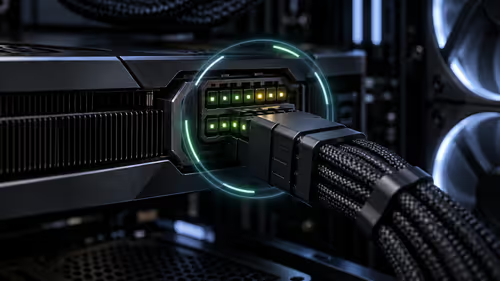
Reseat the RAM (try one stick), reseat the GPU, and check the EPS 8-pin CPU power cable - a flash sometimes coincides with a loose connector. Watch the board's debug LEDs or post-code display: a stuck DRAM or VGA light points to memory or GPU, not the BIOS. As a last resort, re-flash the same BIOS version via flashback to rule out a corrupt update.
FAQ
Is my hardware damaged if the Gen 5 NVMe SSD build will not boot?
Almost never. A BIOS flash resets settings; a CMOS clear and boot-order fix usually restores it.
What speed is the safe fallback?
DDR5-6000 CL30 is the widely stable sweet spot. If the rated profile errors, drop to 6000, test, and only push higher once it is confirmed stable.
Do four RAM sticks make this worse?
Yes. Four DIMMs load the memory controller harder and usually run at a lower stable speed than a two-stick kit. For top speed and stability, prefer a matched two-stick set.
Evetech tip
Update the BIOS first, then run a 30-minute memory test on your 16GB or 32GB kit before trusting the build. Most boot and stability faults after a change are settings, not dead hardware.