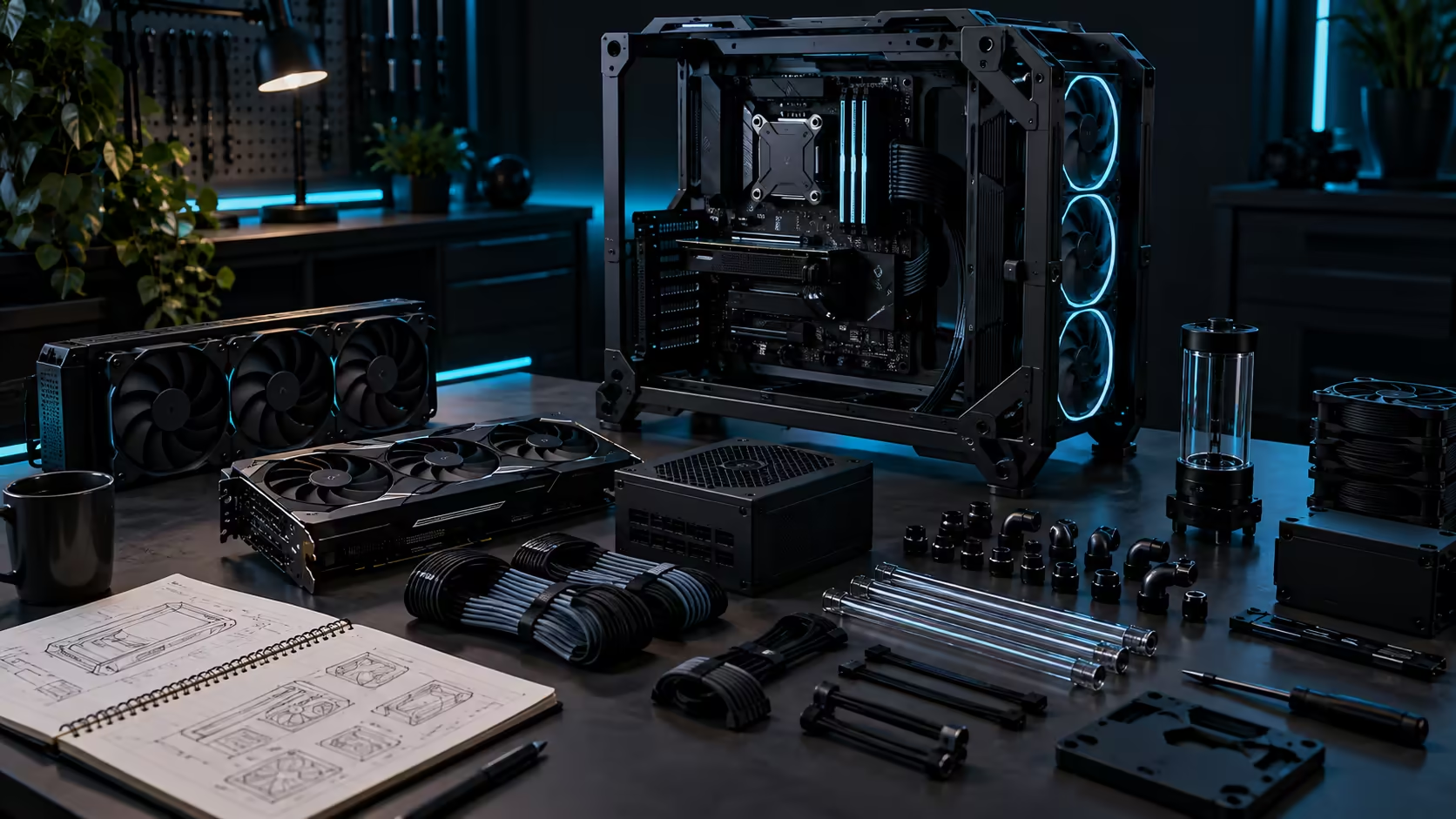
The chassis is the line most people underestimate on an open-frame gaming PC build, and it is the one that will not move. The ROG GR20 Edition 20 is R15,999 before a single component goes into it, which is more than some complete mid-range towers cost. Get that number on the page first and the rest of the budget arranges itself honestly around it, instead of being squeezed at the end when the money has already gone.
Quick Answer
Start the budget at R15,999 for the ROG GR20 Edition 20 frame itself, then plan the radiator, the riser and a graphics card support onto the same page rather than treating them as extras. On an open build, the parts that are usually hidden become visible, so cabling and a power supply you are happy to look at stop being optional. Buy locally so a warranty claim is a courier collection rather than an export.
💰 Where an open-frame budget differs from a tower budget
A conventional tower hides its compromises. An open frame does not, and that shows up in three specific line items.
The first is the frame itself. A R1,500 tower and a R15,999 open frame are not doing the same job. You are paying for a 4mm aluminium-alloy structure that has to stay rigid without side panels holding it square, and for three placement modes that a fixed steel box cannot offer. Whether that is worth it depends entirely on whether the machine is furniture or appliance.
The second is cabling. In a tower, a bundle of loose cables behind the motherboard tray costs nothing and nobody sees it. On an open frame every cable is on display, so custom-length or sleeved cables move from a luxury to something most builders end up buying anyway. Budget for that rather than discovering it.
The third is support hardware. The frame clears graphics cards up to 368mm, and a card near that length mounted vertically needs a support bracket. That is a small amount of money, but leaving it out of the plan is how a R30,000 card ends up resting its weight on a PCIe slot.
🧾 A realistic line-by-line plan
Write the fixed and near-fixed items down before you shop for the fun parts.
The chassis is R15,999. The cooler is next, and it is a genuine fork in the budget: that one mounting area accepts either a 360mm all-in-one or a row of three 120mm fans, and the two paths are nowhere near the same money. A 360mm all-in-one is the more expensive path and the one that looks right in an open build; three good air-moving fans on a tower cooler is the cheaper path and usually the quieter one.
The power supply is the third fixed item, and on an open build it is a visible one. Decide the wattage from the card you intend to fit, not the card you own today, and then look at the power supply range with modular cabling in mind, because a non-modular unit on an open frame means every unused cable is permanently on show.
After those three, the board, memory, storage and graphics card are the same decisions you would make in any build. What changes is that there is no case fan budget to speak of, because the frame ships with a crossflow fan and the open sides do the intake work.
🇿🇦 Buying the frame locally is the cheaper risk
A large aluminium chassis is close to the worst thing to import privately into South Africa.
Volumetric shipping is charged on the size of the box, not its weight, and a mid-tower frame ships in a box that is mostly air and protective foam. Add import duty, VAT calculated on the landed value including that shipping, and a flat clearing charge that is the same on a small parcel as on a large one, and the saving on the sticker price disappears well before the box lands.
The return path is the real cost though. Aluminium frames arrive bent or scratched often enough that couriers treat them as a known risk, and a damaged frame bought locally is a collection and a replacement. The same frame bought abroad is an export at your expense, for an item whose shipping cost was already the problem.
That is also worth remembering for the warranty on the parts inside it. An open build gets handled, moved and rebuilt more than a closed one, simply because it is easy to work on. Having every component under a local warranty makes that a low-stakes habit instead of a risk.
If the budget is the constraint rather than the shape, the current case specials are the honest first stop, and the wider case range shows where open frames sit against conventional towers on price.
🏠 The running costs nobody quotes
Two ongoing items belong in an open-frame budget and almost never appear in one.
Cleaning is the first. There is no dust filter, because there is no intake to filter. A can of compressed air and 10 minutes every second month through a dry Highveld winter is a small, genuine running cost, and skipping it is how an open build ends up performing worse than the tower it replaced.
Placement is the second, and it is free if you plan it. A standard desk lifts the machine about 750mm off the floor, out of the layer where dust concentration is highest, and an open frame sitting on carpet collects far more than the same frame on that desk. A desk against a west-facing wall in a Gauteng summer also feeds the radiator warmer air every afternoon. Neither costs money to fix at build time. Both cost money to fix afterwards.
Frequently Asked Questions
Why does an open-frame case cost so much more than a tower?
The frame has to stay square without side panels bracing it, which means a thicker aluminium structure. You are also paying for multiple mounting orientations rather than one.
What should I add to the budget that a tower build does not need?
Sleeved or custom-length cables, a graphics card support bracket for a long card, and a modular power supply, because all three are visible rather than hidden.
Do I still need case fans?
Far fewer. The frame ships with a crossflow fan and the open sides handle intake, so most of a tower's case fan budget moves to the CPU cooler instead.
Does ordering the chassis from overseas work out cheaper?
Very rarely. Volumetric shipping on a large, light box plus duty, VAT and clearing usually exceeds the saving, and a damaged frame becomes an export at your cost.
How much should I allow for cleaning and maintenance?
Very little in rand. Budget 10 minutes with a can of compressed air every second month, and keep the build up at desk height instead of down at floor level.
Ready to plan an open build without the budget surprises?
Fix the chassis, cooler and power supply numbers first, then spend what is left on the parts everyone will see.