


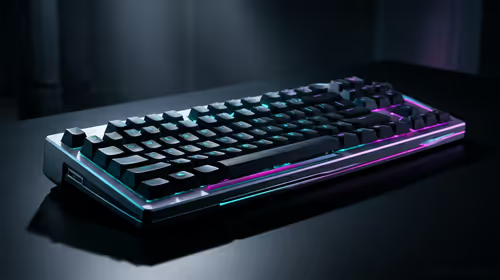
Stuck Pixel Checks for a Mechanical Keyboard Setup
Stuck pixel on a Mechanical Keyboard is likely a display symptom around that setup, not the part itself. Check the monitor, cable, GPU output, drivers, and warranty path first.
Read moreTo choose between balanced and unbalanced cables in a studio, use balanced XLR or TRS for runs over 1.5 meters so the receiver cancels noise along the run. Unbalanced TS cables suit short guitar-to-pedal connections but pick up hum over longer distances.
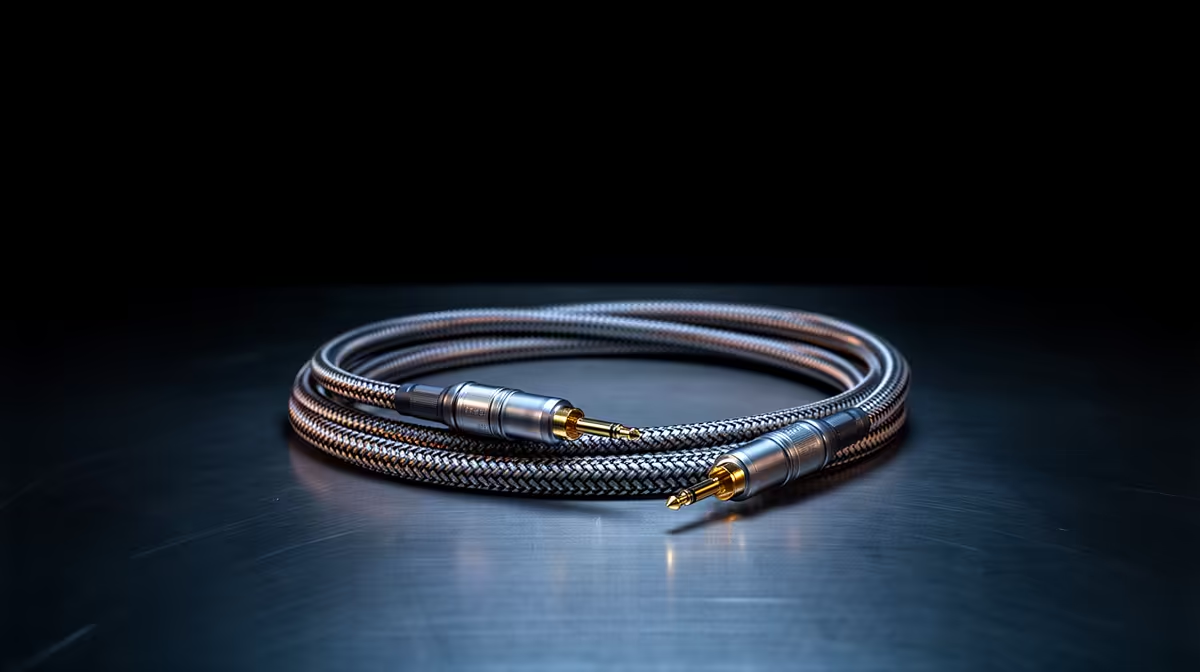
A faint hum creeps into your recording, a buzz that was not there when the cable was shorter, and suddenly you are chasing a ghost. Nine times out of ten the answer is not a faulty interface or a noisy room, it is the balanced and unbalanced cables in your signal chain and which one you used for which run. Get this right and most studio hum disappears before you have touched a single plug-in.
In a studio, use balanced cables, XLR or TRS, for any run longer than about 1.5 metres, because the receiving gear cancels noise picked up along the way. Reserve unbalanced TS cables for short runs like a guitar into a nearby pedal, where their simplicity is fine and the distance is too short for interference to build. The single rule: long run, balanced; short instrument hop, unbalanced.
The whole trick of a balanced cable is redundancy with a twist. It carries your signal on two conductors, one normal and one with its polarity inverted, plus a shield. Along the run, both conductors pick up the same ambient electrical noise from nearby power, lighting and electronics.
At the receiving end, the gear flips the inverted conductor back into phase with the first. Doing so puts your signal back together at full strength, but it also flips the noise on that conductor out of phase, so when the two are combined the noise cancels itself out. This is called common-mode rejection, and it is why balanced lines stay clean over long distances. An unbalanced cable has only a single signal conductor and a shield, with no second copy to compare against, so any noise it collects rides straight into your recording.
The confusion usually comes from the connectors, because the plug does not always tell you whether the connection is balanced.
XLR is the three-pin connector you see on microphones, and it is balanced. TRS, the quarter-inch plug with two black rings, has tip, ring and sleeve, which gives it the extra conductor needed to carry a balanced signal. TS, the quarter-inch plug with a single ring, has only tip and sleeve, which makes it unbalanced. So XLR and TRS can run balanced, while TS is always unbalanced.
The catch that trips people up is that TRS plugs are used for two completely different jobs. On a mono connection like a studio monitor feed, TRS carries one balanced signal. On headphones, the same plug carries two unbalanced channels for left and right. Same connector, different wiring, so do not assume a TRS plug means balanced without knowing what it is connecting.
The decision comes down to distance and what you are connecting.
Reach for balanced whenever the run is more than roughly 1.5 metres or passes near anything electrically noisy. Microphones into an interface, studio monitors from an interface, connections between rack gear, anything that travels a few metres across a room should be balanced XLR or TRS. This is the default for almost every permanent studio connection, because it keeps hum and buzz out no matter what the cable runs past.
Unbalanced TS is the right tool for short, high-output instrument connections: an electric guitar or bass into an amp, or a quick hop into a nearby pedal. Over those short distances there is too little cable for noise to accumulate, and the gear at both ends expects unbalanced anyway. Keep unbalanced runs short, ideally a few metres at most, and you will never hear the difference. Stretch one across a room and you will.
Here is the rule people learn the hard way: a balanced cable only rejects noise if both the sending and receiving gear are balanced. Plug a balanced cable into an unbalanced output or input and you get an ordinary unbalanced connection, with none of the noise cancelling. The cable alone does nothing; the whole chain has to support balanced operation. So check that your interface, mixer and monitors actually have balanced connections before assuming a fancy cable solves a hum.
Cables are the cheapest insurance in any studio, and using the right type from the start saves hours of troubleshooting. If you are also sorting out monitoring, the headphones and headset range at Evetech covers accurate options that reveal whether your chain is actually clean. For everyday studio listening gear that holds up to long sessions, the most popular headsets at Evetech are a practical reference point.
No. TRS has the conductors to carry a balanced mono signal, but the same plug also carries two unbalanced channels on headphones. Whether a TRS connection is balanced depends on what it is wired to, so identify the job before assuming.
Balanced cables stay clean over long distances, comfortably tens of metres, because the receiving gear cancels the noise picked up along the way. That is exactly why they are the standard for any run beyond a couple of metres in a studio.
For short, high-output instrument connections like a guitar or bass into an amp or a nearby pedal. The distance is too short for interference to build, and the gear expects unbalanced. Keep these runs short and unbalanced is perfectly fine.
Only if both ends of the connection are balanced. A balanced cable plugged into unbalanced gear behaves as a normal unbalanced link with no noise cancelling. The interface, mixer and monitors all need balanced connections for the rejection to work.
Its main job is rejecting noise over distance, not changing tone. A balanced run keeps hum and buzz out, which makes the recording cleaner, but a short well-made unbalanced cable in the right place sounds perfectly good too.
A quiet studio starts with the right cables and honest monitoring. Browse the headphones and headsets at Evetech to hear exactly what your signal chain is doing, then route every long run balanced.
No. TRS has the conductors to carry a balanced mono signal, but the same plug also carries two unbalanced channels on headphones. Whether a TRS connection is balanced depends on what it is wired to, so identify the job before assuming.
Balanced cables stay clean over long distances, comfortably tens of metres, because the receiving gear cancels the noise picked up along the way. That is exactly why they are the standard for any run beyond a couple of metres in a studio.
For short, high-output instrument connections like a guitar or bass into an amp or a nearby pedal. The distance is too short for interference to build, and the gear expects unbalanced. Keep these runs short and unbalanced is perfectly fine.
Only if both ends of the connection are balanced. A balanced cable plugged into unbalanced gear behaves as a normal unbalanced link with no noise cancelling. The interface, mixer and monitors all need balanced connections for the rejection to work.
Its main job is rejecting noise over distance, not changing tone. A balanced run keeps hum and buzz out, which makes the recording cleaner, but a short well-made unbalanced cable in the right place sounds perfectly good too.
Stuck pixel on a Mechanical Keyboard is likely a display symptom around that setup, not the part itself. Check the monitor, cable, GPU output, drivers, and warranty path first.
Read more
How to fix stuck pixel Windows 11 USB DAC issues starts with display-only tests. Check HDR, scaling, monitor input, USB cable movement, and safe South African support options before connecting the pixel issue to audio hardware.
Read more
Windows 11 Steam Deck monitor issues often start with display mode, USB-C output, drivers, or dock power. Use this how to fix monitor not detected windows 11 steam deck checklist for SA handheld PC setups.
Read more
Stalker 2 Heart of Chornobyl PC build planning at R100,000 should stay cautious about parts and settings. Balance GPU, CPU, RAM, storage, cooling, and upgrade room before picking a South African gaming PC.
Read more
RX 9070 XT build stuttering needs a step-by-step check before replacing parts. Review drivers, settings, thermals, power, background apps, display limits, cables, and game options before changing hardware.
Read more
GTA 6 on R15,000 needs careful part balance. This SA build guide frames CPU, GPU, RAM, SSD, cooling, and upgrade trade-offs without promising live prices, stock, or exact FPS.
Read more
The smallest ATX case 2026 buyers should choose is the smallest chassis that still fits their exact graphics card, cooler, power supply and airflow plan. ATX support alone does not prove a case has the smallest footprint or volume.

The UGREEN LinkStation Pro eGPU dock combines Thunderbolt 5 and OCuLink connections with an integrated 850W ATX 3.1 power supply and up to 140W laptop charging. South African availability is unconfirmed.

The MSI PRO MAX 341QPXW14G is a 34-inch 3440 x 1440 ultrawide QD-OLED monitor with a 144Hz refresh rate and Mac-focused controls. A South African price and release date are still unknown.

NVIDIA lists 550W required system power for the RTX 5060 reference specification, based on a high-end test system. A quality 550W unit can be enough, but CPU draw, transient load, connectors and ageing decide real headroom.
The smallest ATX case 2026 buyers should choose is the smallest chassis that still fits their exact graphics card, cooler, power supply and airflow plan. ATX support alone does not prove a case has the smallest footprint or volume.
NVIDIA lists 550W required system power for the RTX 5060 reference specification, based on a high-end test system. A quality 550W unit can be enough, but CPU draw, transient load, connectors and ageing decide real headroom.

OpenRGB's master branch now carries changes labelled for 1.0 final, including translation and platform work, but the official tags page still lists 1.0rc3.1 as the newest packaged release. Stable users should wait for the signed release channel.

A motherboard can remain useful for many years when power, cooling and connectors stay healthy. Replace it for confirmed faults, damaged power delivery or a blocked platform need, not simply because the calendar reaches a fixed age.
The smallest ATX case 2026 buyers should choose is the smallest chassis that still fits their exact graphics card, cooler, power supply and airflow plan. ATX support alone does not prove a case has the smallest footprint or volume.

In a 6 bit + FRC vs 8 bit comparison, native 8-bit panels can produce 256 levels per colour channel directly, while 6-bit plus FRC rapidly alternates nearby values to approximate the wider palette. Panel quality still depends on more than bit depth.
The UGREEN LinkStation Pro eGPU dock combines Thunderbolt 5 and OCuLink connections with an integrated 850W ATX 3.1 power supply and up to 140W laptop charging. South African availability is unconfirmed.
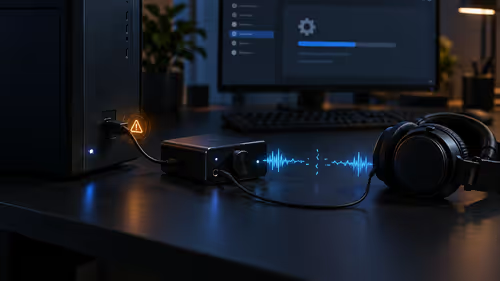
Windows 11 KB5124008 can leave some USB Audio Class 1.0 devices with no sound, Code 10 or failed multichannel output. Microsoft confirms the issue and says switching to two-channel stereo can restore audio for some users.