


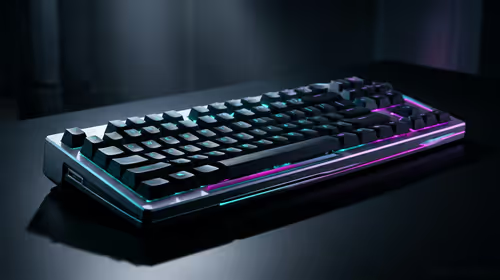
Stuck Pixel Checks for a Mechanical Keyboard Setup
Stuck pixel on a Mechanical Keyboard is likely a display symptom around that setup, not the part itself. Check the monitor, cable, GPU output, drivers, and warranty path first.
Read moreWrong Refresh Rate on a AM5 Motherboard setup is usually a display chain, driver, cable, or settings issue. Check monitor mode, GPU output, OS settings, and game settings first.
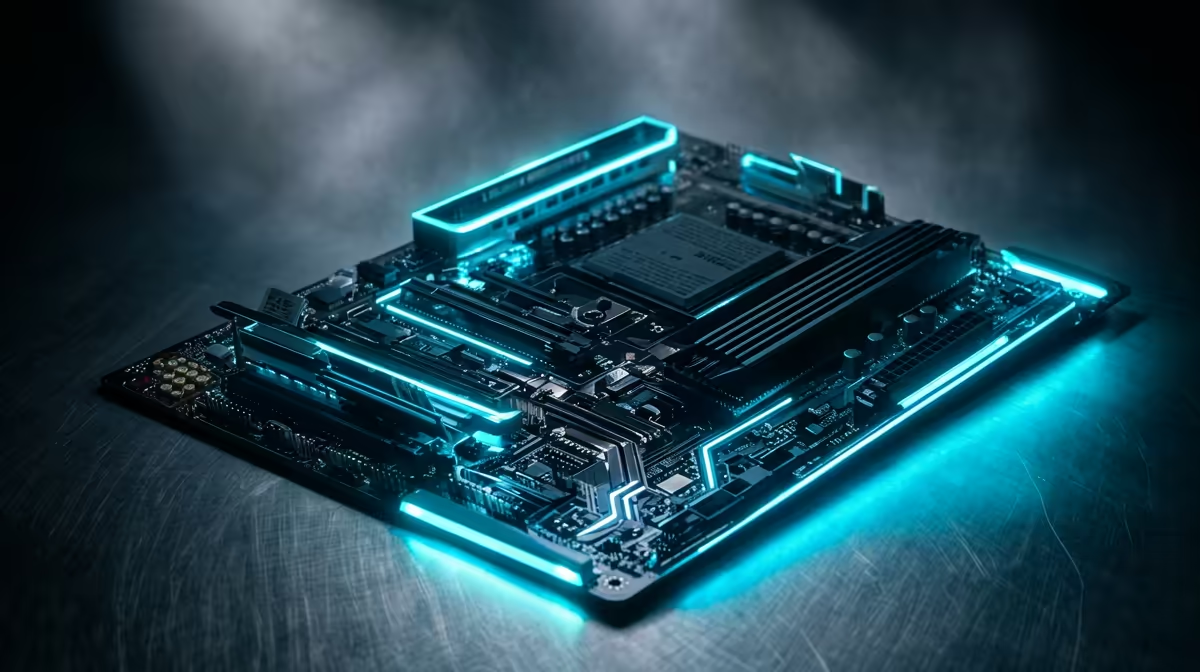
Refresh problems on an AM5 motherboard setup look like a hardware fault but rarely are; the rate lives in display settings, the cable spec, and the GPU driver more than in any single part.
Set the rate in Windows first: Advanced display settings, choose 144Hz, 165Hz, or 240Hz, apply. If the option is greyed out, the cable is the most common culprit, then the monitor's internal overclock or rate setting, then a GPU driver that needs a clean reinstall via DDU. Noting it again because this particular situation has its own quirks.
Many monitors ship with their high-refresh or overclock mode switched off in the on-screen menu, and Windows can only offer rates the panel reports. Open the monitor menu, turn on the high-rate or OC option, save, then set the rate again in Windows. Adaptive sync or FreeSync settings live in the same menu and often need enabling for a smooth result. For an SA an AM5 motherboard setup setup, that is the cheapest, fastest move available.
Bandwidth is the silent killer of high refresh. A 1440p 165Hz panel needs DisplayPort 1.4 or HDMI 2.1; an older HDMI lead trains down to 60Hz to stay stable. A proper cable runs roughly R450 to R1,200, far cheaper than the GPU or monitor people replace by mistake. Plug into the dedicated GPU ports, never the motherboard, when a card is installed. This matters more on an AM5 motherboard setup than the spec sheet ever suggests.
Each display has its own refresh setting in Windows. Select the second monitor in Advanced display settings and raise its rate separately. A weaker cable or port on the second screen can also force it down to 60Hz. On an AM5 motherboard setup specifically, this step pays off more than any quick part swap.
Set it in both so they agree. Windows Advanced display settings is the master, but the GPU control panel can override per-game, so a mismatch causes flicker or a drop back to 60Hz. Match them, then reboot to confirm. Treat an AM5 motherboard setup as its own case rather than copying a generic checklist.
A higher refresh rate only shows frames the GPU already produces, so it does not reduce performance; it just removes the artificial 60fps ceiling. If frame rate is the limit, lower a few settings rather than the panel's refresh. For an AM5 motherboard setup in a South African home, that margin is worth protecting.
Match the monitor to your frame rate Once the refresh is set correctly, shortlist Evetech panels whose refresh matches what your GPU delivers so you pay for frames you will actually see. Stick with this for steady, repeatable results you can trust.
Stuck pixel on a Mechanical Keyboard is likely a display symptom around that setup, not the part itself. Check the monitor, cable, GPU output, drivers, and warranty path first.
Read more
How to fix stuck pixel Windows 11 USB DAC issues starts with display-only tests. Check HDR, scaling, monitor input, USB cable movement, and safe South African support options before connecting the pixel issue to audio hardware.
Read more
Windows 11 Steam Deck monitor issues often start with display mode, USB-C output, drivers, or dock power. Use this how to fix monitor not detected windows 11 steam deck checklist for SA handheld PC setups.
Read more
Stalker 2 Heart of Chornobyl PC build planning at R100,000 should stay cautious about parts and settings. Balance GPU, CPU, RAM, storage, cooling, and upgrade room before picking a South African gaming PC.
Read more
RX 9070 XT build stuttering needs a step-by-step check before replacing parts. Review drivers, settings, thermals, power, background apps, display limits, cables, and game options before changing hardware.
Read more
GTA 6 on R15,000 needs careful part balance. This SA build guide frames CPU, GPU, RAM, SSD, cooling, and upgrade trade-offs without promising live prices, stock, or exact FPS.
Read more
NVIDIA lists 550W required system power for the RTX 5060 reference specification, based on a high-end test system. A quality 550W unit can be enough, but CPU draw, transient load, connectors and ageing decide real headroom.
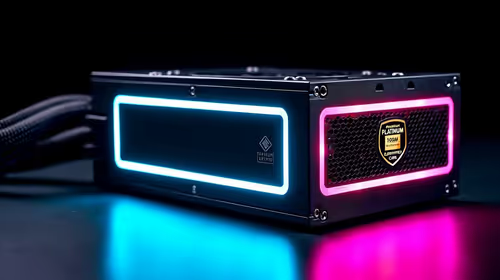
80+ Gold vs 80+ Platinum for couch co-op gaming is about PSU efficiency, heat, fan behaviour, quality, and wattage headroom, not direct FPS. SA buyers should compare the whole build.
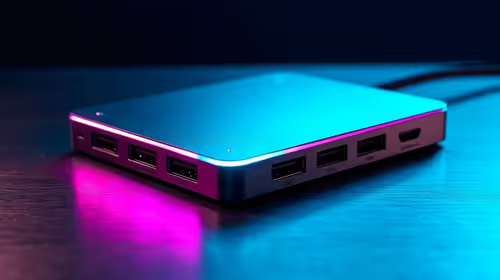
Upgrade your setup with the best USB-C hubs for creators. Discover why high-capacity card readers and dual 4K output are essential for professional South African content production. 🚀💻

B850 motherboard FPS drops needs a methodical troubleshooting pass. Review drivers, thermals, power settings, background apps, cables and game settings before replacing parts in an SA gaming setup.
NVIDIA lists 550W required system power for the RTX 5060 reference specification, based on a high-end test system. A quality 550W unit can be enough, but CPU draw, transient load, connectors and ageing decide real headroom.

OpenRGB's master branch now carries changes labelled for 1.0 final, including translation and platform work, but the official tags page still lists 1.0rc3.1 as the newest packaged release. Stable users should wait for the signed release channel.

A motherboard can remain useful for many years when power, cooling and connectors stay healthy. Replace it for confirmed faults, damaged power delivery or a blocked platform need, not simply because the calendar reaches a fixed age.
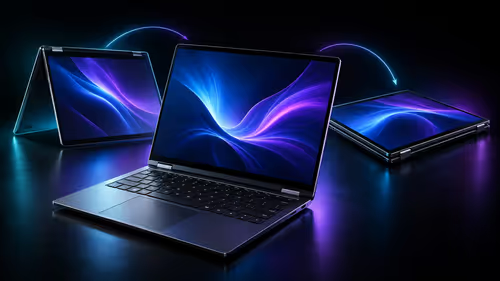
The VAIO T combines a 13.3-inch display with a multi-flip mechanism for laptop, tablet and outward-facing viewing modes. Orders begin in Japan on 18 September; South African availability is unconfirmed.

The smallest ATX case 2026 buyers should choose is the smallest chassis that still fits their exact graphics card, cooler, power supply and airflow plan. ATX support alone does not prove a case has the smallest footprint or volume.
In a 6 bit + FRC vs 8 bit comparison, native 8-bit panels can produce 256 levels per colour channel directly, while 6-bit plus FRC rapidly alternates nearby values to approximate the wider palette. Panel quality still depends on more than bit depth.

The UGREEN LinkStation Pro eGPU dock combines Thunderbolt 5 and OCuLink connections with an integrated 850W ATX 3.1 power supply and up to 140W laptop charging. South African availability is unconfirmed.
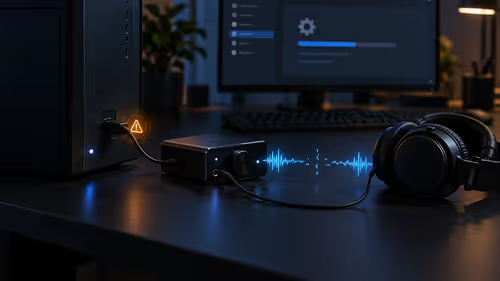
Windows 11 KB5124008 can leave some USB Audio Class 1.0 devices with no sound, Code 10 or failed multichannel output. Microsoft confirms the issue and says switching to two-channel stereo can restore audio for some users.