Most airflow complaints in a gaming PC come down to fan placement rather than fan quality, and the fix usually costs less than people expect. Getting the intake and exhaust direction right on a 120mm pwm case fan matters more for temperatures than almost any other single change you can make to a build. Get the setup wrong and even a good fan ends up fighting the case rather than helping it.
Quick Answer
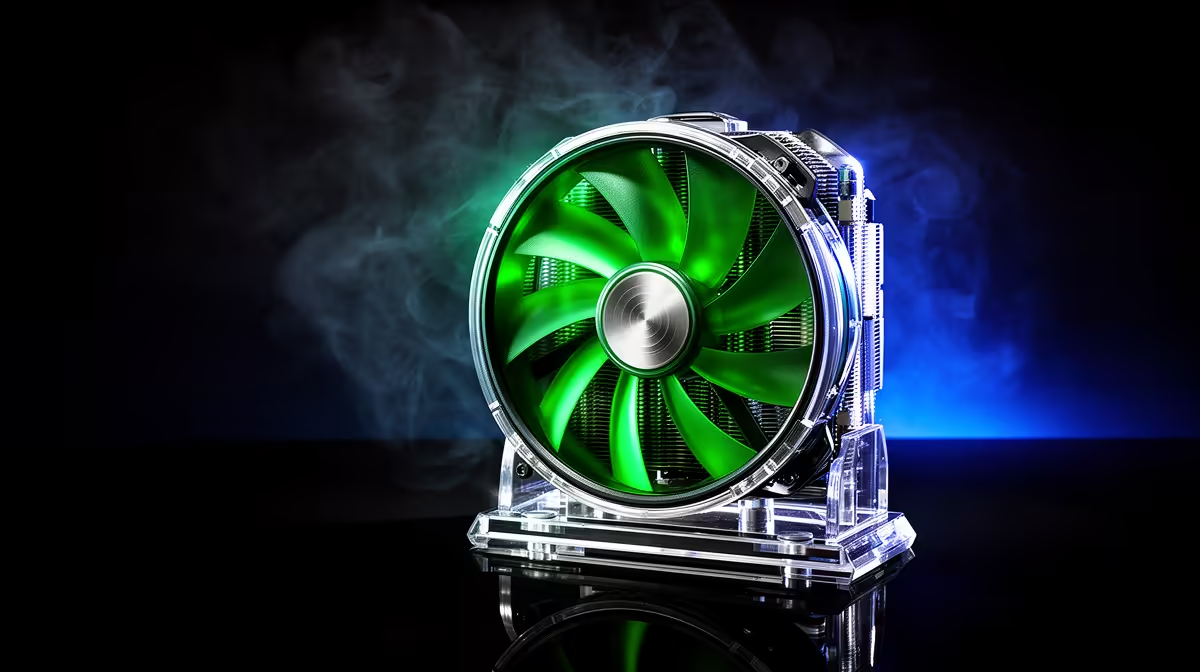
Set a 120mm PWM case fan as intake at the front of the case and another as exhaust at the rear for balanced airflow through the build. The Einarex EX12A pushes 82.9 CFM at R249, drawing just 3W, which is enough output for most mid-tower cases without adding noticeable noise.
🌀 Deciding Which Fans Pull Air In and Which Push It Out
Front-mounted fans should generally pull cool air into the case, while rear and top fans push warm air back out, creating a steady flow across the motherboard, GPU, and CPU cooler. Getting this direction wrong, front fans exhausting instead of intaking, disrupts the whole airflow path and can leave hot air trapped inside the case rather than moving through it. Most fans have a small arrow moulded into the frame showing airflow direction, worth checking before final installation rather than assuming based on which way the cable faces.
Checking Fan Orientation Before Mounting
Take a moment before screwing fans into place to confirm each one faces the right way for its role in the airflow path. It is a five-second check that avoids having to strip the case down again after noticing temperatures climbing higher than expected.
⚙️ Wiring Into PWM Headers Correctly
PWM fans use a four-pin connector that lets the motherboard control speed based on temperature readings rather than running at a fixed speed constantly. Connecting the EX12A to a dedicated CHA_FAN or SYS_FAN header, rather than a header shared with the CPU cooler, keeps case fan speed independent of CPU load, which usually gives a quieter result overall. Most motherboards let you assign each header's fan curve separately in BIOS or through the manufacturer's fan control software.
Why PWM Beats Simple Voltage Control
Voltage-based fan control simply reduces power to slow a fan down, which can cause stutter or stalling at very low speeds. PWM instead switches power on and off rapidly at full voltage, giving smoother speed control across a wider range, particularly useful for a fan rated up to 82.9 CFM that needs to run quietly most of the time and ramp up only under load.
🔧 Matching Fan Count to Case Size
A single intake and single exhaust fan works for smaller cases, but larger mid-towers and full-towers usually benefit from two or three intake fans up front balanced against exhaust at the rear and top. Since the EX12A's white frame suits light-themed and RGB builds, it is worth planning fan count and colour scheme together rather than adding fans piecemeal as thermal issues appear. Browsing the case fan range helps compare CFM ratings before deciding how many fans a particular case needs.
🖥️ Pairing Fans With the Right Case
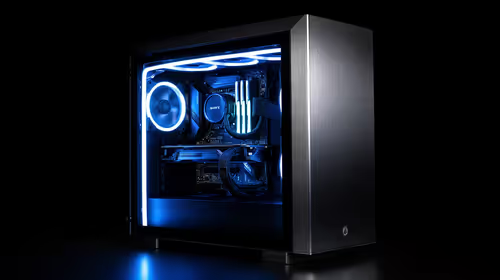
Airflow only works as well as the case allows, and mesh-fronted cases generally support higher CFM fans better than solid-fronted designs that restrict intake. Anyone building from scratch should look at the Einarex case range alongside fan selection, since matching case ventilation to fan output avoids the situation where good fans are choked by a restrictive front panel.
Frequently Asked Questions
How many 120mm fans does a typical mid-tower case need?
Most mid-towers run well with two to three intake fans up front and one or two exhaust fans at the rear and top, though exact numbers depend on the case's ventilation design.
Does PWM control affect noise levels significantly?
Yes, PWM lets the fan idle at low speed during light loads and ramp up only when needed, keeping average noise well below the fan's rated maximum most of the time.
Should case fans run faster than CPU cooler fans?
Not necessarily. Case fans usually run at a gentler curve than a CPU cooler, since their job is steady case-wide airflow rather than spot-cooling one hot component.
What happens if a fan is mounted facing the wrong way?
Airflow direction gets disrupted, which can leave warm air recirculating inside the case instead of exiting, often raising temperatures more than expected.
Is 82.9 CFM enough for a gaming PC?
It comfortably covers most mid-tower builds, especially once fans are split correctly between intake and exhaust rather than all pulling in one direction.
Does fan colour affect performance at all?
No, colour and frame finish are purely cosmetic, so a white frame like the EX12A performs identically to a black equivalent while suiting light-themed or RGB builds better visually.
How loud is the EX12A at full speed?
It is rated up to 40.7 dBA at maximum, which is noticeable under sustained full load but stays well below that most of the time thanks to PWM speed control easing the fan back during lighter workloads.
Ready to boost your airflow the easy way?
Add the Einarex EX12A 120mm PWM fan (R249) on Evetech, to get quiet, PWM-controlled airflow moving through your case in minutes.