You paid for a dedicated laptop GPU, yet some frames still take a detour through the processor's integrated graphics before reaching the screen. A MUX switch can change that display path. The gain varies by game and laptop, so the useful move is to test your own machine instead of treating the switch as a free universal FPS button.
Quick Answer
A manual MUX mode connects the internal display to the dedicated GPU and often requires a restart. Advanced Optimus can switch display paths without that manual reboot on supported hardware. Use dedicated-GPU mode for plugged-in gaming, then compare the same benchmark against hybrid mode. Return to hybrid for battery work if the direct path raises idle power. Across Evetech's in-stock laptop data for July 2026, R35,999 was the median listed price, so it is worth checking whether the performance you bought is reaching the panel.
🛣️ Understand the two display paths
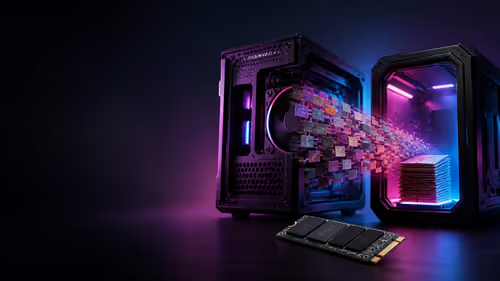
In hybrid mode, the dedicated GPU can render the game while the integrated GPU presents the finished frames to the internal screen. That arrangement helps battery life because the dedicated GPU can sleep during light desktop work. The hand-off can also add overhead or restrict certain display features.
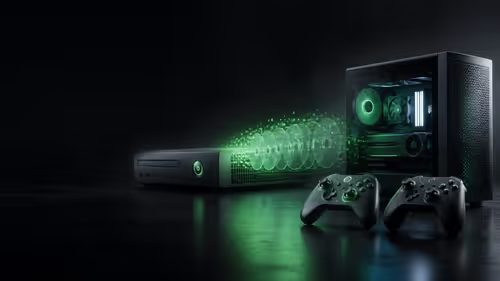
Dedicated-GPU mode routes the panel straight to the discrete graphics processor. A physical or firmware-controlled multiplexer changes the connection. It does not overclock the GPU, add video memory or make a CPU-limited game disappear. It removes one possible obstacle between rendered frame and panel.
Advanced Optimus automates that choice on laptops built to support it. Ordinary Optimus, Advanced Optimus and a manual MUX are related terms, but they do not promise the same switching behaviour. Use your model's documentation and control panel labels.
Evetech's laptop best-sellers give you current model context when display routing appears in a laptop's listed features.
🔎 Find what your laptop actually supports
Open the manufacturer's control software and look for GPU Mode, Hybrid, Discrete, MSHybrid, Optimus or Eco settings. Check the BIOS if the app has no display option. A manual switch may ask for a reboot because the hardware path changes before Windows loads.
NVIDIA's control tools may show which GPU drives the display, but the laptop maker's app remains the safer place to change a model-specific MUX. Install current graphics and system-control drivers through the official route for the machine. Missing services can make a supported option vanish from the app.
No switch in the software does not prove the laptop is faulty. Some designs have a fixed path. Others wire the internal panel one way while selected external ports connect straight to the dedicated GPU.
📊 Run a paired test, not two different gaming sessions
Choose a game with a repeatable built-in benchmark or a save that loads into the same scene. Keep resolution, preset, frame cap and power mode unchanged. Record average FPS, one-percent lows and frame-time behaviour in hybrid mode. Change the MUX setting, restart when asked and repeat after temperatures settle.
Competitive games at high frame rates may show a clearer change because display-path overhead matters more when the system is producing many frames. A demanding game already pinned at the GPU limit may change less. Both results can be correct.
Check latency by feel only after the numbers are recorded. Use the same mouse, display refresh and V-Sync state. If you change four controls with the MUX, you will not know which one helped.
🔋 Put battery behaviour back into the decision
Dedicated mode can keep the powerful GPU awake during browser, video and office work. Watch idle power and estimated runtime after the switch. If unplugged life falls, save hybrid for travel and use the direct path at your gaming desk.
Advanced Optimus is meant to make that transition easier, but switching can still fail for a particular game, driver or external display. A black screen that recovers after a moment may be the path changing. Repeated freezes deserve a driver check and a return to the known-good mode.
When the laptop supports per-app GPU selection, that chooses which processor renders an application. It is not always the same as changing which GPU physically drives the panel. Keep those two decisions separate while troubleshooting.
Browse Evetech's gaming laptop deals if a direct GPU path is an important feature for your next machine; confirm the exact model rather than assuming a whole series shares one design.
🖥️ Check external ports one by one
An HDMI or USB-C display output can be wired to either GPU. Connect your monitor, open the display information and run the paired benchmark again. A port connected to the dedicated GPU may give you the direct path even while the internal panel stays in hybrid mode.
That does not make every dock equivalent. A USB display adapter can use its own compression path, while USB-C DisplayPort Alt Mode may follow the laptop's native GPU wiring. Check the specific port, cable and dock before blaming the game.
Use the mode that solves the task in front of you. Dedicated routing earns its place when it improves your plugged-in game. Hybrid earns its place when you need a cooler desktop and longer battery day.
Frequently Asked Questions
What does a MUX switch actually do?
It changes which GPU is connected to the display, allowing the dedicated GPU to drive the panel directly on supported laptops.
How much FPS can a MUX switch recover?
There is no fixed percentage. Game engine, frame rate, CPU load and laptop design all affect the result.
Is Advanced Optimus the same as a manual MUX switch?
It uses supported hardware to automate display-path switching. A manual MUX asks you to choose the path yourself, often with a restart.
Where do I enable a manual MUX switch?
Look in the laptop maker's control app or BIOS for Hybrid, Discrete or GPU Mode settings.
Does using the MUX switch affect battery life?
Dedicated mode can reduce battery runtime because the discrete GPU may stay active during light work.
Do all gaming laptops have a MUX switch?
No. Confirm the feature for the exact model and panel configuration.
Does external display output still work with a MUX switch enabled?
Usually, but each port has its own wiring and supported modes. Test the actual HDMI or USB-C connection you plan to use.
Checking whether your laptop's GPU has a direct route to the screen?
Compare current gaming laptops at Evetech, confirm MUX support on the exact model and benchmark both paths before choosing your daily mode.