


Stuck Pixel Checks for a Mechanical Keyboard Setup
Stuck pixel on a Mechanical Keyboard is likely a display symptom around that setup, not the part itself. Check the monitor, cable, GPU output, drivers, and warranty path first.
Read moreDeciding on PCIe 5.0 vs 4.0 for your new build? This guide breaks down speed, performance, cost, and future-proofing to help you make the smartest choice. 🚀 Discover if the next-gen leap is worth the investment for your gaming rig or workstation right now. Get the facts! 💻
Building a new PC in Mzansi? You've probably seen "PCIe 5.0" and "PCIe 4.0" on motherboards and graphics cards. One is newer, faster... but is it actually worth the extra cash for your rig? It’s a classic tech dilemma. Let's cut through the jargon and figure out which standard in the PCIe 5.0 vs 4.0 battle is the right choice for your next PC build, whether you're gaming in Cape Town or creating content in Jozi.
Think of Peripheral Component Interconnect Express (PCIe) as the super-highway inside your PC. It’s the physical slot and data connection that lets your most important components—like your graphics card and super-fast NVMe SSD—talk to your processor.
Each new generation of PCIe effectively doubles the speed of this highway. This means more data can be transferred, faster. But does double the theoretical speed actually mean double the performance for you?
The main distinction in the PCIe 5.0 vs 4.0 debate comes down to raw bandwidth. It's a simple numbers game:
For NVMe SSDs, this speed difference is even more direct. A PCIe 4.0 SSD might top out around 7,000 MB/s, while PCIe 5.0 SSDs are already pushing past 12,000 MB/s. That's a serious leap for anyone moving massive files.
Here’s the big question for most South African gamers: will choosing PCIe 5.0 over 4.0 give you more frames in Warzone or Apex Legends?
Right now, the answer is... not really.
Even the most powerful graphics cards on the market today, like the RTX 4090, don't fully saturate a PCIe 4.0 x16 slot. When tested, the performance difference between running a top-tier GPU in a PCIe 4.0 vs 5.0 slot is often less than 1-2%, which is completely unnoticeable during gameplay. For gaming, the GPU's processing power and your CPU are far more important factors. This means you can save a significant amount of money by opting for a robust PCIe 4.0 build and still get elite performance.
Just because a motherboard supports PCIe 5.0 for the main GPU slot doesn't mean all its M.2 SSD slots are Gen 5. Often, boards mix and match, offering one Gen 5 M.2 slot and several Gen 4 slots. Always check the motherboard's detailed specs on Evetech to ensure the slots you need match the components you're buying.
While it might not be a must-have for gamers today, the extra bandwidth of PCIe 5.0 is incredibly useful for a specific group of users.
If your work involves editing 8K video, running complex simulations, or moving gigantic datasets, time is money. A PCIe 5.0 NVMe SSD can drastically cut down on loading and transfer times, making your workflow smoother and more efficient. The difference between PCIe 4.0 and 5.0 here is tangible.
Are you building a no-compromise, top-of-the-line rig designed to last for the next five years? Opting for a PCIe 5.0-ready motherboard is a smart move. It ensures that when next-generation graphics cards and peripherals arrive that can use that extra speed, your system will be ready without needing a major overhaul. Whether you're Team Blue or Team Red, you'll need a modern platform; you can explore the latest Intel motherboards or browse compatible AMD motherboards to see what's on offer.
Choosing between PCIe 5.0 vs 4.0 ultimately depends on your budget and how you use your PC.
For the vast majority of PC builders in South Africa today, PCIe 4.0 hits the sweet spot of price, performance, and availability.
Ready to Build Your Perfect Rig? Whether you're optimising for value with PCIe 4.0 or future-proofing with PCIe 5.0, the right motherboard is the heart of your build. Explore our massive range of Intel & AMD motherboards and find the perfect foundation for your next PC.
The primary difference is bandwidth. PCIe 5.0 offers double the data transfer rate of PCIe 4.0, with up to 128 GB/s on an x16 slot, enabling faster performance for next-gen GPUs and SSDs.
For most current games and GPUs, including high-end models, PCIe 4.0 provides more than enough bandwidth. The performance gains from PCIe 5.0 for gaming are currently minimal, making it a future-proofing investment.
Yes, PCIe is backward and forward compatible. You can plug a PCIe 4.0 graphics card into a PCIe 5.0 motherboard slot, and it will run at PCIe 4.0 speeds without any issues.
Yes, PCIe 5.0 support is tied to the CPU and motherboard chipset. You'll need a compatible modern processor from Intel (12th Gen+) or AMD (Ryzen 7000 series+) and a matching motherboard.
PCIe 5.0 SSDs can achieve speeds over 12,000 MB/s, nearly double the ~7,000 MB/s top speed of PCIe 4.0 SSDs. This dramatically reduces loading times for large files and applications.
For most users, a high-quality PCIe 4.0 system offers excellent performance and value. Investing in PCIe 5.0 is ideal for enthusiasts who want the absolute latest tech and to future-proof their build.
Stuck pixel on a Mechanical Keyboard is likely a display symptom around that setup, not the part itself. Check the monitor, cable, GPU output, drivers, and warranty path first.
Read more
How to fix stuck pixel Windows 11 USB DAC issues starts with display-only tests. Check HDR, scaling, monitor input, USB cable movement, and safe South African support options before connecting the pixel issue to audio hardware.
Read more
Windows 11 Steam Deck monitor issues often start with display mode, USB-C output, drivers, or dock power. Use this how to fix monitor not detected windows 11 steam deck checklist for SA handheld PC setups.
Read more
Stalker 2 Heart of Chornobyl PC build planning at R100,000 should stay cautious about parts and settings. Balance GPU, CPU, RAM, storage, cooling, and upgrade room before picking a South African gaming PC.
Read more
RX 9070 XT build stuttering needs a step-by-step check before replacing parts. Review drivers, settings, thermals, power, background apps, display limits, cables, and game options before changing hardware.
Read more
GTA 6 on R15,000 needs careful part balance. This SA build guide frames CPU, GPU, RAM, SSD, cooling, and upgrade trade-offs without promising live prices, stock, or exact FPS.
Read more
NVIDIA lists 550W required system power for the RTX 5060 reference specification, based on a high-end test system. A quality 550W unit can be enough, but CPU draw, transient load, connectors and ageing decide real headroom.
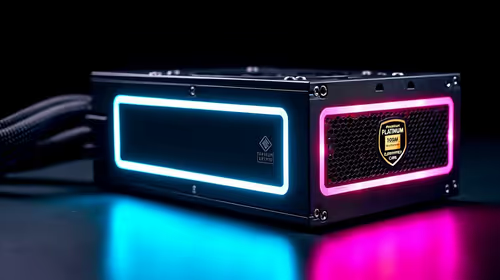
80+ Gold vs 80+ Platinum for couch co-op gaming is about PSU efficiency, heat, fan behaviour, quality, and wattage headroom, not direct FPS. SA buyers should compare the whole build.
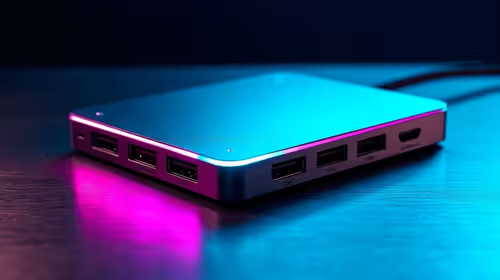
Upgrade your setup with the best USB-C hubs for creators. Discover why high-capacity card readers and dual 4K output are essential for professional South African content production. 🚀💻

B850 motherboard FPS drops needs a methodical troubleshooting pass. Review drivers, thermals, power settings, background apps, cables and game settings before replacing parts in an SA gaming setup.
NVIDIA lists 550W required system power for the RTX 5060 reference specification, based on a high-end test system. A quality 550W unit can be enough, but CPU draw, transient load, connectors and ageing decide real headroom.

OpenRGB's master branch now carries changes labelled for 1.0 final, including translation and platform work, but the official tags page still lists 1.0rc3.1 as the newest packaged release. Stable users should wait for the signed release channel.

A motherboard can remain useful for many years when power, cooling and connectors stay healthy. Replace it for confirmed faults, damaged power delivery or a blocked platform need, not simply because the calendar reaches a fixed age.
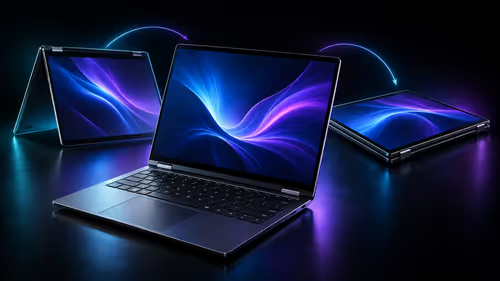
The VAIO T combines a 13.3-inch display with a multi-flip mechanism for laptop, tablet and outward-facing viewing modes. Orders begin in Japan on 18 September; South African availability is unconfirmed.

The smallest ATX case 2026 buyers should choose is the smallest chassis that still fits their exact graphics card, cooler, power supply and airflow plan. ATX support alone does not prove a case has the smallest footprint or volume.

In a 6 bit + FRC vs 8 bit comparison, native 8-bit panels can produce 256 levels per colour channel directly, while 6-bit plus FRC rapidly alternates nearby values to approximate the wider palette. Panel quality still depends on more than bit depth.

The UGREEN LinkStation Pro eGPU dock combines Thunderbolt 5 and OCuLink connections with an integrated 850W ATX 3.1 power supply and up to 140W laptop charging. South African availability is unconfirmed.
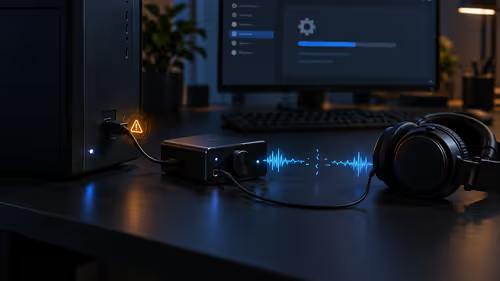
Windows 11 KB5124008 can leave some USB Audio Class 1.0 devices with no sound, Code 10 or failed multichannel output. Microsoft confirms the issue and says switching to two-channel stereo can restore audio for some users.