Is your beastly new CPU hitting its thermal limits before it even breaks a sweat? In South Africa, where ambient temperatures can be a real challenge, even high-end AIO coolers can struggle. As we look towards 2025, with processors demanding more power than ever, it's time to explore the bleeding edge. We're talking about sub-zero temperatures... we're talking about the ultimate chiller. This is your guide to the legendary phase change cooling setup.
What Exactly is a Phase Change Cooling Setup?
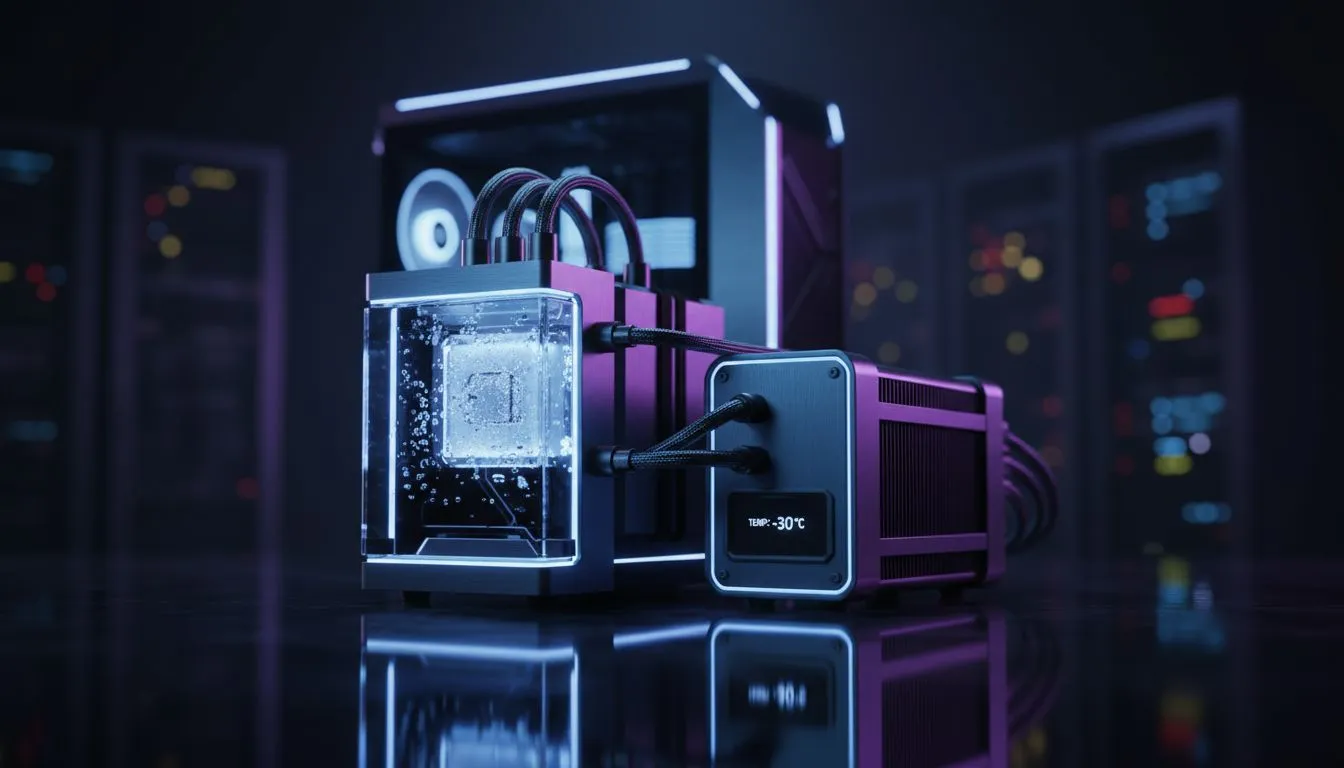
Forget fans and water pumps for a moment. Imagine a miniature, high-power refrigerator bolted directly to your CPU. That's the essence of a phase change cooling setup. It uses a vapour-compression cycle, just like your fridge or air-conditioner, to achieve temperatures well below 0°C, even under heavy load. 🥶
This technology isn't new, but it remains the undisputed king for raw thermal dissipation. A system like this actively chills a metal plate (the evaporator) that makes contact with your processor. A refrigerant gas is compressed, cooled, and then allowed to expand at the evaporator, sucking immense amounts of heat away from your CPU. It's an extreme solution for an extreme performance goal, representing the pinnacle of PC cooling.
Phase Change vs. Traditional Cooling: A Reality Check
So, how does this extreme tech stack up against what most of us use? Let's be realistic... a full phase change cooling setup is in a league of its own, but it comes with serious trade-offs.
For the vast majority of gamers and creators, modern cooling solutions offer fantastic performance without the complexity. A high-quality Air Cooler provides incredible reliability and a simple, set-and-forget experience. They are tough, efficient, and more than capable of handling most high-performance chips.
Stepping it up a notch, the Liquid Cooler (AIO) has become the gold standard for enthusiasts. These sealed-loop systems combine the power of liquid cooling with easy installation and sleek aesthetics, offering a perfect balance of performance and practicality for a powerful PC build.
Is a 2025 Phase Change System Right for You?
This is the big question. A phase change cooling setup offers one massive benefit: unparalleled thermal headroom. This allows for overclocking records and pushing CPUs to their absolute silicon limits. If you're a competitive overclocker or an enthusiast who demands the absolute best, it might be on your radar.
However, the downsides are significant.
- Cost: These are often custom-built, specialised units costing tens of thousands of Rands.
- Power Draw: They have their own power consumption, which isn't ideal in an unexpected outage world. ⚡
- Condensation: This is the biggest enemy. When you cool a component below the ambient dew point, water will condense on it. This requires meticulous insulation of the motherboard socket and surrounding components to prevent short circuits.
Condensation Combat 101 🔧
When running a sub-zero cooling setup, proper insulation is non-negotiable. Use non-conductive materials like neoprene foam, kneaded eraser, and conformal coating on the motherboard PCB around the CPU socket. This creates a barrier, preventing moisture from forming on sensitive electronics and causing catastrophic failure. Always test your insulation in your climate before committing to a long run.
For 99.9% of power users, the performance gains aren't worth the risk and cost. The incredible efficiency of a modern, large 360mm Radiator AIO, especially from a top-tier brand like CORSAIR, provides more than enough cooling power to tame even the hungriest 2025 CPUs without turning your PC into a science experiment.
The Verdict: The Future of Extreme PC Cooling
The phase change cooling setup is a masterpiece of thermal engineering, a true enthusiast's dream. It's a testament to how far we can push technology in the pursuit of performance.
But for your next build, is it the practical choice? Probably not. The real progress for everyday gamers and professionals lies in the ever-improving world of AIO and air cooling. These technologies have become so efficient that they've made extreme cooling a niche pursuit rather than a necessity. Before you dream of ice-cold CPUs, ensure you've explored the best of today's powerful and practical CPU coolers.
Ready to Beat the Heat?
While a phase change setup is the stuff of dreams, we have the cooling power you need today. For maximum performance without the risk, a high-end AIO or air cooler is the smart choice. Explore our massive range of CPU coolers and find the perfect match to keep your rig cool and fast.