A detached room needs a strong network path across open space, not a weak indoor signal stretched through walls. Point-to-point Wi-Fi for gaming can create that bridge when sightlines, outdoor hardware and safe mounting are planned correctly.
Quick Answer
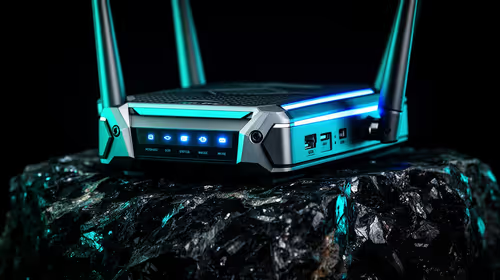
A point-to-point wireless bridge links two buildings with a dedicated pair of outdoor radios. It can give a backyard room a stable network handoff when trenching fibre or another approved cable is impractical. Clear line of sight, correct mounting, compatible radios, safe outdoor cabling, earthing and measured alignment decide the result. Use a qualified installer for rooftop, electrical and lightning-protection work.
Compare routers, switches and network components in Evetech's networking catalogue. Outdoor-rated supporting gear and cables can be identified through the accessory best-seller range. Confirm environmental rating and bridge compatibility from the exact manufacturer documentation.
Choose cable before radio when practical
Ask a qualified installer whether an approved underground or aerial fibre route is safer and simpler. Fibre between buildings avoids a conductive electrical path and radio interference, while trenching, conduit and termination add installation work.
Do not run ordinary indoor Ethernet outdoors or between buildings without a compliant design. Moisture, ultraviolet exposure, lightning and different electrical earth conditions create risks beyond network speed.
A wireless bridge becomes attractive when the buildings have clear sight and civil work would be disruptive. Compare full installed routes rather than the price of two radios against a loose cable.
Prove line of sight
Stand at the proposed mounting points only where it is safe and permitted. The radios need a clear path with space around that path, not a signal fired through a tree canopy, metal roof edge or water tank.
Trees grow and move in wind. A clear winter line can close in summer. Record the path and ask the installer to assess the radio's required clearance for the distance and band.
Do not mount a radio from a ladder or roof edge yourself. Working at height and near mains or lightning paths requires trained people and proper equipment.
Measure the real distance and capacity
Use an accurate site survey rather than estimating from the garden. Choose a bridge pair rated for the distance, expected interference, legal radio use and required throughput.
The advertised wireless link rate is not guaranteed application throughput. Protocol overhead, channel width, signal quality and interference reduce it. Size the link for the backyard room's gaming, calls, streaming and file-transfer needs with reserve.
Avoid a maximum-power approach. Legal limits and good radio design matter. A correctly aimed clean channel can outperform a louder poorly aligned link.
Design both ends as a network
The main building needs a wired handoff from router or switch to the first radio. The backyard radio then feeds a switch, access point or gaming PC according to the layout.
Decide whether the backyard room shares the main LAN, uses a separate network or has guest-style access. A transparent bridge can carry network traffic between buildings, so security and broadcast behaviour need planning.
Give management interfaces strong unique passwords and place them on a controlled network. Update firmware through the manufacturer and back up the configuration.
Do not create a second router with overlapping address service by accident. Use access-point or routed mode deliberately, with one documented device providing addresses for each network.
Install outdoor power and cabling safely
Many bridges use power over Ethernet. The injector, switch and radio must share compatible standards and power requirements. Connector shape does not prove safe power compatibility.
Use outdoor-rated cable, proper drip loops, weatherproof entries and surge or earthing measures designed for the installation. A qualified installer should apply local electrical and building requirements.
Keep indoor equipment dry, ventilated and connected to sound power. Do not route outdoor network cable beside mains conductors without the required separation and protection.
After a nearby lightning event, stop using gear that smells burnt, crackles or shows heat damage. Have the installation assessed rather than replacing the radio and leaving an unsafe path.
Align before optimising games
Mount both radios rigidly and align them using the maker's signal tools. Check signal strength, noise, link quality and negotiated rate. Tighten mounts without shifting aim.
Run a local throughput and latency test between buildings before testing the internet. This isolates the bridge from the provider. Repeat while wind and normal household Wi-Fi are present.
Then play a familiar game over Ethernet from the backyard side. Record router latency, external latency, loss and variation. A good bridge should add a small consistent local delay, though no article can promise wired-equivalent results for every site.
Add Wi-Fi inside the backyard room deliberately
The outdoor bridge delivers the link. It does not automatically provide good indoor Wi-Fi. Place an indoor access point in the room, connected by Ethernet to the far radio or switch.
Choose channels with a site survey so the access point and bridge do not interfere. Keep the gaming PC wired to the far switch where practical, leaving Wi-Fi for phones and portable devices.
Do not use a consumer extender to repeat the main house Wi-Fi through several walls and call it the same design. Each wireless hop shares airtime and can increase variation.
Plan maintenance and failure
Save the radio models, serials, mounting photos, cable route, configuration, firmware and alignment values. Label both power injectors. This helps another technician identify the pair without resetting it.
Inspect mounts and outdoor cable after severe weather from a safe ground position. Let the installer handle height, enclosure and connector work.
Keep a simple fault sequence: test the backyard LAN, radio link, main-house LAN and internet in that order. Rebooting both radios and routers at once destroys the clue about which segment failed.
FAQ
Is a bridge more reliable than an extender?
A dedicated aligned link can be far more stable than repeating indoor Wi-Fi through walls. Site design and installation still decide the result.
Does line of sight matter?
Yes. Clear path and surrounding clearance affect signal, capacity and weather stability. Use a proper site survey.
Is physical cable simpler?
It can be when a compliant route exists. Compare installed fibre or approved cabling with the complete bridge, protection and maintenance plan.
Survey line of sight and a compliant cable route, then have a qualified installer build, protect and baseline-test the bridge before adding the backyard Wi-Fi.