Got your eye on a shiny new Ryzen 9000 or Intel 15th Gen CPU? The hype is real! But before you can unleash that next-level power, there’s one crucial, often-feared step: the BIOS update. Don’t stress, we’ve got your back. This simple guide will show you exactly how to update your BIOS for Ryzen 9000 & Intel 15th Gen safely, ensuring your new chip works perfectly from day one. Let’s get your rig ready for the future. 🚀
Why You Need a BIOS Update for Next-Gen CPUs
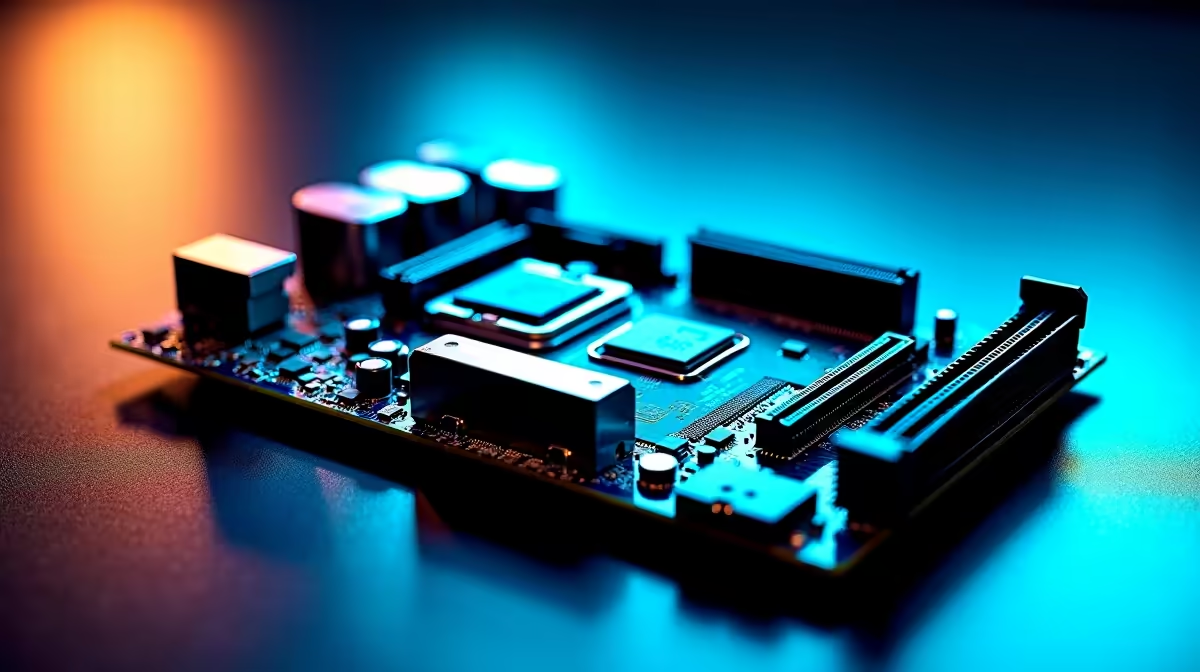
Think of your motherboard's BIOS (or more accurately, UEFI) as its fundamental operating system. It’s the first thing that wakes up, checking your hardware before Windows even thinks about loading. When new CPUs like AMD's Ryzen 9000 series or Intel's 15th Gen arrive, they come with new instructions and requirements. An older BIOS simply won't know how to talk to them.
This is where an Intel 15th Gen BIOS update becomes essential. It provides the necessary compatibility, stability fixes, and performance optimisations to make your new processor sing. It's the digital handshake that makes everything work, and it's the foundation of any great PC build. A proper update ensures you get every ounce of performance you paid for.
Your Pre-Flight Checklist: Before You Update
A little prep work makes the whole process smooth and stress-free. Rushing this step is where problems happen. Before you even think about starting the BIOS update for Ryzen 9000, run through this checklist.
- Identify Your Motherboard: Be precise. Find the exact model name and revision number printed on the board itself (e.g., "MSI MAG B650 TOMAHAWK WIFI", "Rev. 1.0").
- Download the Correct File: Head only to your motherboard manufacturer’s official support website. Navigate to your specific model’s page and download the latest stable BIOS version.
- Prepare a USB Drive: Use a reliable, empty USB flash drive (8GB or 16GB is perfect). Format it to FAT32, as this is the most universally recognised format by motherboards.
- Ensure Stable Power: This is critical, especially in SA. The worst thing that can happen is a power cut mid-update. If you can, use a UPS (Uninterruptible Power Supply). If not, don't attempt an update during loadshedding or a thunderstorm.
Loadshedding Pro Tip ⚡
A BIOS update only takes a few minutes, but a power interruption during that time can brick your motherboard. A small, affordable UPS isn't just for gaming; it's a R1000-R2000 investment that can save your R5000+ motherboard from disaster. It’s the best peace of mind a South African PC builder can buy.
The Step-by-Step Guide to Updating Your BIOS
Alright, you've done your homework. Now for the main event. Here's how to update your BIOS in a few simple steps. The names might differ slightly between brands (e.g., M-Flash, Q-Flash, EZ Flash), but the process is fundamentally the same.
Step 1: Prepare the USB
Unzip the file you downloaded from the manufacturer. You’ll usually find a single file with an extension like .CAP, .ROM, or a series of numbers and letters. Copy this file to the root directory (not inside any folders) of your freshly formatted FAT32 USB drive.
Step 2: Enter the BIOS/UEFI
Insert the USB drive into a port on the back of your motherboard (these are generally more reliable than front-panel ports). Restart your computer and start tapping the Delete or F2 key as it boots up to enter the BIOS setup screen.
Step 3: Find the Update Utility
Look for a menu item called "Tool," "Advanced," or something similar. Inside, you should find the flashing utility. For MSI it’s "M-Flash," for Gigabyte it's "Q-Flash," and for ASUS it's "EZ Flash." This is the key to successfully preparing your motherboard for new CPUs.
Step 4: Flash and Wait... Patiently
Select the utility. It will likely restart the PC into a special update interface. From there, navigate to your USB drive, select the BIOS file you copied over, and confirm you want to proceed. The update will begin. DO NOT turn off or restart your computer for any reason. Just let it do its thing.
Step 5: Reboot and Verify
Once complete, the system will automatically restart. It’s a good idea to enter the BIOS one more time to confirm that the version number has been updated. You can also "Load Optimized Defaults" to ensure a stable starting point for your new CPU. This is how you ensure peak performance on the latest gaming PCs. ✨
What About BIOS Flashback?
What if you have a new Ryzen 9000 CPU but your motherboard's current BIOS is too old to even boot with it? Some modern motherboards have a life-saving feature, often called BIOS Flashback or Q-Flash Plus. This allows you to update the BIOS with just the motherboard and power supply connected—no CPU, RAM, or GPU needed! It’s one of those premium features often found on high-performance workstation boards that has become more common, and it can save you a massive headache. 🔧
And that's it! You've successfully learned how to update your BIOS for Ryzen 9000 and Intel 15th Gen processors. It's a simple but vital skill for any PC builder looking to stay on the cutting edge.
Ready for a Next-Gen Upgrade? Preparing your motherboard is the first step, but the real magic is the hardware itself. Whether you're building a new rig for Ryzen 9000 or looking for a complete pre-built powerhouse, we've got you covered. Explore our incredible range of PC deals and find the perfect machine to conquer your world.