Every cheap part is paid for twice if it destabilises the build. The useful where to save on a gaming PC rule is to cut premiums that do not change the target, while protecting electrical safety, cooling and the components that determine whether the games run well.
Quick Answer
Save on case decoration, extreme RAM speed and storage benchmark tiers when simpler parts still meet compatibility and capacity needs. Do not gamble on power-supply quality, inadequate cooling or a GPU below the required resolution target. Evetech's July 2026 gaming-PC range included a Ryzen 5 5500 and Intel Arc A380 6GB system at R11,969, a dated example of why the complete configuration matters more than one premium component.
💡 Cut features with no assigned job
A plain case can perform as well as an elaborate one if it has suitable airflow, clearance and build quality. Lighting, glass arrangements and unusual materials are aesthetic choices. Cut them first when they do not affect the intended desk.
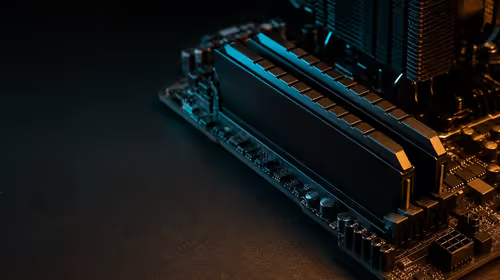
Memory speed also has diminishing returns. Capacity, a stable matched layout and motherboard support come first. Paying for an extreme speed bin while dropping below the required capacity is backwards.
Storage generation is another possible saving. A good SSD is essential for the operating system and modern games, but the highest sequential benchmark may not change ordinary loading enough to justify weakening the graphics budget. Confirm the application's needs before moving down a tier.
Smaller initial storage can work when expansion is easy. It fails when the chosen drive is nearly full on day one or the motherboard has no sensible future slot.
⚡ Protect the power and cooling foundation
A PSU must provide appropriate wattage, connectors, protections and build quality for the exact system. An efficiency badge is useful information but not a complete quality review. Read the full model specification and reputable technical testing.
Evetech listed a Gamemax MAX P550B 550W 80 Plus Bronze ATX 3.1 power supply at R799 in July 2026. That is a named entry reference, not proof that 550W suits every graphics card. Size the PSU from the CPU, GPU and upgrade plan.
Cooling should be adequate rather than extravagant. A modest processor does not need a giant premium cooler, but a hot CPU in a restricted case needs more than the cheapest heatsink available. Include room temperature, sustained workload and noise tolerance.
Saving on fans can increase heat and noise if the case lacks a clean airflow path. Two well-placed suitable fans may beat a larger set installed without direction.
🎮 Fund the performance target
The GPU should be selected from the resolution, settings and frame rate the buyer expects. Cutting it to preserve decorative memory or an unused motherboard feature weakens the purpose of the build.
CPU spending needs balance. High-refresh competitive games can justify more processor performance, while a 1440p GPU-limited setup may not. Compare the exact game benchmarks rather than applying "never cheap out" as permission to overspend.
The motherboard needs the sockets, slots, power delivery and rear connections the system will use. Premium overclocking features, extra expansion and built-in wireless have no value when the owner has no plan for them.
Evetech's gaming PC deals show complete configurations, while the PC best sellers provide another local reference. Compare the hidden foundation parts as carefully as the CPU and GPU.
📋 Use a spend map before checkout
Write four columns: required, useful, cosmetic and future. Required items must meet the performance and safety target. Useful features compete for remaining budget. Cosmetic features come last. Future features need a realistic upgrade date.
For every premium, write the outcome it buys. More capacity prevents a measured memory limit. A stronger GPU reaches the display target. A costlier case changes appearance. This makes cuts deliberate instead of emotional.
Leave a small contingency for a missing cable, fan, adapter or mounting part. A basket balanced to the final Rand can be disrupted by a basic item discovered during assembly.
The cheapest build is not the one with the lowest checkout total. It is the one that reaches the target reliably without paying for a second round of corrective parts.
Frequently Asked Questions
Where is it safe to save on a build?
Case decoration, unused motherboard features, extreme RAM speed and peak storage benchmarks are common candidates when the simpler option meets the requirement.
Which components should not be compromised?
Protect PSU suitability, cooling, required capacity and the CPU-GPU balance needed for the target workload.
Is a cheap power supply a false saving?
It can be. Low price alone does not establish protections, connector support, voltage behaviour or reliability.
Does the case affect gaming performance?
Its appearance does not, but airflow and clearance affect temperature, sustained performance and component fit.
Should I choose slower RAM?
Yes, when the supported lower speed saves meaningful money without sacrificing capacity or stability.
Is a smaller SSD reasonable?
It can be if Windows, applications, active games and free-space margin fit, and expansion remains straightforward.
What if memory cost forces a weaker GPU?
Recheck capacity and speed premiums first. Do not cut below the workload's memory floor, but avoid paying for unused RAM while missing the graphics target.
Ready to cut premiums without cutting the purpose of the PC?
Mark every feature by the job it performs, then compare Evetech gaming builds against the same resolution, capacity and safety checklist.