1440p Monitors Under R10,000: Partners for Midrange GPUs
Quick Answer
Use the R10,000 ceiling as a shortlist filter, then judge the exact monitor on refresh, adaptive sync, pixel response, contrast, stand and warranty. A lower price does not make every 1440p panel equal.
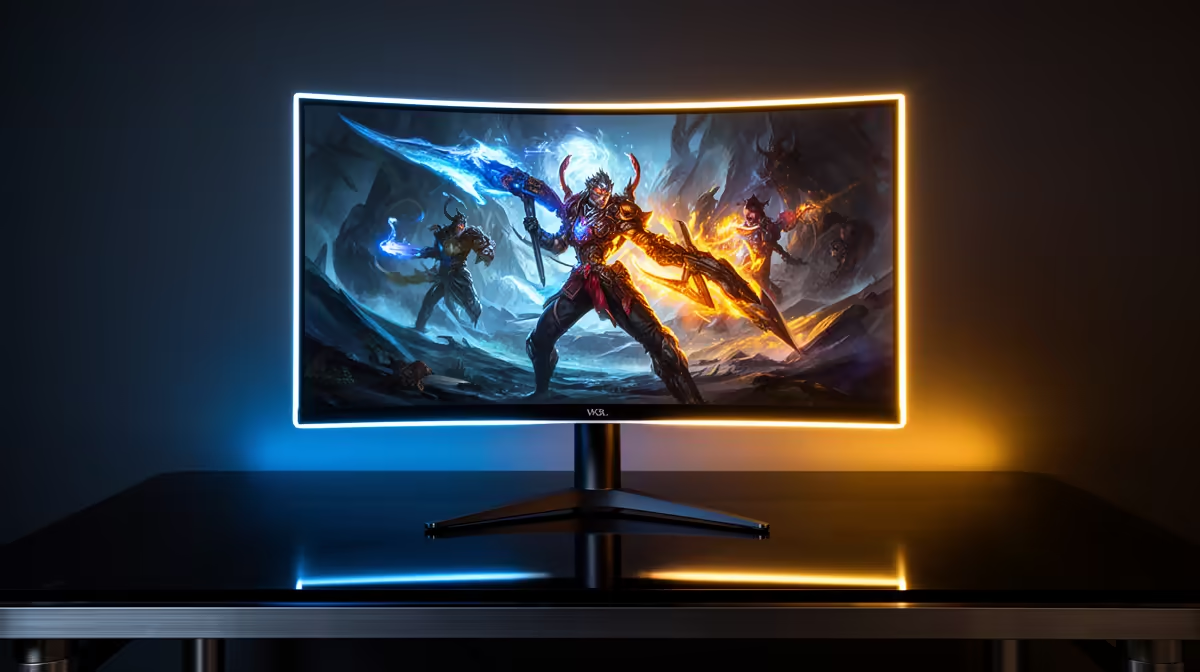
A 27-inch 1440p monitor around 144Hz to 180Hz is the balanced match for a midrange gaming GPU. It improves desktop sharpness and gives competitive games high-refresh room without the full load of 4K.
Confirm the named product's current local price on the day you buy. Monitor prices move, so a model belongs in this bracket only when its dated local listing clears the ceiling at that moment.
Why 1440p Fits Midrange GPUs
The resolution carries about 78 percent more pixels than 1080p and fewer than half the pixels of 4K. That creates a useful middle ground.
Current midrange GPUs can deliver high frame rates in esports and controlled 60fps-to-120fps results in demanding games, depending on title and settings.
Use recent benchmarks for the exact GPU. VRAM, CPU and game patch affect the outcome.
Start With 27 Inches
At 27 inches, 1440p gives clean text and enough desktop space without requiring a deep desk.
A 32-inch 1440p display makes the interface larger and pixel density lower. It suits further viewing distance and buyers who value physical size.
An ultrawide 3440 x 1440 monitor adds width and roughly 33 percent to the standard 1440p pixel load. It asks more of the GPU and budget.
Choose Refresh Before Marketing Extras
The 144Hz to 180Hz range suits mixed gaming. Adaptive sync covers output below the ceiling.
A 240Hz screen can fit competitive play, but panel quality and the PC's delivered frame rate decide whether the premium is useful.
Do not trade a good stand and clean response for a small refresh increase you cannot feed.
Make Adaptive Sync a Requirement
Check FreeSync, G-SYNC Compatible behaviour and the monitor's supported range. Explicit support gives a clearer setup path.
Low Frame Rate Compensation helps below the normal floor when the range supports it.
Read reviews for flicker and overdrive across several refresh rates. A logo cannot show those traits.
IPS or VA at This Budget
IPS offers broad colour consistency and many fast gaming options. Native contrast can look grey in a dark room.
VA gives deeper black and suits atmospheric games. Slow dark transitions can smear on weaker panels.
Choose from measurements. One good VA can beat one weak IPS for your room and game mix.
Response Time Needs Testing
A 1ms claim can describe one best-case GtG transition or an MPRT strobing mode. It does not guarantee a clean panel.
Look for average response, overshoot and refresh compliance. Test the reviewer's recommended overdrive mode.
Consoles sharing the monitor need good response at 60Hz and 120Hz as well as maximum PC refresh.
HDR Is Often the Sacrifice
Many monitors in a value 1440p bracket accept HDR without strong local dimming or brightness. Treat them as SDR displays first.
Mini-LED and OLED can deliver a larger HDR step but may sit near or beyond the budget ceiling depending on current pricing.
Do not pay for a badge when motion, contrast and ergonomics remain weak.
Check Brightness and Coating
A matte coating helps in a bright office but can add grain to white areas. Reflections and window position affect perceived contrast.
Check maximum and minimum SDR brightness. A monitor should fight normal daylight and dim comfortably at night.
Brightness uniformity and backlight bleed vary by unit. Read the return and pixel policy.
Stand Quality Has Daily Value
Height adjustment, tilt and swivel help place the panel correctly. A tilt-only stand can force a riser or monitor arm.
Check VESA support and the stand footprint. Wide gaming feet can consume a shallow desk.
A stronger stand can justify choosing a slightly lower refresh model at the same current price.
Check Ports
DisplayPort usually carries the full PC mode. HDMI timing matters for a console or laptop.
Confirm 1440p at 120Hz for current consoles where supported. A monitor can reach 180Hz over DisplayPort and cap HDMI lower.
USB-C, KVM and hubs are useful only when their power and bandwidth fit your devices.
Pair Common GPU Tiers
An 8GB midrange card can handle many games at 1440p with controlled textures. Demanding new releases may need upscaling or lower settings.
Cards with 12GB or 16GB provide more memory room, but GPU core performance still matters. VRAM capacity is not a performance tier by itself.
Use High before Ultra, keep adaptive sync active and tune from frame-time evidence.
Decide Against 4K Fairly
A 4K monitor gives sharper desktop work and a future upgrade path. It asks much more of the current GPU in games.
At a similar price, a basic 4K 60Hz office panel can trade away high refresh and adaptive sync. That may suit creation and strategy games, not fast gaming.
Choose 1440p when smooth mixed play matters now. Choose 4K when work sharpness and a planned stronger GPU carry more value.
Shop Within the Ceiling
Browse current PC monitors and compare monitor best sellers.
Filter for 2560 x 1440, then check the named model's current price against the ceiling. Do not assume category stock or a permanent bracket.
Shortlist one IPS and one VA. Record refresh, sync range, response, contrast, stand, ports and warranty.
Future-Proof the Useful Parts
A good panel, stand and adaptive-sync range can outlast several GPUs. Ports and resolution should support the next planned system.
You cannot guarantee future game performance or standards. Buy for today's use with a credible upgrade path.
Avoid paying for speculative features while accepting a dim panel or poor motion you see now.
Set Up the Monitor Properly
Use native 2560 x 1440 and select the intended refresh in Windows. Enable adaptive sync.
Choose a balanced overdrive mode and set brightness for the room. Use an sRGB mode when the native gamut oversaturates ordinary content.
Run three games across high, medium and low frame rates. The monitor should remain clean through the range.
FAQ
Can a monitor below the ceiling offer high refresh?
Current pricing and models vary. Verify the named product, but the 144Hz-to-180Hz class is the right target for this shortlist.
Can a midrange GPU drive 1440p?
Yes across a broad library, with settings, upscaling and frame rate adjusted per game.
Should you choose 4K instead?
Choose 4K for desktop sharpness and a future GPU. Pick 1440p for more high-refresh headroom now.
Is VRR common?
Many gaming monitors include adaptive sync, but exact range and GPU compatibility need checking.
What tends to be sacrificed?
Value models can compromise HDR, stand movement, USB features or response tuning. Exact products differ.
Use the R10,000 ceiling only as a live filter, then compare two named 1440p models on measured motion, contrast, stand and current dated price.