A high price threshold can make an ordinary feature set look more exclusive than it is. Asking whether a 4K Gigabit USB-C hub is worth over R1,500 should begin with a real lower-priced reference and require every extra Rand to produce a capability the desk will use.
Quick Answer
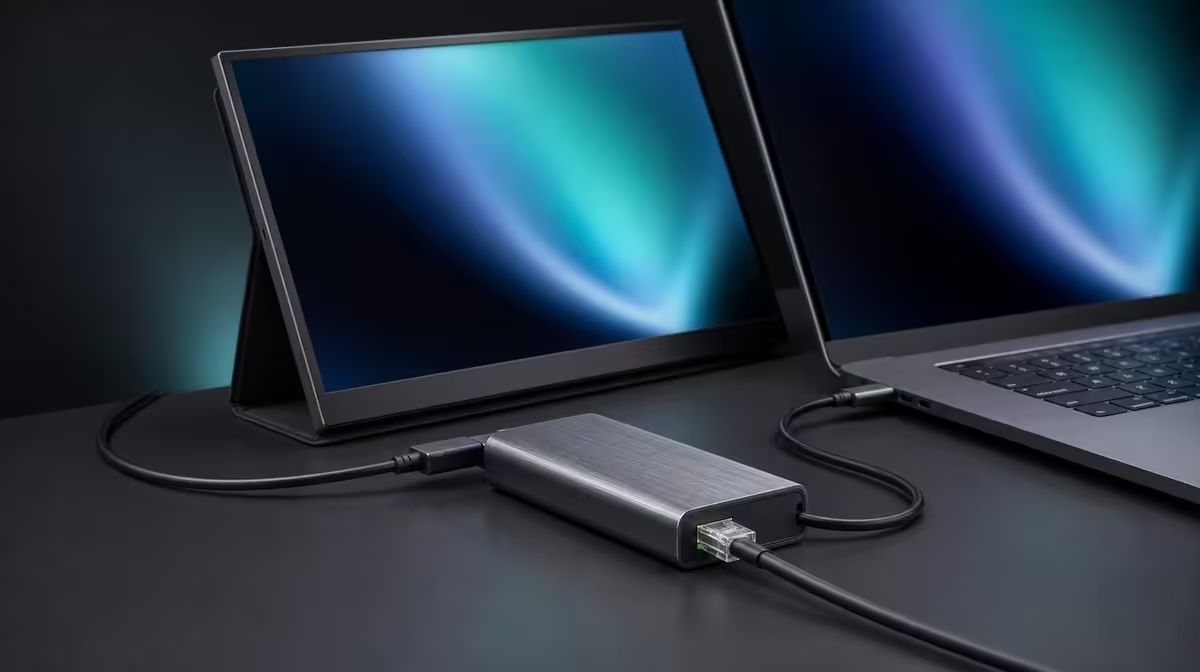
Paying above R1,500 is not necessary simply to obtain 4K video and Gigabit Ethernet. The UPERFECT UExtend costs R399, which is R1,101 below that threshold, and adds 60W passthrough, SD reading, and two USB data ports for compatible hosts.
💸 Correct the threshold before comparing
The R399 UExtend proves that the two headline functions do not automatically place a hub above R1,500. That does not make every costlier option poor value; it means a premium candidate needs another confirmed benefit tied to the buyer's requirement.
Check Evetech's current USB hub selection at purchase time. Compare like-for-like functions and host support while preserving the R1,101 gap as a concrete challenge to any upgrade.
🖥️ Test whether 4K is usable
The source USB-C port must support display output, the cable must suit the chosen path, and the monitor must accept the mode. A hub cannot create video capability at the host. Confirm the picture with other peripherals removed, then add charging and network work gradually.
Treat 4K as the resolution function. Confirm that the actual laptop, connection and screen produce the desired supported output.
🌐 Put Gigabit in network context
The UExtend's Ethernet port is rated at 1000Mbps. Real local and internet results depend on cabling, router or switch capability, service, destination, and shared traffic. The feature earns value when a wired path improves the user's recurring desk work, not when the number remains untested.
Run a representative network task with the display active. If a premium hub claims a different advantage, test that advantage under the same conditions rather than awarding points from the price.
For fixed workstations, Evetech's docking-station range can provide a wider comparison. The more expensive route should win a required connection, power level, or workflow result that the R399 reference lacks.
📊 Make every extra Rand answer a question
Score 60W charging against the laptop's demand, SD reading against the card workflow, and the two USB ports against the attached devices. Count each feature only after it passes with the actual equipment and representative files.
The UExtend also names Nintendo Switch, MacBook, and laptop support, but a buyer must still confirm each intended display, power, network, and peripheral path. Named device families do not turn every possible combination into a guarantee.
Evetech's gaming-accessories options help identify the peripherals that might share the hub. A candidate above R1,500 should be able to answer one or more of these:
- What essential connection does it add?
- What host-supported power need does it meet?
- What repeated setup step does it remove?
- What practical limitation of the R399 reference does it solve?
If no answer survives, the premium is not justified by the two headline features alone. Recheck current UExtend availability and buy around the real task.
Run a blind feature comparison
Create columns for the UExtend and any premium candidate, but hide names and prices. Add rows for host support, 4K display path, charging suitability, wired network, SD, two USB devices, physical placement, and recovery after restart. Mark only confirmed results.
Choose the column that passes the actual setup, then restore the prices. If the premium product wins, the difference should be visible in a required row. If both columns solve the same jobs, R1,101 is a large gap to defend without relying on prestige.
Test two headline functions together
Start with 4K output alone, then establish Ethernet without a storage workload. After both baselines work, activate the screen and wired network in the same ordinary session. The source connection, display route, network cable, and wider equipment all remain involved.
Observe stability rather than forcing an artificial maximum. A presentation plus wired call, a detailed work screen plus local network access, or a film plus network service can provide a more relevant trial than unrelated benchmarks.
Give secondary ports their own value
The 60W path matters when it suits the laptop under load. SD matters when cards recur in the workflow. Two USB data ports matter when two direct devices are enough. Score each consequence if the function disappears.
For example, removing SD may bring back a card adapter; removing one USB port may force repeated swapping; removing Power Delivery may require another host connection. These avoided steps can strengthen the R399 case even before 4K and Gigabit are considered.
Rehearse pack-down and reconnection at a second location. A premium candidate that is harder to carry or rebuild can lose practical value despite an additional confirmed function. The right result balances capability, routine, and the Rands that remain available for other needs.
Use the R1,101 gap as an upgrade budget
Instead of assuming the extra money belongs in the hub, ask what other part of the setup needs attention. The answer may be a suitable display cable, compatible charger, or another defined requirement. This does not prescribe a purchase; it simply prevents the hub ceiling from being spent automatically.
If a candidate above R1,500 really removes an essential limitation, write the improvement and confirm it with the host. The gap can then be justified through a result rather than through a premium label.
Review portability and desk permanence
Measure both the hub and the complete cable kit. A mobile buyer should rebuild the setup at another surface, while a fixed buyer should test wake, restart, and leaving peripherals attached.
Portability can outweigh one additional socket for the traveller; permanence can outweigh compact size for the busy desk. Compare these routines alongside video and network features.
Create a final objection test
Ask why the R399 reference is not enough. Answers such as "it seems cheap" or "the other one has more" should fail. A valid objection names a missing compatible connection, inadequate required power, or another specific outcome.
Then ask why the premium candidate is enough. It should pass the same display, network, charging, storage, and recovery checks. This symmetrical test protects against both false economy and unjustified overspending.
Run an ownership simulation across a normal week: three fixed workdays, a travel day, a presentation or external-screen event, and a storage task. Mark when 4K, Gigabit, charging, SD, and both USB ports appear. The pattern shows whether the headline pair sits inside a frequently used package.
If the R399 reference handles the simulated week, a product above R1,500 needs a demonstrable additional result. If it does not, the failing event becomes the exact requirement for the premium search.
Frequently Asked Questions
How much lower than R1,500 is the UExtend?
Its R399 price is R1,101 below that mark.
Does R399 guarantee compatibility?
No. Host display modes, charging, cables, and attached equipment still require confirmation.
Can Gigabit make any internet line reach 1000Mbps?
No. The Ethernet rating is only one part of the wider service route.
When can paying more make sense?
When another option adds a required, confirmed result the UExtend cannot provide.
Should USB speed be used in this premium test?
Test it with your host, device and representative files, then record completion time and stability.
Ready to challenge a R1,500 hub budget with a real R399 reference?
Compare Evetech's USB hubs and docking options by the additional result each Rand purchases for your host and desk.