Price does not grant Hall sensing a monopoly above R1,500. The Hall Effect controller worth question has a direct correction: the GameSir X5s costs R699, not more than R1,500. Its anti-drift Hall sticks and analog triggers sit R801 below that threshold, so the decision should turn on the actual package and intended games rather than the headline band.
Quick Answer
No, you do not need to spend above R1,500 to obtain Hall Effect mobile controls. Evetech's GameSir X5s is R699, placing it R801 below that figure while including anti-drift Hall sticks and analog triggers. Paying more may make sense for a different platform, format or feature requirement, but Hall sensing alone does not justify the threshold.
🧮 Correct the price comparison first
A misleading price band can make an affordable feature appear exclusive. Here, the reference product changes the premise. R1,500 minus R699 leaves R801, which is too large a gap to ignore. The X5s proves that Hall Effect sticks can appear in a mobile controller well below the proposed level.
That does not mean every sub-R1,500 controller is equivalent, or that price never reflects useful differences. It means the sensing method should be separated from the rest of the product. A different controller may target another device, physical format or input requirement. Those distinctions should be named rather than bundled into a vague assumption that Hall automatically costs more.
Affordability and suitability are two separate verdicts. The X5s proves that Hall input can be affordable at R699. Whether it is suitable depends on Android use, game support, preferred connections and the controls a player values. Keeping those verdicts apart prevents a correct price correction from becoming an overbroad recommendation.
The Evetech gaming controller department is the appropriate place to compare current alternatives by their complete role. Start with platform and game support, then judge connections and controls before considering how close a product sits to a round budget number.
🧲 Understand what Hall hardware buys
Hall Effect sticks measure position magnetically. Traditional potentiometer sticks use physical contact along resistive tracks, which can wear and contribute to unwanted neutral movement. Removing that rubbing measurement surface is the basis for the anti-drift benefit.
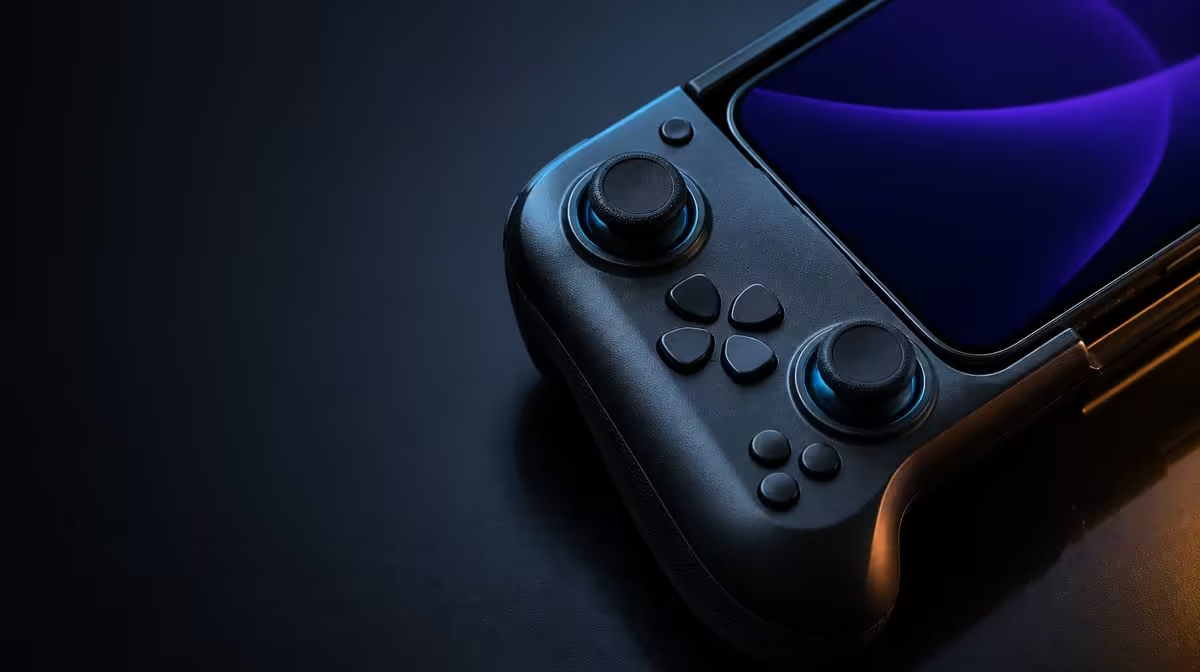
The X5s includes Hall anti-drift sticks and analog triggers. Those are two distinct forms of control: the sticks report movement across axes, while the triggers can provide graduated travel when the game supports it. Their usefulness should be tested in actual play rather than inferred from the feature names.
Hall sensing does not make calibration, deadzone or care irrelevant. Software settings and physical condition still affect the response. A buyer should expect a stronger resistance to contact-related drift, not an impossible promise that no unwanted movement can ever occur.
Run a neutral check when the controller is first configured. Release both sticks, observe the centre, move them through their range and allow them to return naturally. That small routine gives the Hall hardware a fair test and creates a reference for later. It also stops an oversized game deadzone from being mistaken for smooth input.
That measured expectation is important to value. Paying for a durable sensing principle is reasonable. Paying an extra R801 solely because a title implies Hall controls live above R1,500 is not. The R699 X5s establishes a real South African counterexample.
📱 Judge the rest of the mobile package
Android compatibility determines whether the controller reaches its intended audience. Game support still needs to be checked because an Android title may rely on touch input or expose only part of an external controller's features.
The X5s offers Bluetooth, USB-C and 2.4GHz connections. Bluetooth favours a simple mobile arrangement. USB-C creates a direct wired path. The 2.4GHz option needs a dongle that is not included, so the complete cost of that route extends beyond the R699 controller. This missing accessory is a real comparison point, unlike an assumed premium for Hall sticks.
Six-axis gyro adds motion input in supported games. HD Vibration provides a channel for more varied feedback. Swappable ABXY buttons, Turbo and software customisation cover physical labels, repeated inputs and supported mappings. A lightweight design supports portable use.
None of those extras should be used to invent a universal winner. A player who wants Android motion aiming may value gyro strongly. Someone building a PC-only receiver setup may care more about the excluded dongle. Another buyer may use Bluetooth, Hall sticks and nothing else. The package is worth R699 when its useful parts align with that routine.
The physical ABXY caps and software mappings deserve separate attention. A cap changes the visible letter; a mapping changes the action. Buyers who switch layouts may value both, while someone satisfied with the default can leave them untouched. Turbo is similarly conditional: it helps only when a repeated action is suitable and permitted by the game.
Browse Evetech's gaming accessory category for surrounding equipment after the controller role is clear.
⚖️ Know when a higher spend can be rational
Spending above the X5s price can still be sensible when a buyer needs something the product is not being used to prove. A different physical style, platform need or combination of controls may justify another budget. The key is to state that requirement before seeing the price.
Build a three-line comparison. First, write the devices and games. Second, name the essential connection. Third, choose the controls used most often. If the X5s meets those needs, a higher price requires a separate benefit. If it does not, the search should continue without pretending that Hall sensing itself failed the test.
Then add a fourth line for exclusions. On the X5s, the 2.4GHz dongle belongs there. This line is not a complaint; it is an honest boundary around the R699 package. A Bluetooth-focused Android buyer may barely care, while a receiver-first PC player may give it decisive weight.
The same method works above or below R1,500. Compare complete roles, not isolated features. A product earns a higher budget by solving a different or broader need, and a lower-priced option earns consideration by meeting the actual one without unnecessary spend.
Keep the 2.4GHz receiver question explicit. The dongle is not included, so a buyer planning that route should compare the whole arrangement. Bluetooth and USB-C remain available, which means the excluded receiver matters differently to different routines.
Use the popular Evetech accessories page for context around a wider setup, but do not let optional additions inflate the controller decision. The central fact remains simple: South African mobile players can obtain Hall Effect sticks in the R699 GameSir X5s, far below R1,500.
Frequently Asked Questions
Is the GameSir X5s priced above R1,500?
No. It is R699 at Evetech, which places the controller R801 below that threshold. The title's price premise therefore needs correction.
What Hall controls are included at R699?
The X5s includes anti-drift Hall Effect sticks and analog triggers. The sticks use magnetic position sensing, while the triggers serve a different graduated input role.
Does the R699 package include the 2.4GHz dongle?
No. Tri-mode support is part of the controller, but the receiver is not included. Budget for compatible extra hardware only if that connection route is important.
When could a more expensive controller still make sense?
When it meets a specific platform, format or control need that the X5s does not cover for that buyer. A higher price should answer a named requirement rather than stand in for quality.
Ready to compare Hall controllers against real prices?
Browse Evetech's gaming controller category and assess complete features instead of treating R1,500 as the entry point.