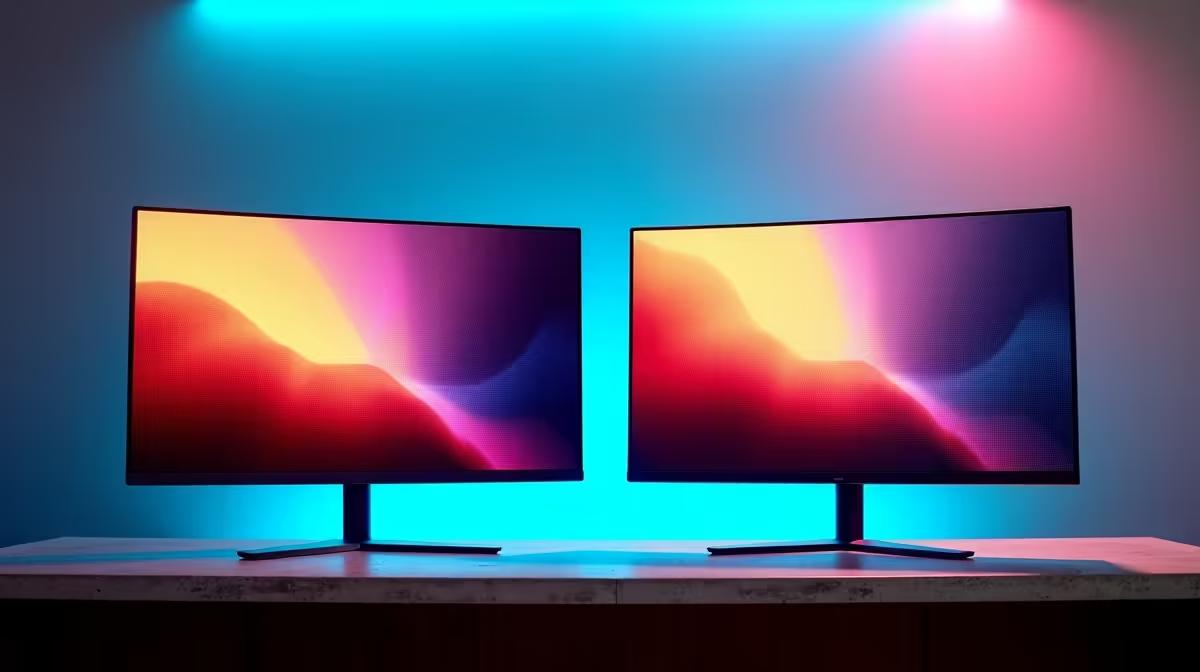
Buying a 1440p QHD monitor for Twitch streaming feels like an obvious quality upgrade, and for what you see on your own desk it is. For what your viewers see, the situation is more nuanced, because Twitch's transcoding pipeline sits between your source and everyone watching. The question worth asking honestly is: where does the QHD resolution actually matter in your specific setup, and where does the gain vanish before reaching the audience?
Quick Answer
1440p QHD looks sharper on your own screen and, when downscaled to 1080p, produces slightly crisper stream output than encoding native 1080p directly. Most viewers watch at 1080p or lower, so the audience gain is modest. QHD is worth it if you game at 1440p and want a sharper personal viewing experience while streaming.
📺 What Twitch Actually Receives From a QHD Source
Twitch's standard stream cap is 1080p at 60fps. Regardless of whether your game is running at 2,560 by 1,440 or 1,920 by 1,080, the output your encoder sends and what Twitch accepts tops out at 1080p in most channel configurations. Viewers watching your stream select from the quality options Twitch generates from that 1080p master.
This does not make QHD irrelevant as a source. When OBS takes a 2,560 by 1,440 canvas and downscales it to 1080p for the stream, the algorithm is working with more source information than it would have if you captured native 1080p. Overlays, text, and fine UI details look slightly less compressed in the downscaled output because the source had more pixels to work with. The gain is real but subtle; a typical viewer focused on gameplay rather than HUD clarity will not notice the difference.
Where QHD as a source gives a cleaner result is when you are cropping or repositioning elements on the canvas in OBS. If you zoom into a section of the game capture, or crop a 1440p game capture to a 1080p output to remove a UI element, the result is sharper than the equivalent crop from a 1080p source because QHD starts with more detail in the uncropped regions.
The Encoding Load Trade-off
Streaming from a QHD source increases the work the encoder does before the output reaches its 1080p delivery size. OBS on a QHD canvas needs to read more pixels per frame and apply more scaling work than on a native 1080p canvas. The additional processing load sits at roughly 15 to 25 percent compared to a native 1080p workflow, depending on the downscale filter quality selected.
For a system with a capable streaming GPU or a dedicated encoding chip, this overhead is absorbed without affecting frame rate. For a system at the limit of its streaming capability, a QHD canvas can create headroom pressure that shows up as dropped frames or encoding lag mid-stream.
⚡ Gaming at QHD While Streaming to 1080p
One of the cleaner use cases for QHD in a streaming context is playing the game at 2,560 by 1,440 on the display for personal clarity, while OBS captures and outputs the session to 1080p for viewers. The game looks sharper on your screen with more visual detail, UI elements are more readable, and the enemy models appear at a finer resolution. The viewer receives the downscaled 1080p version, which is perfectly normal quality.
This dual-resolution approach requires a GPU capable of driving the game at QHD frame rates at acceptable quality settings. In titles like Valorant or CS2 that are relatively undemanding, even mid-tier hardware handles QHD comfortably. In more demanding titles, QHD gaming at high settings requires a capable card, and the streaming encode adds to that load.
The practical result for most SA streamers is a noticeably better gaming experience on their own screen, with streaming quality that is marginally better than a native 1080p source. Whether that combination justifies the monitor cost compared to a 1080p display depends on the individual priority between personal experience and audience output.
Pro Tip ⚡
In OBS, set the downscale filter to Lanczos rather than the default bilinear when streaming from a QHD canvas. Lanczos applies a higher-quality resize algorithm that produces sharper results, particularly for text overlays and game UI elements. The processing cost is minimal on modern hardware and the output quality improvement is visible on static elements.
🧠 When 1080p Still Makes Sense for a New Streamer
A 1080p monitor from R2,500 to R4,000 matches Twitch's output format exactly, with no downscaling, simpler encoding, and lower per-frame GPU load. For a streamer in the early stages of building an audience, that simplicity is genuinely sensible. QHD becomes more compelling once the channel is established and the personal viewing experience becomes the limiting factor. A 27-inch QHD panel also doubles as a workstation display for thumbnail creation and highlight editing, which adds utility beyond the stream itself.
Resolution and Viewer Perception
Twitch viewers predominantly watch on mobile devices or browser tabs where the stream occupies a portion of the screen. The quality difference between a stream sourced from QHD versus 1080p is not perceptible at typical viewing sizes. The scenarios where it might be noticed are large-screen viewing at high bitrates and close comparison, not everyday casual watching.
A higher bitrate matters more to most viewers than a higher source resolution. A stream at 6,000 kbps from a 1080p source outperforms a stream at 3,000 kbps from a QHD source in terms of perceived quality. If channel bandwidth allows, prioritising bitrate headroom gives a more consistent return for viewer experience than changing the source resolution.
🎯 Making the Decision for Your Setup
Three questions focus the choice. Is the primary motivation sharper personal gaming, better stream output, or both? If personal clarity leads, QHD justifies itself independently. If the goal is purely viewer improvement, a higher bitrate on the current 1080p setup may deliver more.
Does the existing GPU handle QHD at your preferred settings in your primary titles? And is the R2,000 to R3,000 price gap available without pulling budget from GPU, RAM, or storage?
For an established South African streamer with capable hardware, QHD makes real sense. For someone starting out, a 1080p display holds nothing back in any way that viewers will notice.
Frequently Asked Questions
Do Twitch viewers actually see the full 1440p from a QHD source?
No. Twitch's maximum ingest and delivery for most channels is 1080p at 60fps. Your QHD source is downscaled by OBS to 1080p before it ever reaches the platform. Viewers select from 1080p, 720p, and lower quality tiers generated from that 1080p master, regardless of what resolution your monitor runs at.
Does streaming from a QHD canvas improve output sharpness?
Slightly. Downscaling 2,560 by 1,440 to 1080p with the Lanczos filter in OBS preserves fine detail better than encoding native 1080p. The gain shows most on text overlays and UI elements. For raw gameplay it is subtle and rarely perceptible to casual viewers.
Will a QHD monitor raise my encoding load and cause dropped frames?
Potentially, if the system is already near its streaming ceiling. A QHD OBS canvas adds roughly 15 to 25 percent more scaling work per frame compared to 1080p. A system with comfortable headroom handles this without dropped frames. A system already pushing its limits may benefit from moving encoding to a dedicated GPU process rather than the CPU.
Can I play games at 1440p and stream at 1080p simultaneously?
Yes. OBS captures the game at QHD and downscales the canvas to 1080p for the stream output. You see the sharper 2,560 by 1,440 image on your display while viewers receive the 1080p version. The GPU drives both resolutions at once, so its capacity determines how comfortably the dual-resolution workflow runs.
Why might a new streamer prefer a 1080p monitor?
A 1080p display matches Twitch's output resolution exactly, simplifying the encoding setup and reducing GPU overhead. The cost difference versus QHD can go toward a better GPU or faster internet, both of which improve the viewer experience more directly than raising the source resolution.
Ready to build a sharper streaming setup on your own terms?
Browse QHD and 1080p streaming monitors for South African content creators, with a range that covers every budget and GPU configuration.