Quick Answer
For heavy sustained CPU loads, a 360mm AIO outperforms top-tier air coolers by 5 to 12 degrees Celsius on chips like the Ryzen 9 9950X and Intel Core Ultra 9 285K. However, a premium dual-tower air cooler such as the Noctua NH-D15 G2 or be quiet! Dark Rock Pro 5 closes that gap significantly on CPUs with 65W to 125W TDP, making AIO the stronger choice only at the high-end of the thermal load spectrum.
Where AIO Pulls Ahead 🌊
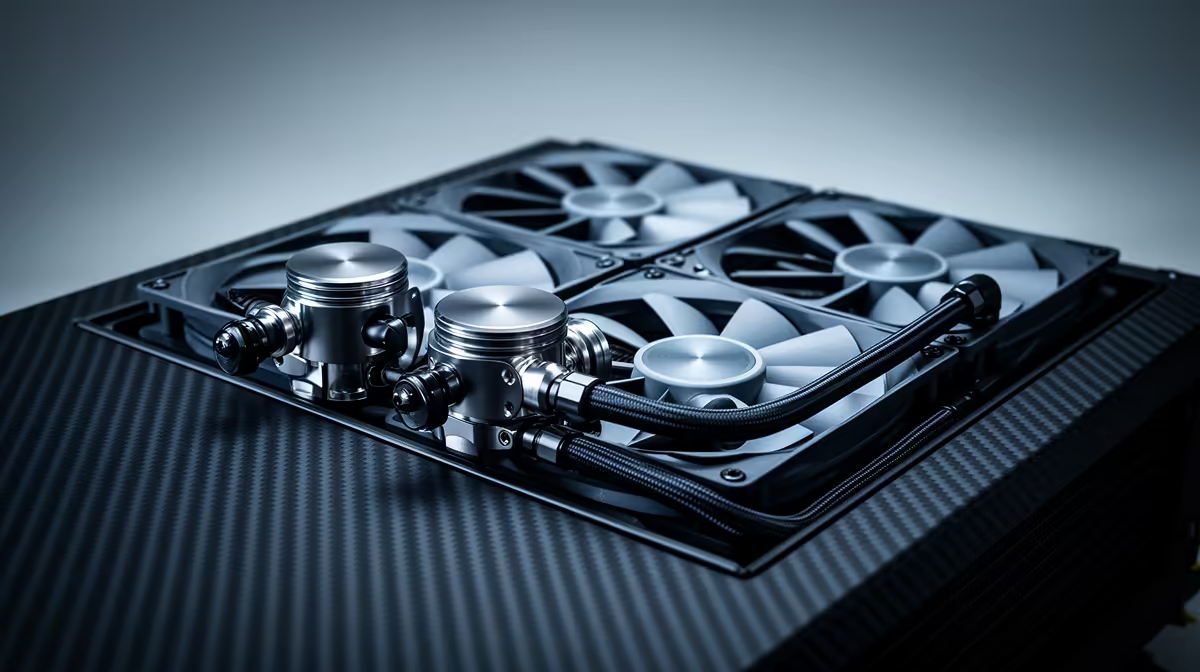
The 360mm radiator's surface area allows it to dissipate sustained loads that overwhelm even the best tower coolers over time. When a Ryzen 9 9950X pulls 200W in a prolonged Blender render, a 360mm AIO keeps package temperatures in the 80 to 85 degree range while a dual-tower air cooler may stabilise 10 to 15 degrees higher, triggering more aggressive boost clock pullback. For SA builders running workstation tasks like 3D rendering or video encoding in addition to gaming, the AIO's edge in sustained thermal performance translates to more consistent frame times and shorter render queues. AIOs also keep the area around the CPU socket clearer, which benefits boards with tight VRM heatsink clearances.
Where Air Cooling Holds Its Ground 💨
Premium air coolers cost less than 360mm AIOs in SA. A Noctua NH-D15 G2 sits around R1,800 to R2,200, while quality 360mm AIOs start around R2,200 and run to R5,500 for flagship models. Air coolers carry zero failure modes related to pump or liquid: there is no pump to fail, no hose to kink, and no coolant to permeate over time. For a mid-range gaming build on a Ryzen 5 9600X or Core Ultra 5 245K, a high-end air cooler is genuinely competitive with a 360mm AIO in gaming workloads where CPU usage is intermittent rather than sustained. RAM clearance can be an issue with dual-tower designs on some microATX boards, so check compatibility before purchasing.
Making the Right Call for Your Build 🖥️
The decision hinges on CPU TDP and use case. If your CPU is rated at 65W or 125W and you primarily game rather than render, a top-tier air cooler matches or closely rivals a 360mm AIO at lower cost. If your CPU exceeds 150W sustained under your typical workload, a 360mm AIO is the more rational investment. Case clearance also plays a role: small form factor and microATX cases often cannot accommodate 360mm radiators at all, making a compact tower cooler the only viable option. Evetech stocks both categories, letting you compare specifications and pricing directly against your build requirements.
Check Case Radiator Support Before Buying ⚡
Confirm your case's maximum radiator length and thickness clearance in the spec sheet before ordering a 360mm AIO. Cases that list 360mm support on the front panel sometimes restrict top-mount options to 240mm due to VRM heatsink clearance. Measure first, order second.
FAQ
Does a 360mm AIO make sense for a Ryzen 5 9600X build?
A premium air cooler handles the Ryzen 5 9600X's 65W TDP without compromise and costs less. A 360mm AIO is overkill unless aesthetics, noise targets or future CPU upgrade plans justify the premium.
Are AIO coolers louder than air coolers under load?
At full radiator fan speed, 360mm AIOs can be louder than premium air coolers using large slow-spinning fans. At moderate speeds the difference is minimal. Fan curve tuning through the motherboard BIOS brings AIO noise to competitive levels with high-quality air coolers during typical gaming sessions.
What is the lifespan difference between AIO and air cooling?
Premium air coolers have no mechanical failure modes and can last indefinitely with the fans occasionally replaced. AIO pumps typically carry 5 to 6 year warranties, reflecting a real expected service lifespan. Budget for a pump-related replacement at the 5 to 7 year mark with liquid cooling.
Not sure which cooling type suits your build?
Browse Evetech's full range of 360mm AIOs and premium air coolers side by side to find the right thermal solution for your CPU and case.