Quick Answer
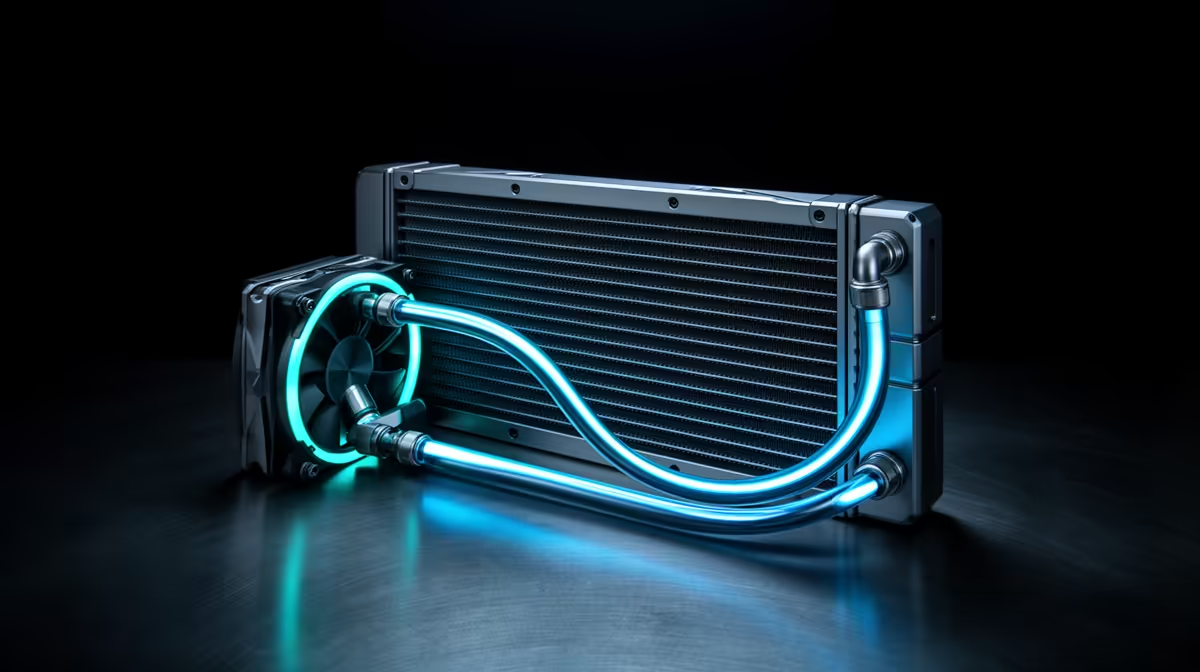
A 420mm radiator has roughly 40 percent more surface area than a 360mm radiator (438mm x 140mm vs 394mm x 120mm), which means more heat dissipation capacity and lower liquid temperatures under sustained load. At equivalent fan speeds, a 420mm AIO runs 3 to 7 degrees Celsius cooler than a 360mm AIO on the same CPU. For most mainstream gaming builds on AM5 or LGA1851, a 360mm AIO is sufficient.
Surface Area and Real-World Thermal Impact 🌡️
The thermal advantage of 420mm over 360mm comes from the combination of larger surface area and wider 140mm fans versus 120mm fans. A 140mm fan moves more air at lower RPM than a 120mm fan of equivalent quality, which means the 420mm radiator not only dissipates more heat but does so more quietly.
In measured tests, a Ryzen 9 9950X under all-core Cinebench load sits around 85 to 90 degrees Celsius on a quality 360mm AIO at 25 degree ambient. The same CPU on a 420mm AIO in the same conditions drops to 78 to 83 degrees Celsius.
Case Requirements: What Each Radiator Size Demands 📐
A 360mm radiator uses three 120mm fans and requires a mounting zone approximately 395mm long. Most full-size ATX mid-towers support 360mm at the front or top without issue. A 420mm radiator uses three 140mm fans and needs a mounting zone approximately 440mm long. Only cases that explicitly support 420mm can accommodate this, and they are typically larger mid-towers or full towers.
This case requirement is the main practical barrier to 420mm adoption. If you are currently shopping for a case, confirm 420mm support on the spec sheet if you plan to use a large AIO now or in the future. Cases that support 420mm typically also accommodate 360mm, 280mm, and 240mm, giving you more flexibility for future upgrades. In SA, 420mm-capable cases range from R2,200 to R5,500.
Price Difference Between 360mm and 420mm AIOs in South Africa 💰
Expect to pay R300 to R900 more for a 420mm AIO from the same brand lineup compared to the equivalent 360mm model. Entry-level 360mm AIOs from brands stocked at Evetech start around R1,500 to R1,800. Equivalent 420mm AIOs start around R1,900 to R2,400. Premium 420mm units with high-quality pumps, ARGB fans, and LCD pump heads run R3,000 to R4,500 locally.
For most gamers running Ryzen 7 9800X3D (a gaming-focused CPU with moderate heat output due to its 3D V-Cache design), a 360mm AIO is more than adequate and the saved R400 to R800 is better invested elsewhere. The 420mm premium is most justified for Ryzen 9 9950X, Core Ultra 9 285K, and Threadripper Pro platforms.
Fan Noise Trade-Off at High Load ⚡
acoustics matter in your SA gaming setup, the 420mm advantage extends beyond temperature: you can run its three 140mm fans at lower RPM for equivalent cooling versus a 360mm's 120mm fans. At moderate gaming loads, a 420mm AIO running at 60 percent fan speed is often inaudible over game audio.
FAQ
Is a 420mm radiator always better than a 360mm radiator?
In thermal terms, yes. But the size and cost premiums make it overkill for mainstream gaming CPUs. A 360mm AIO is the practical ceiling for most gaming builds; 420mm is the right choice for workstation-class CPUs or if you plan to push sustained all-core workloads regularly.
Can I fit a 420mm radiator in my current mid-tower case?
Only if the case spec sheet explicitly lists 420mm support. Most standard ATX mid-towers max out at 360mm. Measure the front and top mounting zones against the 440mm length of a 420mm radiator before purchasing.
Does a 420mm AIO improve gaming frame rates versus a 360mm AIO?
For typical gaming workloads where CPU temps stay well within thermal limits on either cooler, the frame rate difference is negligible. The benefit appears in sustained workloads where the CPU would otherwise thermal throttle, which is rare in pure gaming but common in combined game-plus-stream or game-plus-encode scenarios.
Deciding between a 360mm and 420mm AIO for your build?
Browse the full range of liquid coolers and compatible cases at Evetech, with specs to match cooler to case before you commit.