


iRacing SA Gaming PC Build Guide
iRacing build planning should focus on the target resolution, settings and total system balance. Treat launch wording as time-sensitive, then verify requirements before choosing SA PC parts.
Read morePSU efficiency ratings climb from Bronze through Titanium, with 80 PLUS Platinum delivering 92 percent at 50 percent load. Wattage, efficiency tier, and ATX 3.1 readiness shape both your daily power bill and your transient stability.
The 80 Plus program tests PSU efficiency at 20%, 50%, and 100% of rated load under 230V for SA conditions. Platinum certification requires 90%, 92%, and 89% efficiency at those three load points respectively. Understanding these numbers helps SA buyers pick the correct wattage and certification tier for their build without overspending on capacity that operates outside the efficiency sweet spot.
The 80 Plus organisation tests PSUs under controlled lab conditions: 23 degrees Celsius ambient, stable input voltage, and purely resistive load banks. Results are certified to a six-tier scale: White, Bronze, Silver, Gold, Platinum, and Titanium. At the 50% load point and 230V mains, which is the relevant test for SA, Gold must achieve 87%, Platinum must achieve 92%, and Titanium must achieve 96%. The certification is per-model: the exact unit submitted for testing must pass. Reputable manufacturers maintain consistent quality across production batches; less reputable brands have been caught submitting hand-selected engineering samples. Always cross-reference the specific model number in the 80plus.org database rather than relying solely on the badge on the box.
The 50% load point is where PSU efficiency is highest and where the certification tier is most relevant. For a 1000W Platinum unit, 50% load is 500W: a system with an RTX 5080 and Ryzen 7 9800X3D gaming at around 420W to 480W sits very close to this sweet spot. For a 650W Gold unit powering the same system, 50% load is 325W, and the system runs at 65% to 74% load, slightly past the efficiency peak but still within a few percent of the rated Gold efficiency. The 20% load point during light desktop use and the 100% load point during benchmark peaks see slightly lower efficiency on most units: Platinum still outperforms Gold at these points but the gap narrows. Buying a PSU that puts your typical gaming draw near 50% of rated capacity extracts the most value from the efficiency certification.
The 80 Plus badge tells you efficiency at specific load points but says nothing about voltage regulation quality, ripple suppression, transient response, capacitor quality, warranty length, or build quality. Two Platinum units can deliver 92% efficiency at 50% load while differing by R2,000 in price and significantly in ripple noise. For SA builders, additional evaluation criteria include: Japanese versus Chinese capacitors (Japanese 105-degree-rated capacitors age better in warm SA environments), MTBF rating (aim for 100,000 hours or above for a ten-year build target), warranty length (ten years from premium brands versus five from mid-range), and whether the specific model is in the 80plus.org database rather than carrying an unofficial self-rated badge.
Go to 80plus.org, click the database search, and enter the exact model number of the PSU you plan to purchase. If the model does not appear, the efficiency claim is unverified by the independent organisation. Some brands list product families without the specific wattage variant tested. If in doubt, ask Evetech to confirm the specific unit has its certification independently verified before committing to the purchase.
No.
No.
Yes. Electrolytic capacitors lose capacitance and increase equivalent series resistance with age and heat exposure. A Platinum unit that starts at 92.5% efficiency at 50% load may measure at 90% after seven to eight years of daily use.
Ready to choose the right PSU efficiency tier for your build? Evetech carries certified 80 Plus Gold, Platinum, and Titanium PSUs from trusted brands, all with local warranty support and verified model listings.
iRacing build planning should focus on the target resolution, settings and total system balance. Treat launch wording as time-sensitive, then verify requirements before choosing SA PC parts.
Read more
Skyrim PC requirements should be mapped to resolution, settings and upgrade budget before choosing a tier. Verify current requirements, then balance GPU, CPU, RAM and SSD around SA pricing.
Read more
Skyrim PC builds is a cautious guide for game PC build planning. Compare game requirements, tier fit, resolution goals, RAM, storage, and GPU choice for SA buyers without assuming live prices, availability, or exact benchmark results.
Read more
Hades 2 PC builds is a cautious guide for game PC build planning. Compare game requirements, tier fit, resolution goals, RAM, storage, and GPU choice for SA buyers without assuming live prices, availability, or exact benchmark results.
Read more
Roblox PC builds is a cautious guide for game PC build planning. Compare game requirements, tier fit, resolution goals, RAM, storage, and GPU choice for SA buyers without assuming live prices, availability, or exact benchmark results.
Read more
Mortal Kombat 1 launch needs a balanced parts plan, not a random basket. Map the CPU, GPU, RAM, SSD, cooling, and monitor target to the budget so SA builders know where to spend first.
Read more
Wondering if a TKL wireless mechanical keyboard is worth it for everyday productivity? We break down latency, battery life, comfort, and workflow gains for real work. ⚡⌨️

Maximise battery life on a fanless 15-inch laptop using efficiency core architecture. Cut idle drain, tune power profiles, and improve thermals for longer runtime. 🔋⚙️
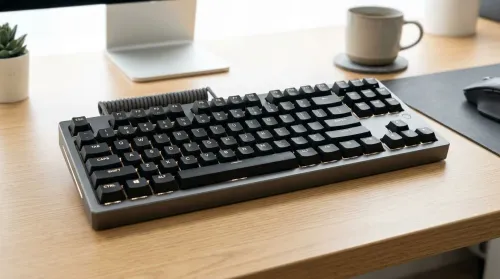
Learn how to reduce desk clutter with a TKL wireless keyboard using fewer cables, smart placement, and tidy essentials. Get a faster, calmer workspace with better ergonomics. ✅🧼
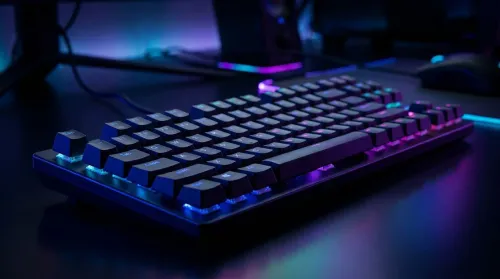
RGB keyboard lighting too distracting? Learn how to manage backlight modes, set brightness, and reduce distraction for focus and productivity 😌🖱️
Are themed gaming keyboards worth the extra cost? Compare build quality, switch options, features, and resale value to find the best fit for your setup 🎮⌨️
Full-Size vs Tenkeyless mechanical keyboards for gaming: find out if a smaller layout truly improves aim, speed, and comfort. We break down layout, desk space, latency-feel, and keybinds 🎮⌨️

Dedicated media rollers vs function key shortcuts: learn which setup gives you better workflow control, faster media access, and fewer mistakes. 🖱️🎧
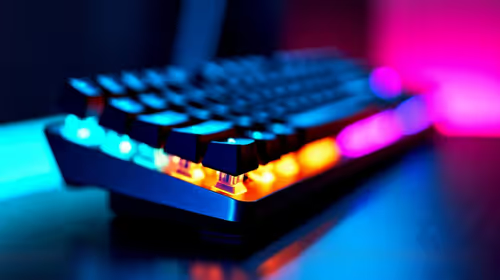
Best Mechanical Switch Type for Gaming: Clicky vs Linear vs Tactile. Find your feel, speed, and noise balance with practical guidance for FPS, MOBA, and productivity 😄🎮
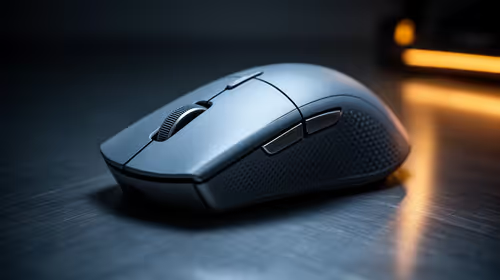
Direct mouse answer: Mouse not keeping up with your work? Everything that matters about dual-mode 2.4GHz + BT 5.0: DPI behaviour, channel switching, battery curves and per-app button mapping. Covers when 2.4GHz USB wins (low-latency desk) and when BT 5.0 wins (laptop, d
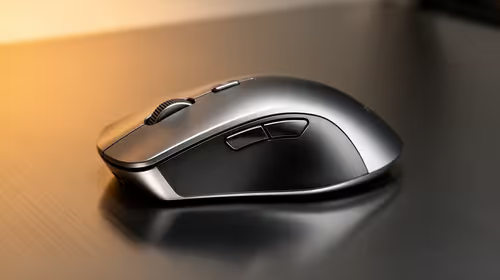
Plain wireless mouse guide: Mouse not keeping up with your work? Everything that matters about wireless productivity mouse: DPI behaviour, channel switching, battery curves and per-app button mapping. Includes DPI tuning tips, channel switch shortcuts, and ZAR-aware fea
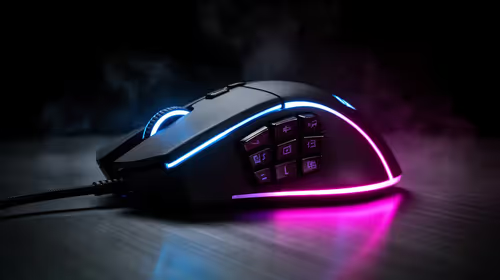
Real productivity numbers: Set up your wireless mouse in this order: everything that matters about wireless productivity mouse: DPI behaviour, channel switching, battery curves and per-app button mapping. Includes DPI tuning tips, channel switch shortcuts, and ZAR-aware
Pen not feeling like paper? Stylus lag and skipping usually trace to old drivers, dirty nibs, or display refresh mismatches, not the pen itself. Covers pressure curve tuning, tilt thresholds, nib swap timing, and SA pricing brackets.