



Marvel Rivals launch in South Africa
Marvel Rivals launch needs a balanced parts plan, not a random basket. Map the CPU, GPU, RAM, SSD, cooling, and monitor target to the budget so SA builders know where to spend first.
Read moreAR Glasses setup guide for small bedrooms in SA should be shortlisted around the job it must do. South African buyers should compare fit, performance, compatibility, and upgrade room, warranty path, and upgrade room before treating any pick as best.
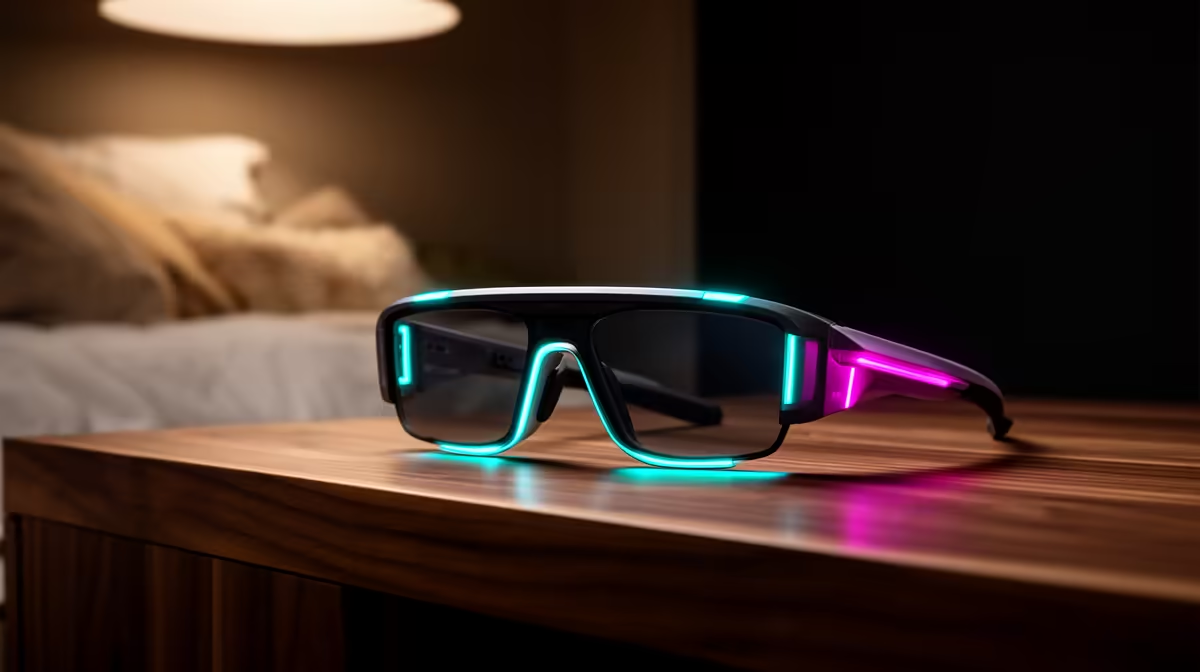
A small bedroom limits both space and viewing distance. Choosing AR glasses that suits tight quarters is the difference between usable and frustrating.
AR glasses work in a small bedroom where space and throw distance are tight as a private big-screen display, not as a standalone games console. Expect roughly R6,000 to R14,000 locally for a 1080p-per-eye pair running a 120 to 130 inch virtual screen; they need a phone, handheld or laptop to do the actual rendering, so judge them on screen quality and comfort, not on chips.
AR glasses replace a monitor, not a PC, and in a small bedroom where space and throw distance are tight that means a private 1080p screen you can use on a couch, a flight or in shared space without anyone seeing it. Look for micro-OLED panels at 1080p per eye, 120 to 130 inch perceived size at a few metres, and ideally a 120Hz refresh for smoother motion. They draw video from a USB-C source, so your handheld or laptop still sets the frame rate - a 60 fps game looks like 60 fps on the glasses.
Weight and fit decide whether you wear them past 20 minutes. Aim for under 80g, swappable nose pads, and dioptre or clip-in prescription support if you wear glasses. Brightness above 400 nits matters in a bright SA room; lower-end pairs wash out near a window. Ignore inflated FOV marketing - a comfortable 45 to 50 degree field with a sharp centre beats a wide but blurry one.
glasses with the exact device you will use - a phone, handheld or laptop. If the port does not support USB-C DisplayPort output, the glasses will not get a picture at all.
No. They are a display only and need a phone, handheld or PC to render the game. The connected device sets resolution and frame rate; the glasses just show the image at 1080p per eye.
Only if the phone has a USB-C port with DisplayPort Alt Mode video output. Many mid-range phones lack it, so check the spec sheet first or plan to drive the glasses from a laptop or handheld instead.
The lightest pairs under 80g with good nose pads are, especially with a darkened room or dimmed cabin. Heavier models start to press after 30 to 45 minutes, so weight and fit matter more than headline specs.
Compare the AR glasses stocked at Evetech by resolution, weight and brightness, then confirm your device supports USB-C video output before you buy.
Marvel Rivals launch needs a balanced parts plan, not a random basket. Map the CPU, GPU, RAM, SSD, cooling, and monitor target to the budget so SA builders know where to spend first.
Read more
Path of Exile 2 launch needs a balanced parts plan, not a random basket. Map the CPU, GPU, RAM, SSD, cooling, and monitor target to the budget so SA builders know where to spend first.
Read more
Black Myth Wukong launch needs a balanced parts plan, not a random basket. Map the CPU, GPU, RAM, SSD, cooling, and monitor target to the budget so SA builders know where to spend first.
Read more
Hollow Knight PC requirements should be mapped to resolution, settings and upgrade budget before choosing a tier. Verify current requirements, then balance GPU, CPU, RAM and SSD around SA pricing.
Read more
Hollow Knight build planning should focus on the target resolution, settings and total system balance. Treat launch wording as time-sensitive, then verify requirements before choosing SA PC parts.
Read more
Fallout 4 PC requirements should be mapped to resolution, settings and upgrade budget before choosing a tier. Verify current requirements, then balance GPU, CPU, RAM and SSD around SA pricing.
Read more
Wondering if a TKL wireless mechanical keyboard is worth it for everyday productivity? We break down latency, battery life, comfort, and workflow gains for real work. ⚡⌨️

Maximise battery life on a fanless 15-inch laptop using efficiency core architecture. Cut idle drain, tune power profiles, and improve thermals for longer runtime. 🔋⚙️

Learn how to reduce desk clutter with a TKL wireless keyboard using fewer cables, smart placement, and tidy essentials. Get a faster, calmer workspace with better ergonomics. ✅🧼

RGB keyboard lighting too distracting? Learn how to manage backlight modes, set brightness, and reduce distraction for focus and productivity 😌🖱️

Are themed gaming keyboards worth the extra cost? Compare build quality, switch options, features, and resale value to find the best fit for your setup 🎮⌨️

Full-Size vs Tenkeyless mechanical keyboards for gaming: find out if a smaller layout truly improves aim, speed, and comfort. We break down layout, desk space, latency-feel, and keybinds 🎮⌨️

Dedicated media rollers vs function key shortcuts: learn which setup gives you better workflow control, faster media access, and fewer mistakes. 🖱️🎧

Best Mechanical Switch Type for Gaming: Clicky vs Linear vs Tactile. Find your feel, speed, and noise balance with practical guidance for FPS, MOBA, and productivity 😄🎮

Direct mouse answer: Mouse not keeping up with your work? Everything that matters about dual-mode 2.4GHz + BT 5.0: DPI behaviour, channel switching, battery curves and per-app button mapping. Covers when 2.4GHz USB wins (low-latency desk) and when BT 5.0 wins (laptop, d

Plain wireless mouse guide: Mouse not keeping up with your work? Everything that matters about wireless productivity mouse: DPI behaviour, channel switching, battery curves and per-app button mapping. Includes DPI tuning tips, channel switch shortcuts, and ZAR-aware fea

Real productivity numbers: Set up your wireless mouse in this order: everything that matters about wireless productivity mouse: DPI behaviour, channel switching, battery curves and per-app button mapping. Includes DPI tuning tips, channel switch shortcuts, and ZAR-aware

Pen not feeling like paper? Stylus lag and skipping usually trace to old drivers, dirty nibs, or display refresh mismatches, not the pen itself. Covers pressure curve tuning, tilt thresholds, nib swap timing, and SA pricing brackets.