Hook a gaming handheld up to a desktop graphics card and it stops being a portable toy and starts behaving like a small gaming PC. The trick is that the eGPU for a handheld you should buy depends entirely on which connector your device has, and the ROG Ally, ROG Ally X and Legion Go do not all speak the same language. Pick the wrong dock and you leave a chunk of that graphics card's power stranded.
Quick Answer
The right eGPU dock depends on your handheld's connector. The original ROG Ally has an OCuLink-class port with roughly 64 Gbps of bandwidth, while the ROG Ally X and Legion Go rely on 40 Gbps USB4. Each connector type needs a matching dock to feed an external GPU, so there is no single best answer across all three handhelds.
Why the Connector Decides Everything
An external GPU lives in a dock outside the handheld, and the cable between them is the bottleneck. A desktop graphics card can push enormous amounts of data, but the handheld can only receive as much as its port allows. That is why the connector, not the GPU itself, sets the ceiling on what you actually get.
Two connector families matter here. OCuLink is a direct, high-bandwidth link that carries PCIe data with relatively little overhead. USB4 is more flexible and more common, but it tops out at a lower bandwidth and carries more overhead. Feed the same graphics card through each and the OCuLink link generally has more headroom for demanding games.
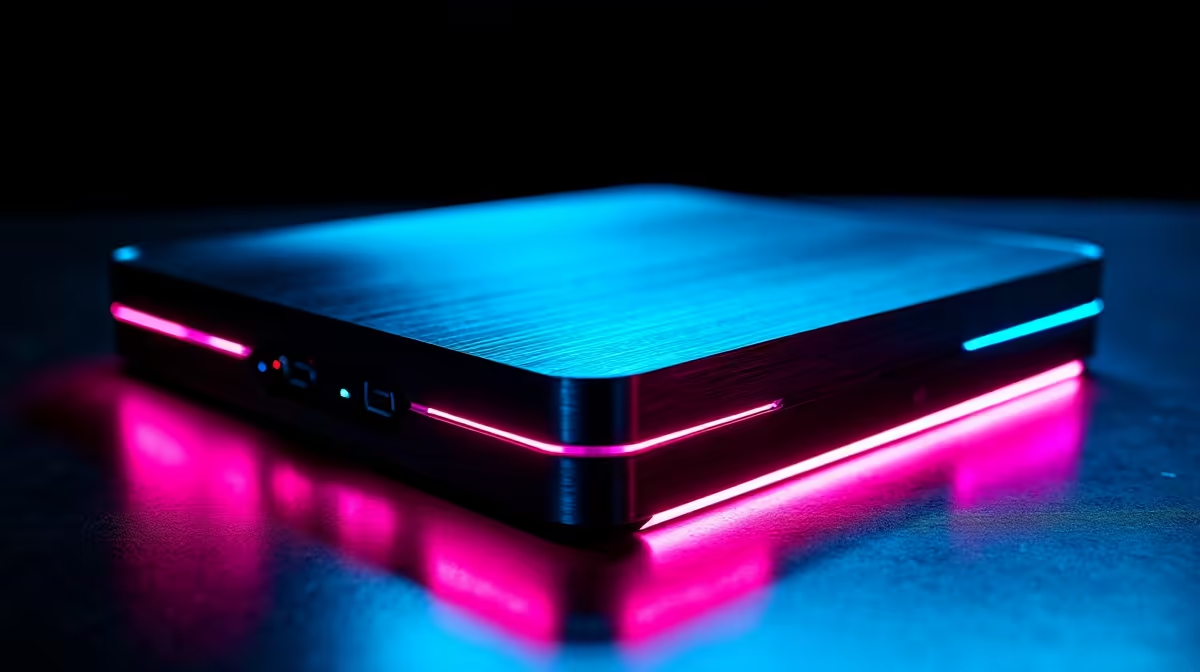
The dock that bridges your handheld to a card is the piece to get right, and the docking stations stocked at Evetech cover the connection types these handhelds use.
Matching Each Handheld to a Dock
The three popular handhelds split into two camps based on their ports.
The Original ROG Ally
The first ROG Ally includes an OCuLink-class connector offering around 64 Gbps of bandwidth. That extra headroom over USB4 means it can drive a more powerful external card with less of a bottleneck, making it the strongest of the three for eGPU use. You pair it with an OCuLink-compatible dock rather than a standard USB4 one.
The ROG Ally X
The ROG Ally X moves to USB4 at 40 Gbps for its external connection. It still works very well with an eGPU, but the lower bandwidth ceiling means a USB4 dock is the right match. Choosing a USB4 enclosure keeps the connection clean rather than trying to force an incompatible link.
The Legion Go
The Legion Go also relies on 40 Gbps USB4 for external graphics. Like the Ally X, it pairs with a USB4 eGPU dock. The practical performance sits in the same broad zone as the Ally X, since both share the same connector bandwidth.
What an eGPU Actually Buys You
The payoff is a major jump in graphics power when the handheld is docked at a desk. Plugged into an external card, these devices can run games at higher settings and frame rates than their built-in graphics manage, turning a portable into a capable desktop gaming machine when you are home.
Understanding the Bandwidth Penalty
Even with the right dock, an eGPU does not deliver the full performance the same card would give a desktop. The connection adds overhead, so you lose some frames compared to plugging the card straight into a motherboard. OCuLink's higher bandwidth loses less than USB4, which is part of why the original Ally has an edge here.
The Card Behind the Dock
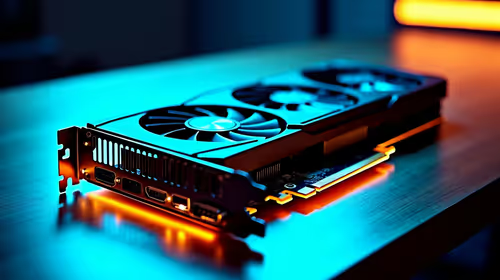
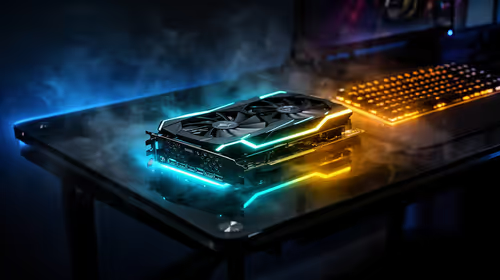
The dock is only half the equation; it houses an actual desktop graphics card. A more powerful card gives more performance, but only up to the point where the connector becomes the limit. On a USB4 link, an extremely powerful card can be partly held back by the 40 Gbps ceiling, so balancing the card to the connector matters.
The Practical Side of Docking
An eGPU setup is a desk-bound arrangement, not something you carry. The dock houses a full-size graphics card and needs its own power supply, so it lives permanently at your desk and you connect the handheld to it when you sit down. That makes it a complement to portable play rather than a replacement for it.
This is actually the appeal. You keep the handheld for couch and travel gaming on its built-in graphics, then dock it for a desktop-class session at home. One device covers both, with the eGPU adding the heavy graphics power only when you are stationary and plugged in.
What Else the Dock Handles
Beyond graphics, docking the handheld at a desk usually means connecting a monitor, keyboard, mouse and mains power at the same time. A good dock or eGPU enclosure keeps that single-connection convenience, so you plug in once and the whole desk setup comes alive. Treating the eGPU as the centre of a proper desk station, rather than just a graphics add-on, gets the most out of it.
Picking the Right Setup
Start with your handheld. If you own the original ROG Ally, an OCuLink dock unlocks its bandwidth advantage and suits a stronger card. If you have the ROG Ally X or Legion Go, a USB4 dock is the correct match, and you should size the graphics card to make sense within that 40 Gbps limit. To compare the cards themselves before committing, the best-selling graphics cards at Evetech show what slots into an eGPU enclosure.
Frequently Asked Questions
Which handheld is best for an eGPU?
The original ROG Ally has an edge thanks to its OCuLink-class port at roughly 64 Gbps, which offers more bandwidth than the 40 Gbps USB4 on the ROG Ally X and Legion Go. More bandwidth means less of a bottleneck for a powerful card.
Can I use any eGPU dock with my handheld?
No. The dock must match your handheld's connector. The original ROG Ally needs an OCuLink dock, while the ROG Ally X and Legion Go need a USB4 dock. Using the wrong type either will not work or will bottleneck the card.
Will an eGPU give me full desktop performance?
Not quite. The connection adds overhead, so you lose some frames compared to the same card in a desktop. OCuLink loses less than USB4, but both still leave you well ahead of the handheld's built-in graphics.
Does the Legion Go use the same connection as the ROG Ally X?
Yes. Both the Legion Go and the ROG Ally X use 40 Gbps USB4 for external graphics, so they pair with the same class of USB4 eGPU dock and perform in a similar broad range.
Is it worth pairing a top-end graphics card with a USB4 handheld?
The 40 Gbps USB4 ceiling can hold back a very powerful card, so an extremely high-end GPU may not show its full benefit. Matching the card sensibly to the connector usually gives better value than the most expensive option.
Want to turn your handheld into a desk gaming rig? Match the right dock from the docking station range at Evetech to your ROG Ally, ROG Ally X or Legion Go and feed it a proper graphics card.