The biggest money mistake in AI development hardware is buying a giant GPU you will never use. The best PC or Mac for AI coding and agents depends almost entirely on one question: are you running models in the cloud or on your own machine? Cloud agents like Claude Code lean on remote compute, so your laptop barely breaks a sweat. Local large language models are the opposite, demanding far more VRAM than most people budget for. Decide your path first, then spend.
Quick Answer
If you use cloud AI agents and coding tools, 16GB of RAM and any modern CPU is enough, and you need no dedicated GPU. If you run local LLMs, prioritise GPU VRAM above everything: 12GB minimum for small models, 24GB or more for serious work. Two completely different budgets for two completely different workflows.
Path One: Cloud Agents and Hosted Tools
Most South African developers using AI today are on the cloud path whether they realise it or not. Claude Code, Copilot, Cursor, and ChatGPT all do the heavy lifting on remote servers. Your machine just runs an editor, a browser, and a terminal while the model thinks elsewhere.
For this workflow the spec sheet is refreshingly modest. A current laptop or desktop with 16GB of RAM, a fast NVMe SSD, and a recent multi-core CPU handles everything comfortably. You are not bottlenecked by hardware, you are bottlenecked by your internet connection and your prompts. A reliable fibre line matters more than a fancy graphics card here.
What to spend the saved money on
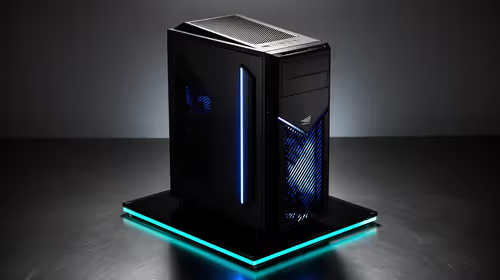
If you are on the cloud path, redirect the GPU budget toward RAM headroom, a quality screen, and battery life if you are mobile. 32GB of RAM future-proofs you for heavy IDE plus browser plus container workloads, and an excellent display saves your eyes across long coding sessions. The pre-configured options in the AI PC lineup cover this tier well without forcing you into workstation pricing.
Path Two: Running Local LLMs
The moment you want to run models privately on your own machine, the rules change entirely. Local inference is VRAM-bound. The model has to fit inside your GPU memory, and if it does not, performance collapses or the model simply will not load.
How much VRAM you actually need
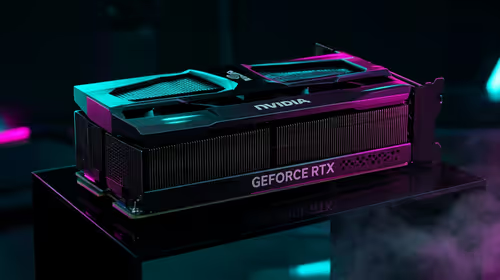
A quantised 7B or 8B model runs on roughly 8GB to 12GB of VRAM. Step up to 13B or 14B models and you want 16GB. For 30B-class models and comfortable headroom, 24GB is the realistic floor. This is why a GeForce RTX with generous VRAM is the centre of any serious local AI build, far more so than raw CPU speed.
CPU and RAM still matter
VRAM is the headline, but system RAM and a fast CPU keep everything around the model responsive: loading weights, running the surrounding tooling, and handling data. 32GB of system RAM is a sensible baseline for local AI work, and 64GB is not overkill if you juggle large datasets alongside the model.
Where Apple Silicon Fits
Apple's M-series chips use unified memory, which means the GPU can address a large pool of shared RAM. A MacBook Pro with 36GB or 48GB of unified memory can run sizeable local models that would need an expensive discrete GPU on the PC side, and it does so quietly and on battery. The trade-off is cost and the fact that some AI tooling targets NVIDIA CUDA first. For developers who value portability, silence, and battery life, Apple silicon is a genuinely strong local-AI option.
Storage and the Parts People Forget
AI work is data-heavy, and storage is the quietly important spec. Model weights, datasets, and container images eat disk space fast. A 1TB NVMe SSD is a sensible floor, and 2TB saves you constant housekeeping if you experiment with multiple local models, since each one can run to several gigabytes. Speed matters too: loading a large model off a slow drive turns a few-second wait into a frustrating one.
Cooling and a quality power supply round out a local-AI build. Sustained inference or training pins the GPU at high load for long stretches, so a case with good airflow keeps the card from throttling. None of this is glamorous, but a machine that runs hot and loud is one you will avoid using, which defeats the point of building it.
A Word on Future-Proofing
The AI tooling landscape moves quickly, and it is tempting to over-buy for capabilities you might use someday. Resist that on the cloud path: those tools improve on the provider's servers, not your desk, so your machine ages gracefully regardless. On the local path, the one component genuinely worth future-proofing is VRAM, because model sizes only grow. If you can stretch to a card with more VRAM than you need today, it is the single upgrade most likely to keep the machine relevant a few years out.
Matching the Build to Your Real Workflow
Be honest about which path you are on before spending. Most people experimenting with AI coding are firmly in the cloud camp and are about to overspend on a GPU that sits idle. A smaller group genuinely needs local inference for privacy, offline work, or cost control on heavy usage, and they should pour the budget into VRAM. If you want a quick sense of what other SA buyers are pairing for development rigs, the best selling PCs give a realistic picture of current price-to-performance.
Frequently Asked Questions
Do I need a powerful GPU for Claude Code or Copilot?
No. These are cloud tools that run the model on remote servers, so a machine with 16GB of RAM and no dedicated GPU is perfectly capable. Your internet connection matters far more than your graphics card for this workflow.
How much VRAM do I need to run local AI models?
Roughly 8GB to 12GB handles small quantised 7B and 8B models, 16GB suits mid-size models, and 24GB or more is the realistic target for larger 30B-class models with comfortable headroom. Buying more VRAM than you need today is the safest way to keep a local-AI machine relevant as model sizes grow.
How much storage should an AI machine have?
A 1TB NVMe SSD is a sensible floor, since model weights, datasets, and container images add up quickly. Step to 2TB if you experiment with several local models, and prioritise a fast drive so large files load in seconds rather than minutes.
Is a Mac or a PC better for AI development?
Both work. PCs with NVIDIA GPUs lead on raw local inference speed and CUDA tooling support, while MacBooks with large unified memory run sizeable local models quietly and on battery. Cloud workflows run equally well on either.
Can I start cloud and move to local later?
Yes, and many developers do exactly that. Start with a modest cloud-capable machine, learn your real needs, then invest in a high-VRAM GPU only once you have a concrete reason to run models locally.
How much system RAM should an AI coding PC have?
16GB is the floor for cloud workflows, 32GB is comfortable for heavy multitasking, and 64GB suits local AI work with large datasets. RAM is cheaper to over-spec than GPU VRAM, so err generous here.