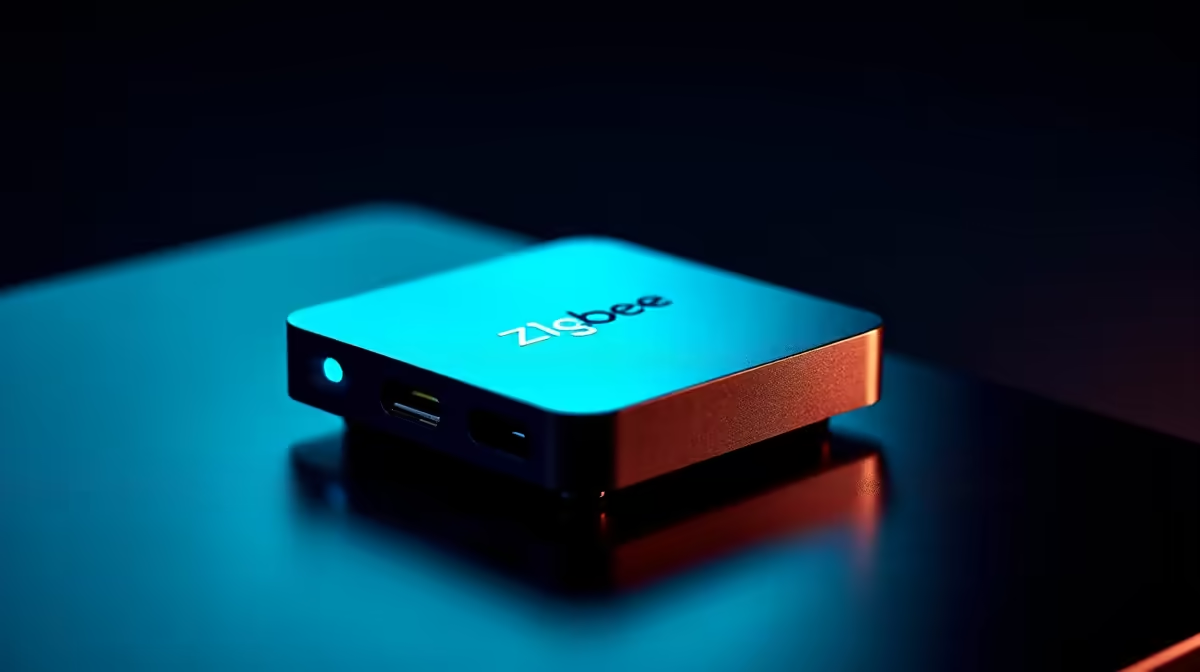
The coordinator is the single most important piece of a Zigbee network, and most problems people blame on cheap bulbs actually trace back to a weak or badly placed dongle. The best Zigbee dongle for Home Assistant in 2026 for the majority of users is the Home Assistant Connect ZBT-2, the official successor to the now-discontinued ZBT-1, rated up to four times faster than its predecessor. But it is not the only sensible pick, and the right one depends on your network size, your walls and your budget.
Quick Answer
For most Home Assistant users the Home Assistant Connect ZBT-2 is the best default Zigbee coordinator in 2026: it is official, well supported, and a big step up from the discontinued ZBT-1. If you want better value, the Sonoff ZBDongle-E is still rock-solid, while the Sonoff Dongle Plus MG24 wins on raw range. Pick the ZBT-2 unless price or wall penetration pushes you to an alternative.
What a coordinator actually does
The Zigbee coordinator is the radio that forms and runs your mesh. Every sensor, bulb and switch talks back to it, directly or hopped through mains-powered devices acting as routers. Its radio quality, antenna and how cleanly it talks to Home Assistant set the ceiling for how large and how stable your network can grow. A poor coordinator shows up as devices that drop off, slow responses and a mesh that falls apart past a few dozen devices, which is exactly why it is worth getting right rather than grabbing the cheapest stick.
Two software paths sit on top of it in Home Assistant: ZHA (the built-in integration) and Zigbee2MQTT (a separate add-on with the broadest device support). The good coordinators below work with both, so your dongle choice does not lock you into one.
The 2026 shortlist
Home Assistant Connect ZBT-2, the default pick
The ZBT-2 is the official Zigbee and Thread USB adapter from the Home Assistant team and the natural replacement for the ZBT-1, which has been discontinued. It is built around a Silicon Labs EFR32MG24 radio with an external omnidirectional antenna tuned for the 2.4GHz band, and it adds a clever twist: a dedicated co-processor handles the serial bridging to your server, freeing the radio to spend all its effort holding the mesh together. That separation is a real reliability win on busy networks and a chunk of why it is rated up to four times faster than the ZBT-1.
One thing to know before you buy: it can act as a Zigbee 3.0 coordinator or as a Thread adapter, but not both at the same time. For a pure Zigbee network that is irrelevant; if you were hoping for one stick to do double duty simultaneously, plan accordingly.
Sonoff ZBDongle-E, the value champion
If you do not need the latest radio, the Sonoff ZBDongle-E remains the best value coordinator in 2026. Based on the older Silicon Labs EFR32MG21, it was the community's top pick for over two years and still runs thousands of Home Assistant setups reliably on both ZHA and Zigbee2MQTT. For a small to medium network where you are not fighting thick walls, it does the job for noticeably less money.
Sonoff Dongle Plus MG24, the range king
When placement is your real constraint, the Sonoff Dongle Plus MG24 is the answer. It uses the newer EFR32MG24 chip and pushes the legal limit on output power paired with a large external antenna, giving it the strongest out-of-the-box gain of the common sticks. If you need to punch a signal through thick face-brick walls or reach a dead zone a standard dongle cannot, this is the one to reach for.
How to choose for your home
Match the dongle to your network size
A handful to a few dozen devices in a flat or townhouse runs happily on any of these, so value (the ZBDongle-E) is a fine call. A larger house with many sensors benefits from the ZBT-2's dedicated bridging and modern radio, which keeps the mesh responsive as device count climbs. A sprawling property or one with stubborn walls is where the MG24's raw output earns its place.
Placement beats almost everything
The biggest performance gain costs nothing: get the dongle off the back of your server and onto a short USB extension cable, away from the USB 3.0 ports and SSDs that spew 2.4GHz interference. A mid-range coordinator placed well will beat a flagship one buried behind a metal case every time. Add a few mains-powered routing devices (smart plugs, mains bulbs) and even a modest stick can hold a large, stable mesh.
Plan around Thread if you care about Matter
If you are eyeing Matter-over-Thread devices, the ZBT-2 can serve as a Thread adapter, just not simultaneously with Zigbee on the same stick. Many people end up running one coordinator for Zigbee and a separate radio for Thread, so factor that in rather than expecting a single dongle to cover both at once.
What to skip and what to check
Avoid the temptation to buy a no-name dongle to save a little, since coordinator reliability is the foundation everything else rests on. Stick to the EFR32-based options above and you are on supported, well-documented hardware. Always check current stock and the exact chip revision before buying, and confirm it works with your chosen software, ZHA or Zigbee2MQTT, both of which the picks here support. Current coordinator models are listed in Evetech's smart home and appliances section, and the USB extension cable that quietly transforms your range is among the accessories best sellers.
Frequently Asked Questions
Is the ZBT-2 worth it over the older ZBT-1?
Yes, and the ZBT-1 is discontinued anyway. The ZBT-2 is rated up to four times faster, uses a newer radio, and offloads serial bridging to a dedicated co-processor for better stability on busy networks.
Can one dongle do both Zigbee and Thread?
The ZBT-2 supports both protocols but not at the same time, you pick Zigbee coordinator mode or Thread adapter mode. For both running together, most people use two separate radios.
Is the cheaper Sonoff ZBDongle-E still good in 2026?
Very much so. It runs reliably on ZHA and Zigbee2MQTT and remains the best value pick for small to medium networks that are not fighting thick walls. It uses an older radio than the ZBT-2 but stays rock-solid.
What is the single best way to improve Zigbee range?
Put the dongle on a short USB extension cable, away from the server's USB 3.0 ports and storage, which interfere on 2.4GHz. That free change often helps more than buying a more powerful stick.
Does the dongle work with both ZHA and Zigbee2MQTT?
The EFR32-based dongles here support both. ZHA is the simpler built-in option; Zigbee2MQTT offers the widest device compatibility. Your dongle choice does not lock you into either path.