Quick Answer
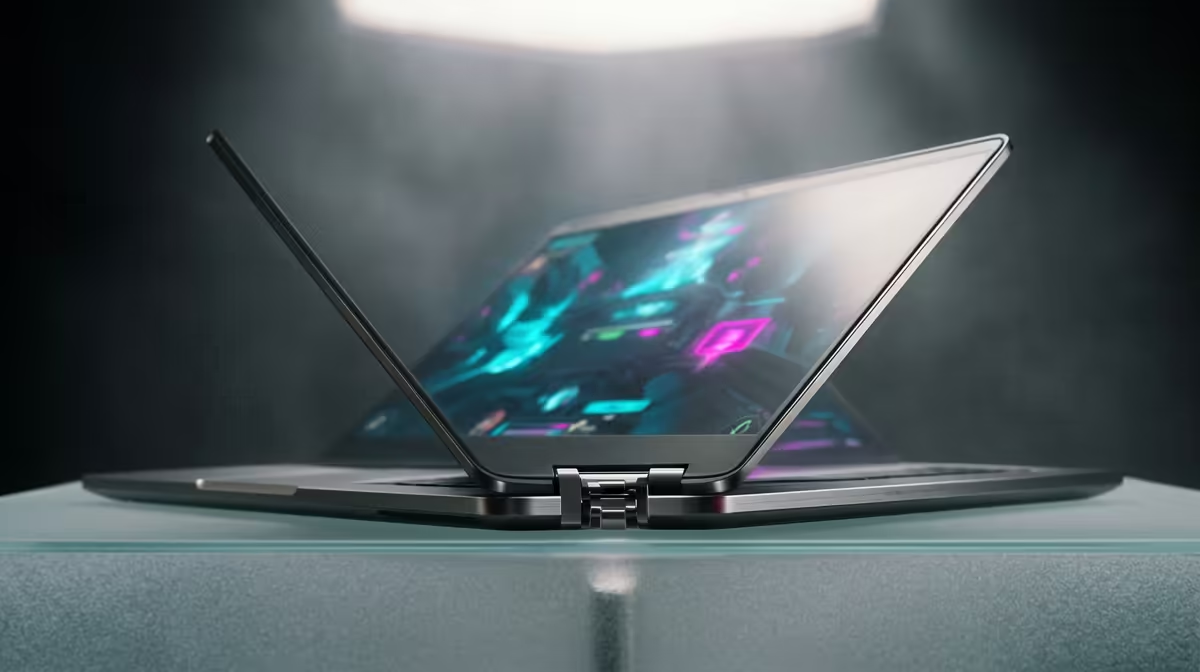
The best 2-in-1 laptop for student creators is a reliable 8GB-16GB machine in the R16,000-R20,000 band, not the cheapest spec on the shelf. Use Lenovo IdeaPad Flex 5, ASUS Vivobook Flip, or HP Pavilion x360 spec as the spec anchor, then prioritise battery life, warranty support, and storage. For South African students, local warranty handling and courier turnaround are part of the buying decision because one broken charger or hinge can interrupt a full week of classes.
Match The Device To The Course
For student creators, choose around 16GB RAM, a colour-aware display, and enough storage for video or design files. Architecture and design users should avoid tiny storage, computer science users should care about keyboard comfort and RAM, and matric or TVET users need a dependable device that starts quickly for assignments. A 13-14 inch screen travels well on Gautrain, MyCiTi, and campus shuttles; a 15.6 inch screen is better if the device mostly stays on a desk.
Specs That Should Not Be Cut
Do not go below 8GB RAM for a new study device, and choose 16GB if the price jump is reasonable. A 256GB SSD is workable for cloud-heavy school use, but 512GB or 1TB is safer for coding projects, design files, recorded lectures, and offline notes. Battery life, USB-C charging, webcam quality, and a full-size HDMI or reliable adapter can matter more than a small CPU bump.
Software And Connectivity Checks
Windows is safest for Office, accounting packages, coding tools, and campus lab compatibility. ChromeOS is fine for web-first schoolwork, while iPadOS or Android tablets need app checks before the device becomes the main machine. Distance-learning students should test Wi-Fi, headset comfort, and webcam angle before the first lecture. If mobile data is required, a SIM-enabled tablet can make sense, but a mini PC still needs a router, hotspot, or Ethernet plan.
FAQ
Is R16,000-R20,000 enough for a student 2-in-1 laptop?
Yes for web study, Office work, research, and light creation if the core specs are right. It is too tight for heavy 3D, large video projects, or specialist faculty software unless the student already has a stronger desktop.
Should students choose a Chromebook, tablet, or Windows laptop?
Choose Windows when course software is uncertain, Chromebook when the workload is web-first, and tablet when handwritten notes are the main reason to buy. The safest single-device choice for most SA courses is still a Windows laptop or 2-in-1.
What should be checked before buying for campus use?
Check weight, charger type, warranty support, webcam quality, keyboard feel, and whether the device fits the required course apps. Also confirm enough storage for offline work, because campus Wi-Fi and residence internet are not always consistent.
Build the student shortlist around the course
Compare the 2-in-1 laptop options by RAM, storage, screen size, battery life, and warranty support before choosing the lowest price.