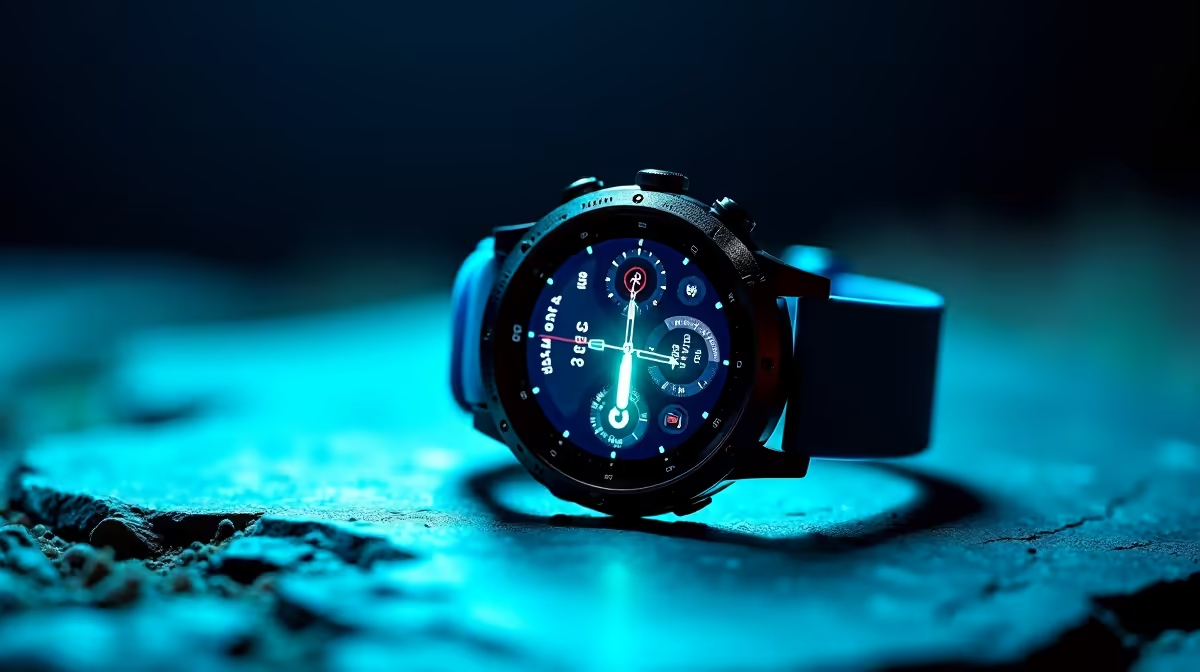
Why Dedicated GPS Beats Smartphone Mapping on the Trail
Scaling the Drakensberg or navigating the technical trails of Tokai Forest requires more than just grit. It requires precision. When your phone signal drops in a deep kloof, you quickly realise that relying on a mobile app for maps is a massive gamble. That is exactly why built-in navigation for trail runners is more reliable... it provides a dedicated satellite link that functions regardless of cellular tower proximity 🏃♂️.
The Science of Signal Reliability in the Wild
Smartphone navigation relies heavily on Assisted GPS (A-GPS), which uses cellular data to speed up satellite acquisition. When you are deep in a valley with zero bars, your phone struggles to maintain an accurate lock. Dedicated smart watches use high-sensitivity GNSS chips that communicate directly with multiple satellite constellations like GLONASS and Galileo.
This direct link ensures that your pace, distance, and elevation data remain accurate even under dense forest canopies. Unlike a phone, which might "drift" and add phantom kilometres to your run, a dedicated wearable keeps your track tight and your turn-by-turn directions responsive.
Battery Life and Environmental Endurance
One of the biggest risks on a long trail is battery drain. Using a smartphone for active GPS tracking, especially with the screen on to check directions, can kill a battery in a few hours. A device from the Promate smart watch collection is engineered for efficiency. These wearables are designed to pulse the GPS signal at optimised intervals... ensuring you have enough power to finish a 25km mountain run and still have juice left for an emergency call.
Furthermore, South African weather can be unpredictable. A sudden downpour in the Cape can easily damage a smartphone tucked into a hydration vest. Most dedicated fitness wearables carry high IP ratings for water and dust resistance, making them far more resilient than your average mobile device ⛈️.
Trail Safety Tip ⚡
Before heading out on a new route, always download the offline GPX file of your trail. Even with built-in navigation for trail runners, having the map pre-loaded on your watch ensures that you can see the path ahead without needing any data connection whatsoever. It is a lifesaver when the fog rolls in on Table Mountain.
Precision Navigation Without Breaking the Bank
Many runners assume that high-end navigation features are reserved for watches costing upwards of R15,000. However, the market has shifted significantly. You can now find highly capable budget-friendly GPS wearables that offer core tracking features for under R1,000. These devices provide the essential data needed to monitor your heart rate and track your route without the bulk or fragility of a phone.
By offloading the navigation task to your wrist, you save your phone’s battery for what it does best... capturing the sunset at the summit or calling for a pickup when you reach the finish line 🚀.
Ready to Find Your Perfect Match?
Whether you are training for your first 10km or prepping for a multi-day ultra-marathon, having the right tech on your wrist makes all the difference. Explore our massive range of smart watch specials and find the perfect companion to conquer the South African wilderness.